Posts

Dholshomudro or Elephant ear, Leea macrophylla

Image
Dholshomudro or Elephant ear ( Leea macrophylla , family : Vitaceae) is an annual rhizomatous herb with large green leaves. The height of the plant is barely a meter. It can be usually seen in the edge of the forest, especially in Chottogram and Chottogram Hill Tracts of Bangladesh. Dented leaves are gigantic, beautiful to see; simple, ovate, cordate at base, apex acuminate, 20-60 cm long and 10.16-45 cm wide, edge undulated. Veins and midribs are clearly visible. Petioles are thick and hollow, 10-15 cm long.   It blooms in June-July.  At the tip of the twig is borne large cyme inflorescence with huge number of flowers.  Peduncle 30 cm tall.  Flowers are small, soft, whitish, sepals 5, petals 5. Fruits are also small, globose, tapered, .smooth, 4-6-lobed, 6-1 cm in diameter. Juveniles are green, matures are blackish.  Young leaves are eaten as vegetables. Color can be made from the roots. Power of roots is anti...
Buno Joba or Jongli Ghagra, Urena lobata

Image
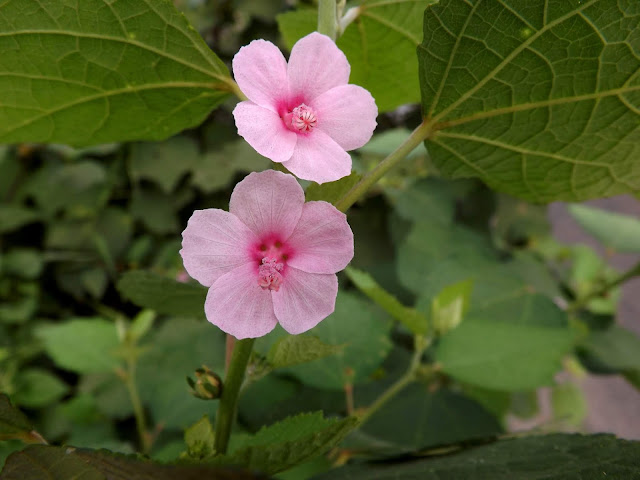
Buno Joba or Jongli Ghagra ( Urena lobata , family : Malvaceae) is an erect branched plant with about 1.5 m height. The plant is covered with tiny hairs all over the body. Other names: Gamera, Bon-okra, Altera, Nageji, Jongli khagra, Kongo pat. Leaves are ovate, round or 5-7 lobbed, 3.5-12 cm long, irregularly toothed, covered with rigid hair. Petiole 2-8 cm long. Flowers are small, violet or pinkish, clustered or solitary, about 1 cm across. Calyx 5-cleft, petals 5, stamens many. The fruit is globose with 5 carpels and is covered with short stiff spines. It blooms almost in all seasons. It is found everywhere in Bangladesh. It grows in abandoned places. Root is used as diuretic and useful in neurological disorder. The flower is called Buno Joba (wild hibiscus) In Bangla.

Joggodumur, Jagdumur, Ficus racemosa

Image
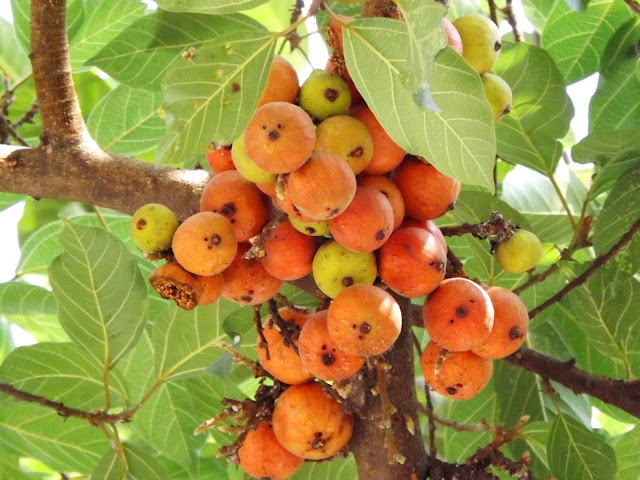
Joggodumur , Jagdumur ( Ficus racemosa , family : Moraceae) is a  medium to large deciduous tree (15-16 m) with branches. The florets of the tree remain inside fruit or fig and cannot be seen from outside. Figs are good vegetables. The good looking plant can be easily detected by its brilliant red fruits which grow in cluster on trunks or branches. Leaves are slightly hairy, green, elliptical-ovate, 14-18 cm long, petiole 1.5-2.5 cm long. Mid-rib and veins are clearly visible. Figs are hairy also, big, 2-4 cm across. Immature fruits are light green, bright red when ripe. They are nutritious.                               Propagation of the plant is caused by seeds. The plant grows in wilderness and on fallow lands. It is found everywhere in Bangladesh. Fruits, roots, leaves and bark are used in cut wound and different tooth diseases. Its latex is used to prevent blood dripping. ...

Polash, Flame of the Forest, Butea monosperma

Image
Polash or Flame of the Forest ( Butea monosperma , family : Fabaceae) is a medium-sized (12-14 m) flowering tree reaching 9-15 m height. Trunk is crooked, young shoot downy tomentose. Sanskrit name of the plant is Kingshuk. Leaves are compound, trifoliate, long petioled; leaflets leathery, turning glabrous with age, terminal leaflet obovate, 12-20 cm long and 12-16 cm wide.  Flowers are big, velvety, orange scarlet or orange, borne on 10-15 cm long inflorescence. Sepals 5, petals 5. The keel petals are united to form a beak. Flowers bloom in February. When spring comes the whole tree is filled with fire-colored flowers. This is why the flowering tree is called the Flame of the Forest. These unique flowers only lasts for two weeks. Fruit is capsule, 10-15 cm long and 3-4 cm wide, brown when mature. Propagation of the plant is caused by seed.  The beautiful tree is grown in big gardens and in roadsides. It is found in the Sal-Ban of Bangladesh. Seeds are ...

Udal or Elephant rope tree, Sterculia villosa

Image
Udal or Elephant rope tree ( Sterculia villosa , family: Sterculiaceae) is a medium-sized deciduous tree with spreading hairy branches. Bark is white, smooth and thick. It is one of the most spectacular forest trees of Ban g ladesh. It has many characteristics.  In Bangladesh it is mostly found in Chottogram, Chottogram Hill Tracts and Sylhet. Leaves are alternate, large ovate-oblong, deeply lobed, long petioled, and crowded at the end of branches. Flowers are orange-yellow with purple centre, borne on long drooping panicles. Both male and female flowers bloom in the tree. Flowers bloom in March.  Before appearing new leaves numerous hanging fruits can be seen at the end of the spring.  Fruit is 4-8 cm  long, curved, green when raw and brilliant red when ripe. Seeds are dark, rounded. The tree is propagated by seeds. It is planted along roadsides and in large public gardens. It is used as purgative. Its bark is used extensiv...