Posts

Showing posts with the label tropical_Africa

Gima-shak or Pot-biroot, Glinus oppositifolius

Image
Gima-shak or Pot-biroot ( Glinus oppositifolius , family: Molluginaceae) is an annual herb with diffiuse branches and taproot. Stems can be 3 to 40 cm long. Young shoots and branches are silky and sometimes reddish. It is found in waterside area, cropfield, fallow land and damp places in Bangladesh. It occasionally grows on old walls. It is found in the tropical Asia, Africa and in Australia too.  Leaves are 1-2.5 cm long, elliptic-oblanceolate, petioled, opposite. Flowers are tiny, white in color, showy, 0.4 cm long, petals 5, stamens 5-10. The flower buds are reddish. Fruits are ellipsoid, reddish or brownish, 4-5 mm, 3-valved; seeds numerous. The plant is propagated by sedds.  It can be planted as an ornamenal plant in tub or pot. It is eaten as vegetables in Bangladesh. It is used in constipation, indigestion, itching and various kinds of skin diseases. By the by, like many other herbs the color of the whole plant is occasionally reddish.
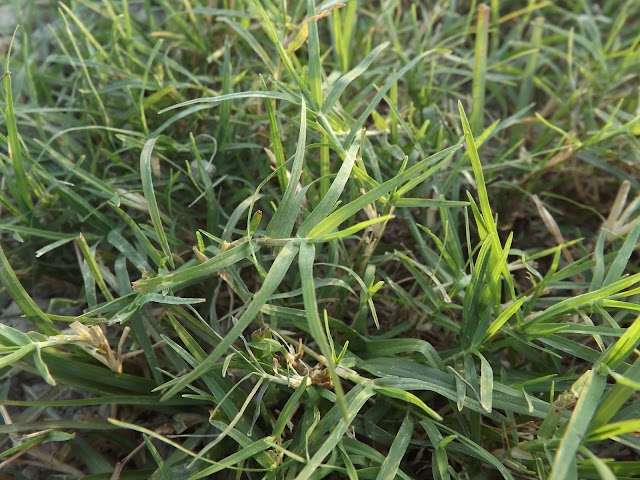
Durba-ghash or Bermuda grass, Cynodon dactylon

Image
Durba-ghash or Bermuda grass ( Cynodon dactylon , family: Gramineae) is a perennial grass with cylindrical nodes and internodes. It creeps on ground by creating roots from nodes of stem. Stem (up to 45 cm long) is usually green, sometimes reddish. The creeping herb is a traditional medicinal plant of the Indian subcontinent.  It is found all over the country as a crop weed. It is also found in South and Southeast Asia and The tropical region of Africa. Although its roots do not go deep into the soil, it retains the soil quite well. Otherwise, in a rainy country like ours, it would have been impossible to prevent soil erosion. Leaves are narrow or linear with pointed tip, pale green, minutly hairy, 2-8 cm long. The leaf ligules are covered with thin white hairs. Inflorescence is brownish green, divided in to 5 parts, each part 2-5 cm long. Flowering occurs almost round the year. It is propagated by seeds, rhyzome and stolon. The plant contains trit...

Boichi or Madagascar plum, Flacourtia indica

Image
Boichi or Madagascar plum ( Flacourtia indica , family: Flacourtiaceae) is a spiny shrub with numerous branches, attaining a height of 2-3 m. Bark is grey and rough. Young leaves and shoots are reddish. There are numerous long and sharp spines all over the body of this leafy shrub. It is found in village thickets, in deep forest and the edge of water bodies in Bangladesh. Globally it is found in many Asian countries, tropical Africa and Madagascar.   Other names:  Baichha, Tamabot, Bunj, Dungkhoir, Beuchi, Kanta-bohuri, Bongkui-kanta, Bon-khoi. The size and shape of leaves vary from ovate to lanceolate or almost heart-shaped. Those are usually 3-6 cm long, having numerous tiny nerves through the blade, deeply dented, blunt or slightly acute at the end, petioled, alternate.  Flowers are tiny, yellowish of greenish. They appear from the node of leaves. Female and male flowers are in different plants. Flowering occurs in the end of winter.  ...

Ghaghra or Bon okra, Xanthium strumarium

Image
Ghaghra or Bon okra ( Xanthium strumarium , family: Asteraceae) is an annual upright herb with rough hairs, attaining a height of 150 cm. Stem is black or brown-spotted and short with fewer branches. The plant is found everywhere in Bangladesh. Other names: Bicha-phol, Lehora, Khagra, Hagra, Choto khagra,  Leaves are hairy in in both parts, opposite, 5-12 cm long, triangular, dentate, almost look like Brinjal leaf; long-petioled.  Flowers are borne in disc inflorescence, terminally in pairs, whitish.  Fruits are ovoid, thorny and easily caught by clothes and bodies of animals. Each fruit contains two flattened black-seeds.  The plant produces flower in spring and fruits in the summer. Propagation of the plant is caused by seeds. It is grown in fallow land, in field and roadside. It boosts energy, sex potency, breast milk and cures blood dysentery, gonorrhea and rheumatism.  Roots taste bitter. Village doctor...

Kanchira or Bengal dayflower, commelina benghalensis

Image
Kanchira  or Bengal dayflower ( commelina benghalensis , family: commelinaceae) is an annual herb with swollen nodes. It is native to tropical Asia and Africa.  Common names: Kanchira, Bengal dayflower, Tropical spiderwort. Leaves are green, alternate, simple, 10-15 cm long, with prominent sheath. Inflorescence arises from the axil of a foliage leaf. Flower is blue, small, sepals 3, petals 3. It blooms in August-September.  Propagation of the plant is caused by seeds.  It grows as a weed on fallow land in Bangladesh. Its juice is applied as antiseptic on cut or burning injury. Root is used in headache, fever and leprosy. Knot of stem is used to prevent sterility.

Choto hurhuri, Fringed spider flower, Cleome rutidosperma

Image
Choto hurhuri or   Fringed spider flower   ( Cleome rutidosperma , family: Cleomaceae) is a small-sized annual herb with branches up to 1 m height. The plant is native to tropical Africa and has become naturalized in the tropical and sub-tropical world. It grows on fallow land as weed in Bangladesh. Common names: Choto hurhuri, Fringed spider flower, Purple cleome. The plant flowers round the year.  Flowers are pink, white, lilac, violet or blue, single, on leaf axil. Sepals 4, petals 4, stamens 6. Leaves are trifoliate, middle one long, light green. Leaflets are glabrous, 4-7 cm long and 2-4 cm wide. Fruit is capsule, 4-7 cm long, tubular, narrow at both ends, with an array of seeds.  Cleome rutidosperma keeps fruiting throughout the year, although most abundantly in the rainy season in Bangladesh. The seed contains alkaloid.  The leaves are collected from the wild and eaten as a cooked vegetable or added to soup. Propaga...

Holud hurhuri, Asian spider flower, Cleome viscosa

Image
Holud hurhuri  or Asian spider flower ( Cleome viscosa , family: Cleomaceae) is a small-sized annual herb with branches, up to 1 mm in height. The herb is native to tropical Africa, tropical Australia, Malaysia and South Arabia. It has become introduced in South Asia.  Common names: Holud hurhuri,  Asian spider flower, Dog mustard, Yellow Spider Flower, Wild mustard, Sticky cleome. Leaves are palmately compound, leaflets 3-5, odorous, glandular, hairy, viscose, elliptical-ovate, 1-4 cm long. Flowers are pale yellow, on axillary raceme. Sepals 4, 3-6 mm long, hairy and glandular, petals 4 and 8-15 mm long, stamens numerous and 4-8 mm long.  The plant produces flower from January t o  June.  Fruit is 4-7 mm long, viscose and hairy; seed dark brown to black. Leaves are used in paratyphoid, dysentery, bronchitis, gonorrhea, ear-sore and  external application to wounds and ulcers. The seeds are anthelmintic and carminative...

Jhumko joba, Fringed rosemallow, Hibiscus schizopetalus

Image
Jhumko joba or   Fringed rosemallow   ( Hibiscus schizopetalus , family: malvaceae) is an ornamental flowering shrub with drooping branches.  The evergreen  shrub can be 3 m tall . The plant is very adorable to the amateur gardeners of Bangladesh.  Common names:   Jhumko joba,  Fringed rosemallow, Japanese lantern. Flower is big, orange to red, on oxillary long pedicel. Sepals 5, petals 5. Petals are chopped, curved downwards. About 15 inches long staminal tube rises from middle of the petals. Pistil passes through the staminal tube and stigma is divided into five parts. Leaves are deep green, petioled, ovate-elliptical, deeply serrated. Hibiscus schizopetalus  is native to tropical Africa and eventually has become popular to the most tropical and subtropical areas of the world.  The flower is very unusual than the other members of the hibiscus family. The species name 'schizo' derives from its distinctive sh...

Akondo, Crown flower, Calotropis gigantea

Image
Akondo or Crown flower ( Calotropis gigantea , family: Apocynaceae) is a perennial shrub with branches and milky latex, attaining a height of 5 m. Bark is grey. The stem is slightly wooody and much branched at the base. Some plants have been found whose trunks are quite hard and woody and those look like small-sized trees.  Common names:  Akkan, Madar. Young shoots and lower part of leaves are tomentose. The plant is an iconic one in the rural areas in Bangladesh. It is found in several countries in South and Southeast Asia, including the Indian subcontinent, China, Malaysia, Myanmar, and Thailand. Branches and leaves emit milk when snapped. Leaves are whitish green, leathery, short-petioled or sessile, broadly ovate, 10-20 cm long and 6-12 cm wide, tip slightly pointed.  For video please visit :   https://www.youtube.com/watch?v=yH5nOu16vYw&t=37s Flowers are light violet with white shade. Sepals 5, petals 5.  Flowers are seen round the ye...

Kakrol, Spiny gourd, Momordica dioica

Image
Kakrol or Spiny gourd ( Momordica dioica, family: Cucurbitaceae) is a perennial, dioecious, climbing creeper, originated from Indo-Malayan region and gradually found in East Asia, Polynesia, tropical Africa and South America. Common names: Kakrol, Spiny gourd, Teasel gourd, Bristly Balsam Pear, prickly carolaho. The yellowish and oval-shaped fruits have soft prickle. Seeds are egg-shaped, emarginate.    Leaves are petioled, 4-8 cm long and 3-6 cm wide, broadly ovate, base cordate, margin denticulate, apex acute. Flowers are single, axillary, whitish, yellow at the centre.  Momordica dioica is used as a vegetable in Bangladesh, India, as well as South Asian countries.  The climber has tuberous roots and simple tendrils. It is used in the treatment of  hypertension, diabetes and   to relieve pain.