Posts

Showing posts with the label evergreen_tree

Bandorhola or Ramdalu, Duabanga grandiflora

Image
Bandorhola or Ramdalu ( Duabanga grandiflora , family: Lythraceae) is a large evergreen or semi-deciduous tree with dwarf drooping branches and erect trunk. The tree can grow up to 45 meters tall. It can be easily identified from other trees in the forest by its innumerable hanging branches. It is mostly found in Sylhet, Chattogram and Chattogram Hill Tracts. It is also found in several countries in Southeast Asia, especially Thailand, Laos, Cambodia, Malaysia and the Andaman Islands. Other names: Bandormula, Kocha, Lampati. Leaves are big, dark green, coriaceous (leathery), oblong, cordate at base, 15-30 cm long and 7-12 cm wide, glabrous, opposite. Flowers are big, white, 5-8 cm across, having unpleasant odor borne on drooping branches, stamens many. Sepals 5, green and thick; petals 5, wrinkled, short-lasting. Flowering occurs in spring. Fruit is globose capsule, coriaceous, about 8 cm wide, with many seeds. It is edible to local people. The tree is propgated by seeds.   ...
Agor or Lign aloes, Aquilaria agallocha

Image
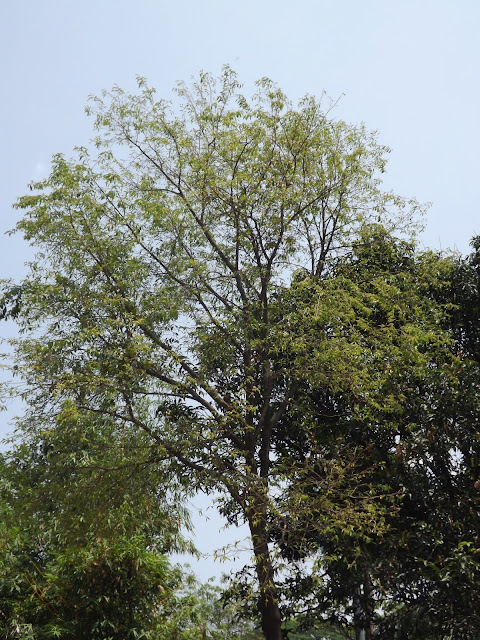
Agor or Lign aloes ( Aquilaria agallocha , family: Thymelaeaceae) is an large evergreen tree with spreading branches. Trunk is straght, glabrous. Bark is whitish. Wood is soft. Perfume stick Agorbati and various kinds of perfumes are made from its wood. It is cultivated as commercial crops in Bangladesh, especially in the hilly area of Moulovibazar district. It is originally from India. It can be seen scattered in different parts of Bangladesh. Other name: Oguru  Leaves are green, thin, glabrous, lanceolate, petioled, 7-12 cm long and 2-5 cm wide, entire, apex acute, alternate. Flowers are whitish, borne on umbel inflorescence; petals 5. Flower blooms in April-May. Fruit is 2-5 cm long, obovate, covered with thick hair. Brown-colored seeds come out of the fruit and hang for 1-2 days. Propagation of the plant is caused by seeds.   Powder of timber is used to prevent insect infestation. Bark is used to make rope. Resin is obtained as a result of the action of a type of f...

Chondona, Chandana, Macaranga peltata

Image
Chondona  or Chandana ( Macaranga peltata , family: Euphorbiaceae) is an evergreen tree with profuse branches and nice crown. The tree usually gets 12 m height. Young parts of the tree are hairy but smooth. Its leaves are very spectacular. In Bangladesh the plant is planted on the roadside areas and parks and gardens for this reason.  Leaves are big, dark green, broadly ovate to orbicular, apex pointed, extended slightly, 15-20 cm long and 12-18 cm wide, alternate, smooth upside, glandular beneath. Veins and midribs are palmately arranged on blade. Petiole is very long and it is strangely connected to the lower part of the blade. Flowers are small, creamy white on raceme inflorescence. Male flowers (in the pic) grow from the axil of large bracts.  Fruit is capsule, round, orange-red. Propagation of the plant is caused by seeds. Flowers appear in March-April and fruit in December-January.  By the by, the species name 'peltata' ...

Kukurchita or Indian laurel, Litsea glutinosa

Image
Kukurchita or Indian laurel ( Litsea glutinosa , family: Lauraceae) is a medium-sized evergreen tree with branches attaining a height of 7-8 m. Bark is grey and shiny. The whole tree is filled with wild smell. The tree grows here and there in Bangladesh. As a traditional medicinal plant, its leaves are used to make nutritious drinks, which relieve stomach-ache. It is also energetic and can cure many womanly diseases.  Other Bangla names:  Menda, Pisla menda, Kajlipata, Fotekka, Roton, Kharjura, Karjuki. Leaves are 7-20 cm long, slightly hairy, ovate, dark green in color. If crushed sticky leaves emit a kind of aroma.  Small yellowish flowers bloom in clusters on the axil of leaves. Flower has many stamens, it looks like the earring of women. Flower blooms in summer (May-June). Fruits are round in shape. The ripe fruit is purplish black in color.  Propagation is caused by seeds. Village children frequently use these fruits as the bull...

Bottlebrush or Lemon bottlebrush, Melaleuca citrina

Image
Bottlebrush or Lemon bottlebrush ( Melaleuca citrina , family: Myrtaceae) is a medium-sized evergreen tree with profuse branches, sometimes shrubby in nature and semi-deciduous or completely deciduous. It is famous for its beautiful drooping branches and brilliant red 'bottlebrush'-like flowers.  Leaves are narrow, lanceolate, alternate, about 3-6 cm long and 1 cm wide, without pedicel, green or silvery green. Flowers are small and bloom on spike inflorescence. Stamens are dark red, numerous and bigger than petals. Flower appears round the year. Tiny fruits contain numerous seeds. Propagation is by air layering and seeds. As decorative plant it is planted in the park and gardens in Bangladesh. If crushed, leaves emit a kind of aroma that scented like lemon. That's why the species name of the plant is 'citrina'. The leafy and gorgeous flowering tree is a must-planted tree in Indian subcontinent's parks and gardens as well as tropi...

Chalta, Elephant apple, Dillenia indica

Image
Chalta or Elephant apple ( Dillenia indica , family: Dilleniaceae) is an evergreen tree with branches attaining a height of about 10 m. In Bangladesh, the flower of the plant is a iconic flower of  rainy season. This beautiful tree is native to South and Southeast Asia. Common names: Chalta, Elephant apple Leaves are petioled, simple, green, lanceolate, 15-27 cm wide, serrated, with 30-40 conspicuous veins. Flowers are lagre, showy, white, with many yellow stamens at center. Petals 5, sepals 5. It blooms in June-July. Fruit is big, round, 7-10 cm across.  Propagation is caused by seeds.  Dillenia indica is one of the most common homestead trees in Bangladesh. Fruit, leaves, root and bark contain a lot of vitamin C, tannin and glucose. These are useful in cough, constipation, dyspepsia, epilepsy and intestinal gas. Fruit juice is used in hair care. Tasty pickles are made from its fruit.

Tetul, Tamarind, Tamarindus indica

Image
Tetul or Tamarind ( Tamarindus indica , family: Leguminosae) is a large evergreen tree, with spreading canopy about as wide as the tree's height. It can get  a height of 30 m but is usually less than 20 m. It is native to tropical Africa and become naturalized in the tropical world. The tree is grown in Bangladesh as ornamental tree, and for the edible pods which pulp is extremely sour in taste.  Leaves are compound; leaflets are oblong, 10-18 pairs, small, linear, 0.4-3.2 cm long and 0.3-1.1 cm wide.  Tamarind trees are slow growing but long lived, with a 200-years life span. Flowers borne in small drooping clusters. Buds are red, sepals 5, yellow on the inner side. Petals 5,  unequal,  1-1.3 cm long, pale  yellow or cream-colored, with red venation marks.  The plant is propagated by seeds.  Fruits are 12-15 cm long, and 2-3 cm wide, skin hard but brittle, brown. The pulp contains 8-10 chocolate-colored seeds....

Jilapi Babul, Blackbeed tree, Pithecellobium dulce

Image
Jilapi Babul or Blackbeed tree ( Pithecellobium dulce , family: Leguminosae ) is a medium-sized evergreen tree with pofused branches and spreading crown.  The tree can reach a height of 10-15 m. Trunk is spiny. Bark is grey.  The tree is native to Americas. It is introduced to South and Southeast Asia.  Common names: Khoia babla, Jilapi babul,  Jilapi,  Dokkhini babul, Blackbeed tree, Manila tamarind. Leaves are bipinnate, each pinna has a single pair of ovate-oblong leaflets. Young leaves are brownish.  In Bangladesh  flower blooms in spring, They are small, fragrant, greenish-white, 1 cm in diameter, borne in globose head.  The edible fruit is a pod, 10-15 cm long. When ripe (in summer) it turns tightly-coiled shape and reddish-brown in color and this is the main characteristic of the tree.  Fruit tastes sweet and sour.  Seeds are shiny, black in color.  Leaves and raw fruits are used as...

Ashok, Saraca asoca

Image
Ashok  ( Saraca asoca , family: Caesalpiniaceae) is one of the most beautiful flowering trees in Bangladesh. The tree is widely distributed in the hilly area of Bangladesh, India, Nepal, Myanmar, Sri Lanka and Malaya area. It gives fragrant flower profusely in the months of February-May, though it may be found round the year. This is as an avenue & garden tree in Bangladesh. It grows well in partial shade and rich porous soil. Common names: Asoka, Ashok. To watch video:  https://www.youtube.com/watch?v=Dv-ML6Lq4yc It is a small to medium-sized evergreen tree with dark brown, rough bark and spreading, drooping branches. Leaves are compound, leaflets alternate, 3-5 pairs, oblong-lanceolate, glabrous, coriaceous, petiolate, 15-39 cm long. 3-7 cm wide. The tree is regarded as a sacred one to the  buddhist  community of   Bangladesh, India, Sri Lanka, & Nepal. Emperor Ashoka was born under the tree. The  plant has many folkloric, religio...