Posts

Showing posts with the label Combretaceae

Bohera or Belleric myrobalan, Terminalia bellirica
Image
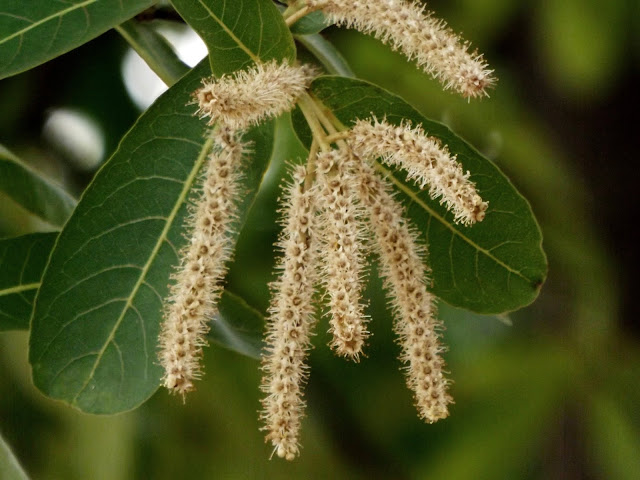
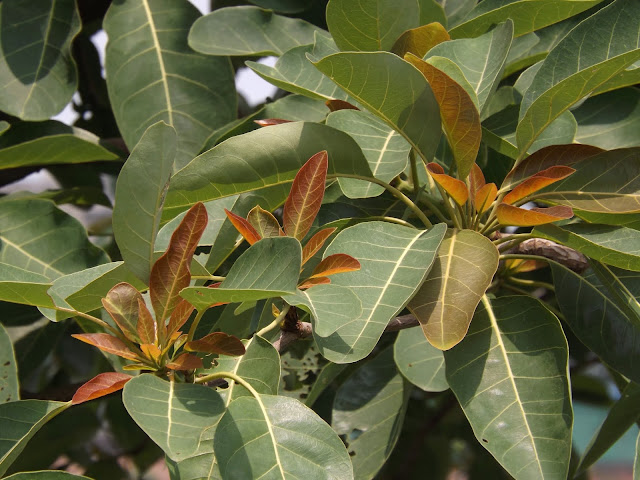
Bohera or Belleric myrobalan ( Terminalia bellirica , family: Combretaceae) is a large deciduous tree with numerous spreading branches, attaining a height of 30 to 40 m. Trunk is straght. Bark is thick and deep grey in color. Widely heard ‘Triphala’ is a mixture of Horitki ( Terminalia chebula ), Amloki ( Phyllanthus emblica ) and Bohera. According to Ayurvedic method, regular consumption of Triphala-soaked water will reduce excess weight effortlessly. It is found in the Sal forests as well as hilly forests of Bangladesh. It is also found in Southeast Asia and Northern Australia.  Other names:  Boyra, Bastard myrobalan (Eng). Leaves are ovoid or obovoid, 8-20 cm long and 5-10 cm wide with rounded tip, long petioled, alternate, clustered at the end of branchlets. The leaves totally fall off in winter. The sparkle of new leaves in spring is bound to catch everyone's eye.  Inflorescence is axilary, terminal, pendant, spike, up to 8 cm long. Flowers are sweet-scented, ...

Monkey's brush, Combretum rotundifolium

Image
Monkey's brush ( Combretum rotundifolium , family: Combretaceae) is a large extensive woody ornamental climber. Among the gardeners of the tropical world the it is very popular for its brilliant orange-red flowers. The bushy climber is native to Madagascar. However, it is found throughout Asia & Africa.  During blooming it seems as if someone has set on fire on the climber. The leafy climber itself a beautiful one.  Leaves are simple, opposite, oblong-lanceolate, 10-15 cm long. Flowers are small, orange-red, scentless, arranged on large compact terminal spike, spreading a lot of golden stamen. It blooms in the summer to autumn.  Propagation is caused by cuttings or air layering. The tolerant vine is grown on wall, arch and pergola in Bangladesh. If you want to keep it small trimmed once a year.

Modhu-monjori ori Rangoon creeper, Combretum indicum

Image
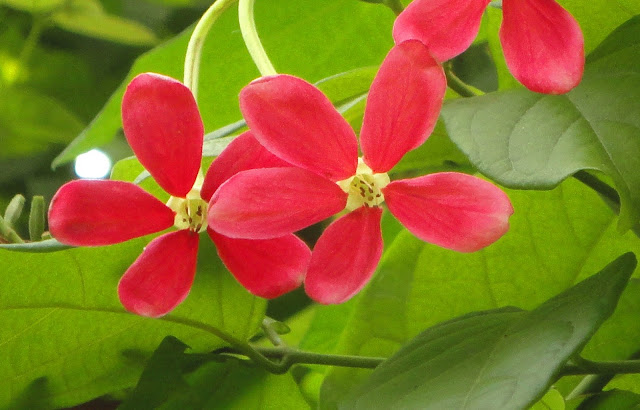
Modhu-monjori or Rangoon creeper (C ombretum indicum , family: Combretaceae) is a extensive woody perennial creeper with red flower clusters. The ornamental vine is native to South and Southeast Asia, specially to Indian subcontinent and Myanmar. The woody climber can reach a length up to 8 m. Common names: Modhu-monjori, Madhuri-lota, Rangoon creeper, Chinese honeysuckle. Flowers are originally red, slightly scented, corolla tubular, petals 5. Flowers bloom mainly in summer and rains.  Leaves are green, rough, opposite, ovate, apex acuminate, edge wavy, 6-14 cm long and 3-6 cm wide.  With the change of time the white flower becomes pink and then it turns red. Fruits are elliptical, 5-winged, dark brown in color.  The Bangla name of the flower (Modhu-monjori) is named by Rabindranath Tagore. It is grown in garden  as ornamental flower plant in Bangladesh. Leaves, roots and seeds are used in skin disease, worm, stomach disorder, ...

Arjun or Arjuna, Terminalia arjuna

Image
Arjun or Arjuna ( Terminalia arjuna, family: Combretaceae) is a medium or large-sized deciduous tree, of about 20-25 m height, with numerous drooping branches and large canopy. Bark is thick, whitish grey, smooth and loose. Wood is hard. It has long been used as one of the most popular medicinal plants in the Indian subcontinent. The tree is native to Bangladesh as well as Indian subcontinent. It is also found in some countries of South and Southeast Asia. Common names:  Arjuna, Arjun tree. Leaves are simple, green, oblong and surprisingly conic, 10-20 cm long and 8-10 cm wide, sessile or less petioled, opposite, tip blunted. Flowers on spike inflorescence, are small and whitish yellow. Flowering occurs in April-May with the arrival of new leaves. Fruit is somewhat 5-angular and winged, woody, 2.5-3.5 cm long. Propagation is caused by seeds. Propagation is caused by seeds. Local herbalists and enthusiasts do not allow the trunk of this tree to remain intact in order to ...

Kath-badam, Bengal almond, Terminalia catappa

Image
Kaat-badam  or  Bengal almond ( Terminalia catappa , family: Combretaceae) is a large deciduous tree with spreading horizontal branches. It is found in the tropical Asia, Africa and Australia. Common names: Katbadam, Deshi badam, Bengal almond, Indian almond, Tropical almond. During winter the beautiful green leaves of terminalia catappa turn to red. Leaves are simple, 15-25 cm long and 8-15 cm wide, obcordate, alternate or whorled.  Flowers appear in the summer. Flowers are small, grey white, clustered on axillary or terminal spike. Flowers on the upper part of the inflorescence are male and those are on the lower part are bisexual.  Fruit is elliptical, 4-6 cm long, red when ripe.   The tree with nice canopy is planted in avenues and gardens as ornamental tree in Bangladesh. Propagation of the plant is caused by seeds.