Posts

Showing posts with the label legume

Kuchai or Konoklota, Caesalpinia enneaphylla

Image
Kuchai or Konoklota ( Caesalpinia enneaphylla , family: Caesalpiniaceae) is a woody scandent shrub or bushy climber with profuse branches and bipinnate leaves. Branches are scattered, dark browish and filled with neumerous dots and stout and hook-like spines. In Bangladesh it is found beside the streams and on hill slopes in Sylhet, Chattogram and Chattogram Hill Tracts. It is also found in Indian subcontinent and China as well as South and Southeast Asia.  Leaves are beautiful to look at; compound, bipinnate, rachis 20-30 cm long, pinnae 8-12 pairs, opposite; leaflets are tiny, elliptic-oblong, 8-10 pairs, opposite, 1.5-2.5 cm long. The fragrant flowers are bright yellow, in terminal or auxillary panicles, bloom periodically from bottom to top, up to 30 cm long. Flowers 1.5-3 cm long; petals 2-lobed, sepals 5, stamens 10. Flowering occurs from August to October. Fruit is a legume, elliptic-oblong, 7-11 cm long and 2-4 cm wide. Seeds 4-6. Young pods are red-colored. The plant is ...

Kath-shola or Budda pea, Aeschynomene indica

Image
Kath-shola or Budda pea ( Aeschynomene indica , Family: Fabaceae) is a woddy annual or perennial erect undershrub with some narrow and slender branches and sensative leaves, attaining a height of 1 to 1.5 m. Stem is corky, greenish and glabrous. It loves to grow near the water bodies and in ditches, fallow lands and muddy soil in Bangladesh. It is also found throughout Asia. Other names: Shola (Bang); Indian jointvetch (Eng).  Leaves are light green, compound, bipinnate; blades 40-60, tiny, linear-oblong, alternate, petiole short, no veins except the midrib. In the absence of sunlight, the leaves curl up like most other members of Fabaceae. Flowering occurs in rainy season. These are in axillary raceme, 2-4, tiny, reddish yellow, 1-1.5 cm long. Sepals 5 with connecting 2-lipped calyx. Upper part of the calyx is entire, lower entire or 3-lobed. Corolla caducous, two times larger than calyx. Peduncle and pedicel are glutinous and slightly hairy.     Fruit is legume,...

Durba-ghash or Bermuda grass, Cynodon dactylon

Image
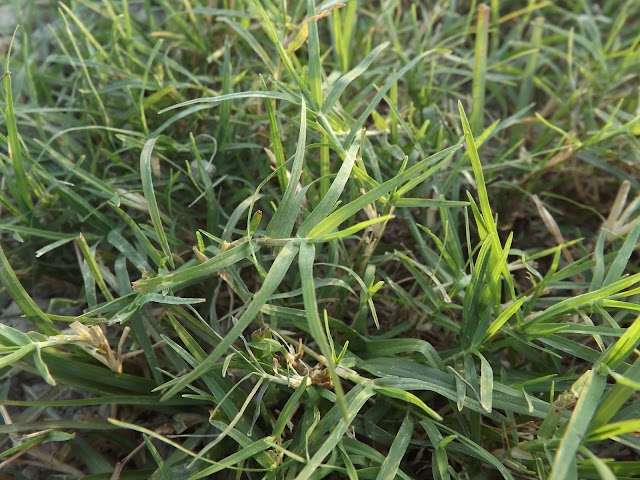
Durba-ghash or Bermuda grass ( Cynodon dactylon , family: Gramineae) is a perennial grass with cylindrical nodes and internodes. It creeps on ground by creating roots from nodes of stem. Stem (up to 45 cm long) is usually green, sometimes reddish. The creeping herb is a traditional medicinal plant of the Indian subcontinent.  It is found all over the country as a crop weed. It is also found in South and Southeast Asia and The tropical region of Africa. Although its roots do not go deep into the soil, it retains the soil quite well. Otherwise, in a rainy country like ours, it would have been impossible to prevent soil erosion. Leaves are narrow or linear with pointed tip, pale green, minutly hairy, 2-8 cm long. The leaf ligules are covered with thin white hairs. Inflorescence is brownish green, divided in to 5 parts, each part 2-5 cm long. Flowering occurs almost round the year. It is propagated by seeds, rhyzome and stolon. The plant contains trit...

Oporajita or Butterfly pea, Clitoria ternatea

Image
Oporajita or Butterfly pea ( Clitoria ternatea , fabaceae) is an annual twiming climber. It is native to tropical Asia and found throughout the tropical world. The flower look like women's genitalia. The genus name 'clitoria' and Sanskrit name 'Jonipushpi' are mentioned for this reason.  Common names:  Oporajita,  Asian pigeonwings, Butterfly pea. Flowers are butterfly-shaped, blue, light blue or pure white. Leaves are pinnately compound, leaflets 5 or sometimes 7 per pinnae; leaflets ovate, alternate, the terminal one is largest.  Flower blooms throughout the year.  Fruit is a legume, 4-7 cm long and about 1 cm wide.  Propagation is caused by seeds. Root, bark and leaves are used to prepare medicines for pain, goitre, diabetes, bronchial and skin diseases. Root is used for defusing the affect of snake's poison and for smooth delivery of baby.  The flower is popularly known as butterfly. 

Shirish or Lebbek tree, Albizia lebbeck

Image
Shirish or Lebbek tree ( Albizia lebbeck , family: Fabaceae) is a large deciduous tree with spreading crown, attaining a height of 15-20 m. The black bark tree is native to Bangladesh as well as Southeast Asia and Australia. Common names: Shirish, Siris, Kalo koroi, Lebbek tree, Frywood. Leaves bipinnate with a large gland on the base of petiole, pinnae 2-5 pairs. Leaflets 2.5-4 cm long and 1.5-2 cm wide, ovate, oblong, pale green.  Flowers bloom in April-June.  Flowers are  very  fragrant,  greenish white, heads globose, containing many flowers. Stamens are longer than petals and sepals. The fruit is a legume, 12-30 cm long and 2-5 cm wide. It contains 6-12 seeds. Propagation of the plant is caused by seeds.  Albizia lebbeck is a  good timber tree, fast growing and suitable for a forestation.  Bark prevents skin diseases and leaf night blindness. It is also useful in tuberculosis, diarrhea and leprosy.

Shonalu, Golden shower tree, Cassia fistula

Image
Shonalu  or   Golden shower tree   ( Cassia fistula , family: Fabaceae) is a medium-sized deciduous tree attaining a height of 8-10 m. This fast growing tree is native to South and Southeast Asia.  As an ornamental  flowering  tree it is planted in gardens, parks and roadsides in Bangladesh as well as Asian countries. Common names: Shonail, Shonalu, Bandor-lathi, Flame of the forest, Golden shower tree. Leaves are compound, rachis 10-35 cm long. Leaflets are ovate, 8-15 cm long and 3-7 cm wide. Flowers are yellow in pedunculate racemes, 40-50 cm long. Flower is showy, big, 4-6 cm across. Flowering season is early summer (April). Fruit is a legume, 30-60 cm long, black in color. Pungent odorous fruit contains several seeds. Monkeys used to play with the sticky fruits of cassia fistula and for this reason the local people of Bangladesh called it Bandor-lathi (Monkey stick).  Propagation of the plant is caused by seeds...

Ashok, Saraca asoca

Image
Ashok  ( Saraca asoca , family: Caesalpiniaceae) is one of the most beautiful flowering trees in Bangladesh. The tree is widely distributed in the hilly area of Bangladesh, India, Nepal, Myanmar, Sri Lanka and Malaya area. It gives fragrant flower profusely in the months of February-May, though it may be found round the year. This is as an avenue & garden tree in Bangladesh. It grows well in partial shade and rich porous soil. Common names: Asoka, Ashok. To watch video:  https://www.youtube.com/watch?v=Dv-ML6Lq4yc It is a small to medium-sized evergreen tree with dark brown, rough bark and spreading, drooping branches. Leaves are compound, leaflets alternate, 3-5 pairs, oblong-lanceolate, glabrous, coriaceous, petiolate, 15-39 cm long. 3-7 cm wide. The tree is regarded as a sacred one to the  buddhist  community of   Bangladesh, India, Sri Lanka, & Nepal. Emperor Ashoka was born under the tree. The  plant has many folkloric, religio...