Posts

Showing posts with the label euphorbiaceae

Boro dudhia or Asthma plant, Euphorbia hirta

Image
Boro dudhia  or Asthma plant ( Euphorbia hirta , family: Euphorbiaceae) is annual prostate or semi-erect herb with spreading branches and taproot, attaining a height of 30-5-0 cm. Stems and branches are soft, slender and hairy. Stem produces milky sap when snapped. It is found on fallow land, in cropfields and beside roads in Bangladesh. The plant is native to tropical America, but has adapted to other tropical regions. Other names:  Boro dudhi, Boro kerui, Ghao-pata (Bang); Garden spurge, Hairy spurge (Eng). Leaves are light green or reddish green, elliptic-lanceolate, 1-1.5 cm long hairy on both sides, edge serrated, apex blunted, opposite.  Flowers are smaill, reddish green on leaf axil. Flowering occurs round the year. Fruit is triangular capsule. Propagation of the plant is caused by seeds.  It is useful in asthma, cough, chronic dysentery, bronchitis, phlegm and pain. The plant is quite eye-catching. As an ornamental plant it can be planted in gardens. Anyone...

Orboroi or Star gooseberry, Phyllanthus acidus

Image
Orboroi or Star gooseberry ( Phyllanthus acidus , family: Euphorbiaceae) is a small-sized decidous tree with soft branches, attaining a height of  8-10 m. Bark is rough and greu in color. It is found everywhere in Bangladesh as a homestead tree. Its sour fruit is quite popular to children and women. Madagascar and Malaysia are considered to be the original home of the plant.  Other names:  Horboroi, Aalboroi, Noil, Noyel, Royel, Nolta, Leboir, Forfori, (Bang); Malay gooseberry (Eng). Leaves are pinnate, 35-40 cm long, 16-30 leaves in a pinnae. Leaflets are light green, oval-shaped, 7-9 cm long and 3-4 cm wide, alternate.  The flowers are tiny, clustered on spikes, reddish, grow abundantly on branches. Female and male flowers appear separately on the same branch. Flowering occurs at the beginning of spring. Fruits are edible, round, 1-2 cm wide, somewhat quadrangular, green in color, juicy, light yellow when ripe, 1-seeded. It looks a lot like Amloki , a member of i...

Jamalgota or Gum plant, Jatropha curcas

Image
Jamalgota or Gum plant ( Jatropha curcas , family: Euphorbiaceae) is a small-sized deciduous or semi-deciduous tree with soft wood and branches, attaining a height of 6 m. Bark is whitish grey, smooth and shiny; it releases thin scales. On injury it produces a kind of milky substance. The shrubby tree is called Gum plant for this kind of sticky juice. The plant is originated in tropical America and gradually spread to other tropical and subtropical areas. It is found mainly in the medicinal gardens of Bangladesh.  Other names : Chanda, Bag-verenda, Bon-verenda, Shada jeol (Bang); Posion nut, Physic nut, Barbados nut, Bubble bush, Purging nut (Eng).  Leaves are light green, long petioled, cordate at base, and slightly palmate, 10-15 cm long, alternate or opposite, pointed lobes 3-5. The palmate veins have sub-veins. Flowers are yellowish green, small, without any pedicel, gathering at the ends of branches. Female and male flowers are produced separately in the same infloresce...

Boloch or Bolosh, Balakata baccata

Image
Boloch or Bolosh ( Balakata baccata , family: Euphorbiaceae) is an large-sized evergreen tree with glabrous body, attaining a height of 30 m. Petiole and young leaves are reddish. Bark is grey. It is found in the hilly areas of Chattogram and Sylhet division in Bangladesh. It is also found in some countries of South and Southeast Asia.  Other names: Chotomol, Kalabel, Kalagota, Koilan, Bila, Billa. Leaves are eye-catching, elliptic-lanceolate, 8-20 cm long and 4-10 cm wide, alternate, acute or blunt. Midrib and veins clearly visible. The midrib starts slightly away from the base. Reddish petioles are 2-10 cm long.  Flowers in terminal inflorescence, yellowish, nice smelling. These are andromonoecious (having male and bisexual flowers in same plant). Flowering occurs in spring.  Fruit is berry, subglobose, fleshy, tastes sweet. These mature in late autumn. Birds love the fruits very much. Seeds 1-2. It is tall and nicely crowned tree and can be planted as ornamental one...

Lotkon or Burmese grape, Baccaurea ramiflora

Image
Lotkon or Burmese grape ( Baccaurea ramiflora , family: Euphorbiaceae) is a small tree attaining a height of 6-8 m. Trunk is stout and bark is grey in color. It  is a very common and popular fruit in Bangladesh. It is found throughout the South and Southeast Asia. Indonesia is considered as its original home.  Other Bangla names:  Harfata, Bhubi, Kanaiju, Lotka, Lotkaw, Kicchuan, Notka.   Leaves are simple, alternate, deep green, 10-20 cm long and 3-8 cm wide; lanceolate-ovoid, veins and midrib are clearly visible, undulate with cute apex, pedicel quite long.                                                 Flowers are very attractive, tiny, brown in color, they appear in cluster on the body of trunk and main branches. Flowering season is spring.      In the rainy season, the round fruits hang ...

Kamela or Monkey-face tree, Mallotus philippensis

Image
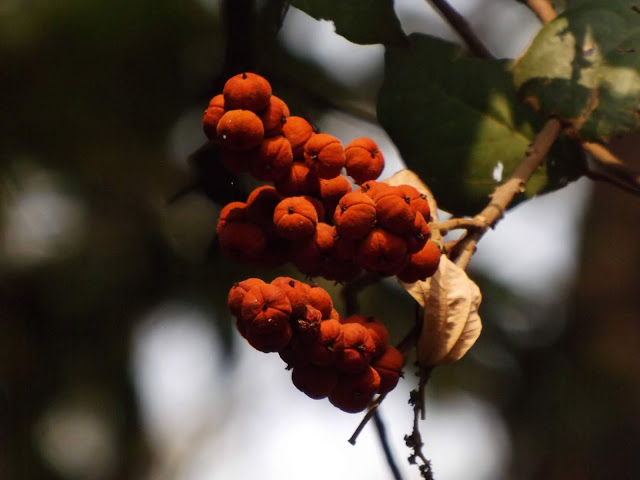
Kamela or Monkey-face tree ( Mallotus philippensis, family: Euphorbiaceae) is a small-sized tree, usually 8-12 m in height. The bark of the evergreen tree is grey, smooth and wrinkled. Young shoot, leaves and inflorescence are covered with rust-colored hair. The tree is found everywhere in Bangladesh. It is also found in South and Southeast Asia. Other names: Shinduri, Kamala, Kapila, Komolaguli.  Leaves are simple, green, alternate, petioled, ovate-lanceolate, edge slightly undulated, acuminate at the apex, 8-20 cm long and 3-6 cm wide. The lower side of the leaves contain many glands. Petiole is 1-8 cm long and has a pair of gland at the bottom. Flowers are small, reddish brown, borne on spike inflorescence. Male and female flowers bloom on separate inflorescences.  Fruit is a capsule, globose, having three lobes, covered with red powdery substance, almost 1 cm in diameter. Seeds are blackish, subglobose.  Flowers and fruits are fou...

Chondona, Chandana, Macaranga peltata

Image
Chondona  or Chandana ( Macaranga peltata , family: Euphorbiaceae) is an evergreen tree with profuse branches and nice crown. The tree usually gets 12 m height. Young parts of the tree are hairy but smooth. Its leaves are very spectacular. In Bangladesh the plant is planted on the roadside areas and parks and gardens for this reason.  Leaves are big, dark green, broadly ovate to orbicular, apex pointed, extended slightly, 15-20 cm long and 12-18 cm wide, alternate, smooth upside, glandular beneath. Veins and midribs are palmately arranged on blade. Petiole is very long and it is strangely connected to the lower part of the blade. Flowers are small, creamy white on raceme inflorescence. Male flowers (in the pic) grow from the axil of large bracts.  Fruit is capsule, round, orange-red. Propagation of the plant is caused by seeds. Flowers appear in March-April and fruit in December-January.  By the by, the species name 'peltata' ...

Pitalu or Laddu, Trewia nudiflora

Image
Pitalu or False White Teak (T rewia nudiflora , family: Euphorbiaceae) is a medium-sized deciduous tree with soft stem. Young branches and leaf backs are hairy. This is an indigenous plant of Bangladesh, as well as Indian subcontinent. Leaves are simple, green, ovate-cordate, 10-18 cm long and 6-13 cm wide, edge entire or serrate, apex acute, oppositely arranged. Petiole is 2.5-8 cm long.  During the spring when flowering comes it seems to be the best flowering tree of the land. Male and female flowers appear on separate trees.  Male flowers are borne on 20 cm long hanging spike inflorescence. Female flowers usually grow as single on long penduncle. Male flowers bear numerous yellow stamens. Female flowers have no petals. Flowering season of the tree is spring (Feb-Apr).   Fruit is globose, 2-4 cm wide, 5 chambered. Fruit ripens in Oct-Dec. Propagation is easily possible from seeds. The plant is found almost everywhere in ...

Lal verenda, Jatropha gossypifolia

Image
Lal verenda or Bellyache bush  ( Jatropha gossypifolia , family : Euphorbiaceae) is a shrub with adhesive on whole body attaining a height of 1-2 m. The plant's whole body-color is reddish and its young leaves are the same. For this reason it is called Lal verenda in Bangla. Leaves are palmately compound, 3-lobbed, each 10-2 cm long, blackish red (matures are greenish), viscose, long petioled. Flower blooms in rainy season. They are small, red, clustered in terminal panicle. Sepals 5, petals 5. Immature fruit is green, yellow when ripe, 3-chambered. Propagation of the plant is caused by seeds. The plant is full of herbal qualities. Oil extracted from it is used in pain.  Genus name gossypifolia means cotton-like leaves.

Muktajhuri, Indian acalypha, Acalypha indica

Image
Muktajhuri or   Indian acalypha   ( Acalypha indica , family: Euphorbiaceae) is an annual herb attaining a height of below 1 m. It is found in Tropical Africa, South and Southeast Asia.     Common names: Muktajhuri, Indian acalypha, Three-seeded mercury. Leaves are green, oval-shaped, serrated with hairs. Pedicel is 2.5-4 cm long. Flowers are very small, greenish in color, embedded in round bract.  Flower and fruit appear almost round the year.  Seeds are small and round. In Bangladesh, it is found in fallow land and road.  Propagation of the plant is caused by seeds.