Posts

Showing posts with the label spectacular_leaves

Shalu kocu or Shola kochu, Alocasia fornicata

Image
Shalu kocu or Shola kochu ( Alocasia fornicata , family: Araceae) is an erect perinnial herb with rhizome and stolon, attaining a height of 1 to 1.5 m. Stolon grows horizontally. Roots are whitish. It is found everywhere, specially in ditch and damp places in Bangladesh along with Pipul ( Piper longum ), Bhat ( Clerodendrum viscosum ), Asam lota, ( Mikania micrantha ) and other species of ferns. It is also found in South and Southeast Asia. All parts of the plant is eaten as vegetable in the country.  Leaves are broad, thin, triangular, pale but deep green, glabrous, shiny, 30-40 cm long, bottom part cut apart. Petiole is thick and almost as long as the total height of the plant, 40-45 cm. Like other members of the genus Alocasia, new leaves develop slowly from its wrapped state. New leaves are spectacular. Numerous small and yellow-colored flowers are clustered on spadix inflorescence, covered with eye-catching white-colored spathe. In the initial stage the inflorescence is full...

Lal shonail or Pink shower, Cassia javanica

Image
Lal shonail or Pink shower ( Cassia javanica , family: Fabaceae) is a medium-sized deciduous tree with knotted and shortened trunk, attaining a height of 12-16 m. Bark is grey. Young shoots are silky. Its spreading branches sometimes almost touch the ground towards the peripherry. It is an ideal tree for planting in a large garden. It is found in the hilly forests of Sylhet and Chattogram in Bangladesh. As a beautiful ornamental tree, it is planted in parks, botanical gardens, gardens and roadsides in the country. It is also found in various tropical countries of Asia. At the beginning of summer, the canopy of the tree is covered with flowers in such a way that it looks as if a pink fountain is waiting to fall. In order to get colorful colors in summer, you have to plant this tree in the garden with Jarul, Krishnochura, Shonalu and Konokchura. Leaves are spectacular. These are compound, 12-24; leaflets elliptic-oblong, 2.5-4.5 cm and 2-3.5 cm wide. Flowers are scented, pink or reddish...

Folsha or Falsa, Grewia asiatica

Image
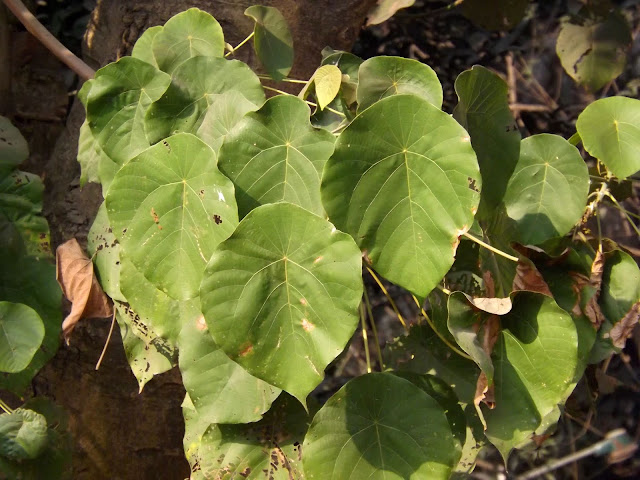
Folsha or Falsa ( Grewia asiatica , family: Tiliaceae) is a small-sized deciduous tree with short trunk and drooping branches, attaining a height of 6-7 m. Young shoots are pubescent. Bark is rough and grey in color. It is a little known tree of edible fruit in the country. The spectacular young leaves are reddish and this feature is enough to identify the tree. Other names:  Shukri, Dhamani.  It is found in village thickets as well as hilly areas of Bangladesh. It is also found in some countries of South and Southeast Asia. Leaves are heart-shaped, broadly ovate, 6-20 cm long and 8-10 cm wide, cordate at the base, dented, tip slightly elongated, alternate. Flowers are small, 2 cm in diameter, yellow-colored, in axillary clusters. Petals 5, sepals 5. Sepals are twice as large as the petals. Flowering occurs in March-April. Fruits are drupe, round, 10-12 mm across, dark purple when ripe. The taste of the fruit is basically sour, but slightl...

Daruchini or True cinnamon tree, Cinnamomum verum

Image
Daruchini or True cinnamon tree ( Cinnamomum verum , family: Lauraceae) is a medium-sized evergreen tree with profuge foliage. The tree is bushy in nature. Bark is grey and rough. It is famous for its spectacular brilliant red leaves. Strongly scented bark is used as spice.  It is cultivated widely in China, Java and Sumatra. It is found in Hill Tracts in Bangladesh as a commercial pllant. As an ornamental plant, it is also found in parks, gardens and botanical gardens in the country. It is originated from Sri Lanka. Aromatic leaves are green, glabrous, slightly hard and thin with three strong parallel nerves; ovate-lanceolate, opposite or almost opposite. Young leaves are very beautiful and these are gorgeous red in color. Flowers are very small, pale brown, borne on compound umbel. Flowering occurs at the end of winter. Fruit is Ovoid-oblong, 1.5-2 cm long, slightly fleshy, deep purple when ripen. The tree is propagated by seeds and cuttings....

Lungichor or Running Mountain Grass, Oplismenus compositus

Image
Lungichor or Running Mountain Grass ( Oplismenus compositus , family: Poaceae) is a perennial grass with spectacular leaves and inflorescence, attaining a height of 20-120 cm. It trails on ground by growing roots from the hairy nodes.  It is found in the  tropical and subtropical regions of Asia, Africa, South America and Australia. It is found in shady and damp places of forest in Bangladesh. Leaves are green, hairy, lanceolate-ovate, 3-12 cm long, pointed apex, sessile, undulate. Flowering occurs in the autumn to late autumn. Raceme inflorescence 10-25 cm long. Lower florets are barren, Upper florets bisexual. Fruits are linear, tiny. When spikelets become dry, they try to touch passing animals and this way they complete the  propagation. The leaves of the plant are beautiful. So it can be planted in gardens, parks and road islands. Gohur is the another Bangla name of the plant.

Rubber bot or Indian rubber, Ficus elastica

Image
Rubber bot or Indian rubber ( Ficus elastica , family: Moraceae) is a medium or large evergreen tree with aerial prop roots grow from its branches. The fig tree with milky latex in its leaves and shoots can get a height of more than 30 meters. The trunk is smooth, black-colored and has very tiny whitish spots. This tree is well-known as an ornamental plant. In Bangladesh, it is found on roadside area or the edge of forest and in parks and gardens. The beautiful tree is native to South and Southeast Asia. Leaves are spectacular, simple, big, leathery, deep green, sometimes deep purplish, shiny and smooth, elliptic-ovate, 12-30 cm long and 5-12 cm wide, petioled, alternate, acuminate at the top. Florets remain inside the fruit or fig which cannot be seen from outside. Fruiting occurs in the late spring. Fruits develop in the nodes of  the Fruits. They usually round, sometimes slender in shape. Mature fruits are yellow or red in color. The plant is propagate...

Chondona, Chandana, Macaranga peltata

Image
Chondona  or Chandana ( Macaranga peltata , family: Euphorbiaceae) is an evergreen tree with profuse branches and nice crown. The tree usually gets 12 m height. Young parts of the tree are hairy but smooth. Its leaves are very spectacular. In Bangladesh the plant is planted on the roadside areas and parks and gardens for this reason.  Leaves are big, dark green, broadly ovate to orbicular, apex pointed, extended slightly, 15-20 cm long and 12-18 cm wide, alternate, smooth upside, glandular beneath. Veins and midribs are palmately arranged on blade. Petiole is very long and it is strangely connected to the lower part of the blade. Flowers are small, creamy white on raceme inflorescence. Male flowers (in the pic) grow from the axil of large bracts.  Fruit is capsule, round, orange-red. Propagation of the plant is caused by seeds. Flowers appear in March-April and fruit in December-January.  By the by, the species name 'peltata' ...