Posts

Showing posts with the label rubiaceae

Gondhovadulia or Skunkvine, Paederia foetida

Image
Gondhovadulia or Skunkvine ( Paederia foetida , family: Rubiaceae) is a perennial twining climer having very unpleasant scented leaves and hairy shoots. The beautiful leafy climber is found everywhere in Bangladesh as homestead plant. It grows naturally in hilly forests of the country too. Beside Bangladesh it is also found in the countries of Southern Asia.  Other names :  Gondhovaduli, Gondhobadali, Badali-vadalia, Gondhal, Gandhal, Modhulota, Paduni pata; Bhadra & Prasarani (Sanskrit). Leaves are simple, deep green, oblong-ovoid with cordate base, tip elongated, 5-10 cm long and 7 cm wide, hairy, long petioled. Its leaves produces almost the scent of human stool. But the truth is, its leaves are eaten as a very tasty vegetable in the Indian subcontinent. And these are used as effective medicine in the treatment of various kinds of diseases. Flowers are in terminal or axillary inflorescence, almost 1 cm in length, campanulate, pink or white in outside, violet in inner ...

Koinari or Golden gardenia, Gardenia coronaria

Image
Koinari or Golden gardenia  ( Gardenia coronaria , family: Rubiaceae) is a medium-sized deciduous tree with profuse branches at the top. The tree can get a height of  12-15 m. It is found in the hilly areas of Sylhet, Chottogram and Chottogram Hill Tracts of Bangladesh.  Leaves are simple, glossy green, oblong-lanceolate, 10-20 cm long, short-petioled, 3-5 opposite leaves at the top of the branchlets. Veins and midrib are stout in texture. Flowers are yellow, very fragrant, showy, 5-7 cm across, petals 5, having long tube, calyx tubular too. Flower blooms at the spring. Fruit appears single or in a pair, 2-5 cm long, 5-angled. The plant is propagated by seeds. The tree, despite being quite beautiful not so popular in our country. Its wood is used as firewood. The inside of the fruit is eaten by the children. It is found abundantly in India and Myanmar. It is grown in the parks and botanical gardens in the country.  

Daruhoridra, Narrow-leaf morinda, Morinda angustifolia

Image
Daruhoridra or Narrow-leaf morinda ( Morinda angustifolia , family: Rubiaceae) is a shrub or small tree with soft branches attaining a height of 2 to 6 m. The evergreen plant is mostly found in the Shal forests, the Sundarbans and in coastal areas. It is also planted in the garden and parks.  Indian subcontinent and China are its original home. Leaves are dark green, lanceolate, dented, 10-30 cm long and 4-5 cm wide, tip pointed. Flowers are showy, pure white, scented, tubular in the lower part, clustered on head inflorescence. Sepals 5, petals 5. flowering occurs throughout the year. Fruits are very peculiar, composite. Each fruit seems to have one eye! The fruits become purplish when ripe. Propagation of the plant is caused by cutting and seed.  The plant has medicinal quality and used in asthma, common cold, vomiting and dysentery. It is also used to cure wound and regain energy. Bark and root are used in urinal problems. A kind of yell...

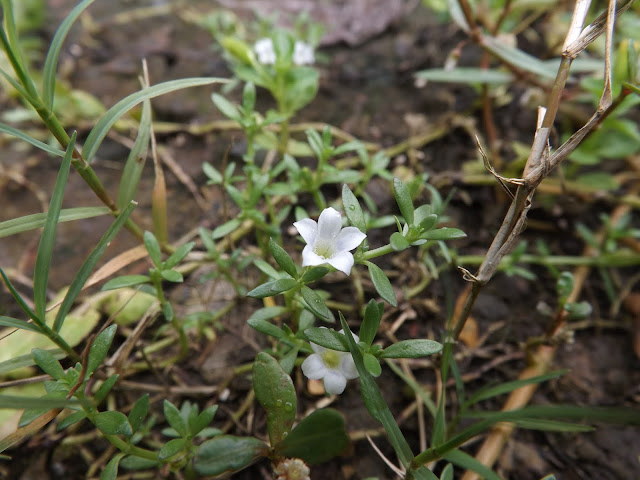
Dudhia or Shet kerui, Dentella repens

Image
Dudhia or Shet kerui ( Dentella repens , family: Rubiaceae) is an annual herb with soft slender stem. It creeps along the ground and spreads around. Leaves are entire, thick and juicy, elliptic but pointed at both ends, 1 cm long.  Funnel-shaped flowers are solitary, small, nearly sessile, petals 5-lobed, 1 cm long, absolute white in color. Flowers bloom in the rainy season.  It is grown as weed on fallow land and at the edge of water bodies. The plant helps to prevent erosion of land. By the by, the plant's species name 'repens' means spreading or creeping.                                   Other Bangla names : Shadaphuli, Shada jabri, Bhuipat.

Kodom, Neolamarckia cadamba

Image
Kodom or Kadam ( Neolamarckia cadamba , family: Rubiaceae) is a tall fast growing deciduous tree with horizontal and spiral branches attaining a height of 15-20 m. The beautiful tree is native to South and Southeast Asia. This tree is closely associated with Radha-Sri Krishna. It is frequently mentioned in Bengali and Sanskrit literature. Its Sanskrit name is Kadamba. Common names: Kadam, Burflower-tree. Leaves are 12-22 cm long, elliptic oblong, dark glossy green above, alternative. Leaves have  conspicuous veins. Flower blooms in rainy season. However, sometimes it can be seen blooming even in winter. Flowers are borne on head, terimnal, single. Flower receptacle contains innumberable florets, white and yellow mixed. Flowers are strongly-scented. A kind of awkward smell comes out from the falling flowers though. It is planted in the villages for its dense shade. Its timber is soft and used as firewood. It is also used to ma...