Posts

Showing posts with the label quadrangular_stem

Ram-bashok or Tita-phul, Phlogacanthus thyrsiformis

Image
Ram- bashok or Titaphul ( Phlogacanthus thyrsiformis , family: Acanthaceae) is a perennial erect shrub with large leaves and few branches, attaining a height of 2.5 m. Main stem and branches are quadrangular. It is found at the forest edges of hilly areas of Bangladesh. It is also found in the Indian subcontinent and some countries of Southeast Asia. It can be planted as an ornamental flower in parks and gardens for its dazzling flowers. Leaves are simple, large, lanceolate, 7-20 cm long and 6-8 cm wide, acute at both ends, dark green, petioled, opposite. Upright inflorescence is terminal with many beautiful orange-colored flowers, 12-30 cm long. Flowers are funnel-shaped, 4-4.5 cm long. Flowers bloom in the spring.  Fruit is capsule, 3 cm long, seeds 12-14. Propagation of the plant is caused by seeds. It is used in common cold, fever, asthma, and skin diseases and rheumatism. Its flowers are used as an antidote to pox. Flowers are eaten as vegetable somewhere.  Synonym: J...

Nilkanthi or Blue Snakeweed, Stachytarpheta urticifolia

Image
Nilkanthi or Blue Snakeweed ( Stachytarpheta urticifolia , family: Verbenaceae) is a semi-erect herb with branches. Stem is quadrangular and slightly woody. It can get a height of 2 m. In Bangladesh it is found in Chattogram and Chattogram Hill Tracts and greater Sylhet area. The beautiful flowering plant has not yet become popular in the country. The propagation of the perennial plant is caused by seeds. Due to its dazzling purple or bluish flowers the plant is very popular throughout the tropical regions of the world.  Serrated-leaves are shinny green, simple, opposite, elliptic, 4-7 cm long, 2-5 cm wide, sessile. Midrib and veins clearly visible. Flowers are very attractive, scented, purple in color with white mark in the centre, sepals 5, petals 5, borne on very long terminal inflorescence, quite curved, looks like snake tail or rat tail. Flowering occurs in the rainy season. Fruit is a capsule, oblong, blackish. It has some medicinal values...

Shohosro-beli or Chinese Glory Bower, Clerodendrum chinense

Image
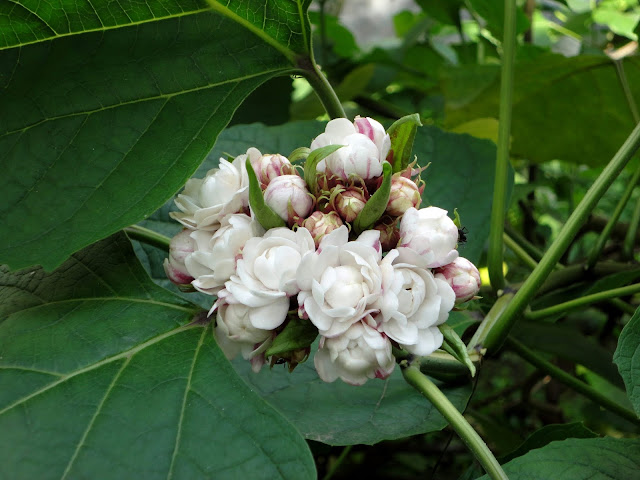
Shohosro-beli or Chinese Glory Bower ( Clerodendrum chinense , family: Verbenaceae) is a perennial shrub with quadrangular stem, attaining a height of 1-1.5 m. Usually, many plants of the species are seen together in wilderness in Bangladesh. As an ornamental plant it is planted in parks and gardens in the country.  Leaves are large and thin, 10-15 cm long and 7-12 cm wide, ovate-cordate, light green, hairy, deeply serrated, long petioled. Lower side of the leaf is light brown with red shade.  Summer and Rainy seasons are the flowering time of this evergreen shrub. Flowers are clustered on round head at the end of branches. Flowers are white with pink shade, multipetaled, sweet-scented, 2.5 cm across.  Flowers are very much like Beli (Arabian jasmine, Jasminum sambac ). The fragrance of the flowers are very much like that flower too. That’s why the Bangla name of the plant is Hajar-beli.  It is believed that the original home of the...

Kalmegh or Green chirayta, Andrographis paniculata

Image
Kalmegh or Kalomegh, Green chirayta ( Andrographis paniculata , family: Acanthaceae) is a bushy herb attaining a height of 1 m. Stem and branches are quadrangular. It is well-known medicinal plant in Bangladesh as well as in Indian subcontinent. The whole plant is bitter.   Leaves are deep green, simple, opposite, narrow, 5-8 cm long, dented; veins and midribs are clearly visible. leaves taste bitter.  Flowers are small, white with pinkish shade; tomentose; they will be red too. They bloom from late autumn to spring (November-March).  Fruit is a capsule. They are narrow, upwards, small in size. There are numerous seeds in a pod. It propagates through seeds. The plant grows on fallow lands as weed in Bangladesh. Nowadays it is grown in homestead or farmland for its medicinal value.  It is used in dysentery, fever, worm, sore and stomach disorder. Liver tonic is prepared from the plant. The leaves are used to clean rotten woun...

Rokto-dron or Red verticilla, leonurus sibiricus

Image
Rokto-dron or Red verticilla ( Leonurus sibiricus , family: Lamiaceae) is an annual herb from Shetodron family attaining a height of 90-110 cm with upright and quadrangular stem. It is usually found in crop fields in Bangladesh and is treated as weed. The plant is native to Indian subcontinent.  Other local names: Gumajoma, Jajura, Goma, Dibbopushpi, Shupushpa, Hejurchi, Chitropotrika. Leaves are dark green, opposite, petioled. The leaves of its upper part are simple, lanceolate and linear but in lower parts those are divided into few parts, almost palmate.  Flowers are tubular, small, pink with violet shade with permanent calyx, clustered on inflorescence verticillaster. Petals are bilipped or bilabiate. Fruits are four-seeded, 1-1.5 cm long. It is propagated by seeds.  Though the plant is not recognized as ornamental, but its flowers are very eye-catching indeed. Flowers and fruits are seen throughout the year. White-co...

Lutki, Malabar melastome, Melastoma malabathricum

Image
Lutki or  Malabar melastome ( M elastoma malabathricum , family: Melastomataceae) is a perennial shrub found in tropical and sub-tropical Asia. It is a common plant of Sal forest and the hilly areas of Bangladesh. The evergreen shrub is found throughout South and Southeast Asia. Common names: Lutki, Datranga, Tea indicator plant, Malabar melastome, Indian rhododendron. This shrub can reach a height of 1-2 meter high. The quadrangular and reddish stems are covered with small rough hair.  The leaves are ovate,-elliptic, or elliptic-lanceolate, 7-20 cm long with three ribs, hairy. The petiole 1-2 cm long. The nice looking shrub flowers throughout the year. Flowers are big, showy, purple in color, grows on terminal inflorescences. Petals 5, sepals 5, stamens 10.  The edible fruit is a berry; globose, 5-13 mm long and 4-10 mm wide, succulent, dehiscent. As a wild fruit children eat this tasty berry and color their mouths black...

Harjora lota, Veld grape, Cissus quadrangularis

Image
Harjora lota or Veld grape ( Cissus quadrangularis , family: Vitaceae) is a deciduous climber with smooth, stout, succulent, quadrangular stems. It has simple tendrils, born opposed to leaf. The stem of the plant has great repute in the treatment of bone fracture. That's why it has been named 'Harjora lota' or 'Harbhanga lota' in Bangla.  Other local names: Harenga, Kumor-lota It is native to Bangladesh, India and Sri Lanka. The perennial climber is also found in Africa, Arabia, and Southeast Asia. It has been introduced to Americas. The large branched climber's leaves are simple, 3-6 cm long and 2-7 cm wide, fleshy, cordate, 3-5 lobed, toothed, acute to obtuse at apex, petioled, glabrous on both surfaces., opposite. Inflorescence umbellate cymes, glabrous. Flowers are reddish, corolla lobes 4. Fruit is a berry, globose, red when ripe.  An extract is used as a cure for scurvy and irregular menstruation, and in ear and nose ...