Posts

Showing posts with the label Vitamin_C

Amloki or Amla, Phyllanthus emblica

Image
Amloki or Amla  ( Phyllanthus emblica , family: Pyllanthaceae) is a small to medium-sized deciduous tree with branches attaining a height of 6-14 m. The plant is commercially cultivated in Bangladesh as well as Indian subcontinent. Amloki contains more vitamin C than any other fruits in the world except Barbados cherry.  Common names: Amla, Anola, Indian gooseberry, Emblic myrobalan. Flowers are very small, yellowish, crowded towards the lower portion of the branchlets. Flower blooms in March-April.  Leaves are feathery, small and linear.  Fruit is globose, light green, slightly transparent. Ripe fruit is yellowish; seed 6, blackish. Propagation is caused by seeds and by cuttings. Usually 6-7 years old plant starts giving fruits and the fruiting continues for 30-40 years. The fruit tastes not only sour but tastes bitter and sweet too.  The plant is grown in orchard for its valuable fruits, rich in medicinal substances. Fr...

Chalta, Elephant apple, Dillenia indica

Image
Chalta or Elephant apple ( Dillenia indica , family: Dilleniaceae) is an evergreen tree with branches attaining a height of about 10 m. In Bangladesh, the flower of the plant is a iconic flower of  rainy season. This beautiful tree is native to South and Southeast Asia. Common names: Chalta, Elephant apple Leaves are petioled, simple, green, lanceolate, 15-27 cm wide, serrated, with 30-40 conspicuous veins. Flowers are lagre, showy, white, with many yellow stamens at center. Petals 5, sepals 5. It blooms in June-July. Fruit is big, round, 7-10 cm across.  Propagation is caused by seeds.  Dillenia indica is one of the most common homestead trees in Bangladesh. Fruit, leaves, root and bark contain a lot of vitamin C, tannin and glucose. These are useful in cough, constipation, dyspepsia, epilepsy and intestinal gas. Fruit juice is used in hair care. Tasty pickles are made from its fruit.

Koromcha, Karonta Fruit, Carissa carandas

Image
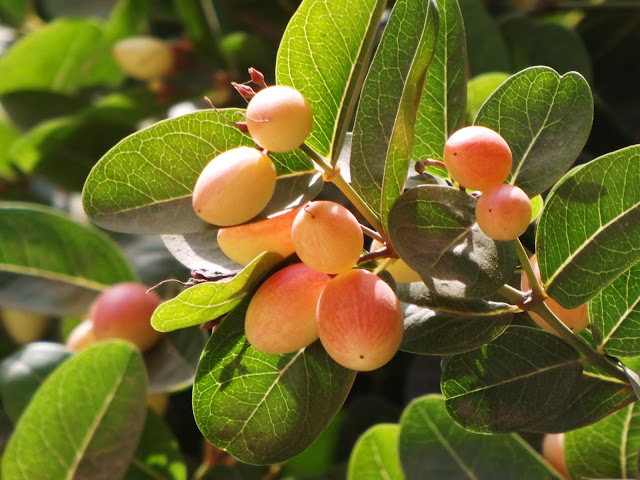
Koromcha or Karonta Fruit ( Carissa carandas , family: Apocynaceae) is a hardy medium-sized bushy shrub, attaining a height of 2-3 m. This drought-tolerant and spiny flowering shrub is native to Indian subcontinent and adjacent areas.  Common names: Koromcha, Karonta Fruit, Crane berry. Leaves are green, ovate-oblong, thin, glabrous. Branches have thorns in pairs. As a homestead plant the thorny shrub is planted for its attractive looking and extremely sour fruits. The fruit contains a lot of Vitamin C.  It is used in bilious trouble. It is expectorant and useful in fever, cold, worm and tastelessness. Rainy season is the planting time. Propagation of the plant is caused by seeds.  Plants raised from seed start bearing two years after planting.  The roots of the plant are heavily branched. Flowers are showy, white and bloom in spring (March-April). F ruit is berry, green when raw and red when ripe. It ripens in the summer.  ...

Bilombi or Cucumber tree, Averrhoa bilimbi

Image
Bilombi or   Cucumber tree   (A verrhoa bilimbi , family: Oxalidaceae) is a fruit-bearing small tree with short trunk and profuse branches, attaining a height of 5-10 m. This beautiful tree is native to Moluccas, Indonesia (possibly) and now cultivated throughout the tropical Asia.  Common names: Bilombi, Bilimbi, Bilombu (Bang), Cucumber tree (Eng). Flowers are small, inter-mixed with purple and white and borne on the old stem. Calyx is rust colored. Flower blooms mainly in March-April.                               Leaves are light green and compound. Leaflet is lanceolate with sharp end, 3-6 cm long,  alternate.  Fruit is fleshy and cylindrical, 4-11 cm long. The ripe fruit is yellowish green. Averrhoa bilimbi is found all over Bangladesh as a homestead plant. Propagation of the plant is caused by seeds.  Fruit contains vitamin C, potassi...