Posts

Showing posts with the label Horitoki

Bohera or Belleric myrobalan, Terminalia bellirica
Image
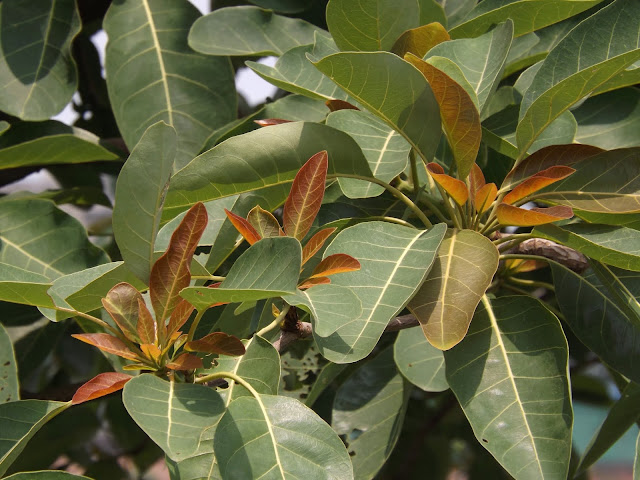
Bohera or Belleric myrobalan ( Terminalia bellirica , family: Combretaceae) is a large deciduous tree with numerous spreading branches, attaining a height of 30 to 40 m. Trunk is straght. Bark is thick and deep grey in color. Widely heard ‘Triphala’ is a mixture of Horitki ( Terminalia chebula ), Amloki ( Phyllanthus emblica ) and Bohera. According to Ayurvedic method, regular consumption of Triphala-soaked water will reduce excess weight effortlessly. It is found in the Sal forests as well as hilly forests of Bangladesh. It is also found in Southeast Asia and Northern Australia.  Other names:  Boyra, Bastard myrobalan (Eng). Leaves are ovoid or obovoid, 8-20 cm long and 5-10 cm wide with rounded tip, long petioled, alternate, clustered at the end of branchlets. The leaves totally fall off in winter. The sparkle of new leaves in spring is bound to catch everyone's eye.  Inflorescence is axilary, terminal, pendant, spike, up to 8 cm long. Flowers are sweet-scented, ...

Amloki or Amla, Phyllanthus emblica

Image
Amloki or Amla  ( Phyllanthus emblica , family: Pyllanthaceae) is a small to medium-sized deciduous tree with branches attaining a height of 6-14 m. The plant is commercially cultivated in Bangladesh as well as Indian subcontinent. Amloki contains more vitamin C than any other fruits in the world except Barbados cherry.  Common names: Amla, Anola, Indian gooseberry, Emblic myrobalan. Flowers are very small, yellowish, crowded towards the lower portion of the branchlets. Flower blooms in March-April.  Leaves are feathery, small and linear.  Fruit is globose, light green, slightly transparent. Ripe fruit is yellowish; seed 6, blackish. Propagation is caused by seeds and by cuttings. Usually 6-7 years old plant starts giving fruits and the fruiting continues for 30-40 years. The fruit tastes not only sour but tastes bitter and sweet too.  The plant is grown in orchard for its valuable fruits, rich in medicinal substances. Fr...

Horitoki, Chebulic myrobalan, Terminalia chebula

Image
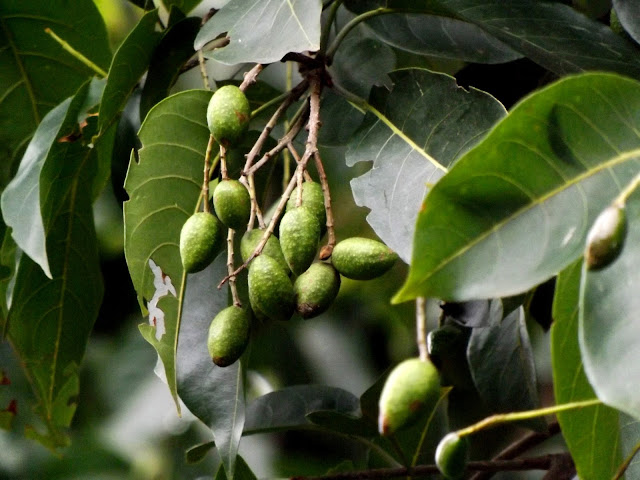
Horitoki or Chebulic myrobalan  ( Terminalia chebula , family: Combretaceae) is a medium to large-sized slow growing deciduous tree with branches. The species is native to South and Southeast Asia. In Bangladesh, it is found in Chittangong, Chittagong hill tracts, Sylhet and Mymensingh area.  Common names:  Horitoki, Chebulic myrobalan, Black c hebulic myrobalan. Leaves are sub-opposite or alternate, 7-18 cm long and 5-10 cm wide, elliptic, green, leathery, glabrous. Flowers are small in spikes. Spikes 5-15 cm long, terminal. Sepals 5, petals 5. Flower blooms in April-May. Fruit a drupe, ellipsoid, smooth, 2.5-5 cm long. It has been planted as avenue tree in Bangladesh. Propagation of the plant is caused by seeds. It is used as stomach, liver and intestinal medicine. It is also used in piles, menstruation disorder, rheumatism, constipation and diabetes. Powder of dry fruits is useful for teeth. Its ash mixed with butte...