Posts

Showing posts with the label Acanthaceae

Horgoja or Sea Holly, Acanthus ilicifolius

Image
Horgoja or Sea Holly ( Acanthus ilicifolius , family: Acanthaceae) is an evergreen spinous mangrove shrub with semi-woody base and shallow tap-roots, attaining a height of 3 m. Its green stems and branches have dark brown spots. Stems, as well as leaves, have long strong spines. In the urge of life it is sometimes seen to produce stilt roots. They live together like colonies in the brackish mud of the sea. The salt-tolerant plant can be found throughout the mangrove-habitated Southern coasts of Bangladesh. The armed plant is also found in South and Southeast Asian countries, like Sri Lanka, India, Pakistan, China, Philippines, Malaysia and in Northern Australia and Polynesia. Other names: Hargoja, Horkuch kata (Bangla), Holly-leaved Acanthus, Holly Mangrove (Eng), Harikush (Sans). Having unusual pattern and vigorous, acute spines the leaves may remind us of the leaves of Creeping thistle ( Cricus arvensis ). These are strange, crooked, shiny green and unevenly multi-lobed; 6-12 cm l...

Nilambori or Blue fox tail, Ecbolium viride

Image
Nilambori or Blue fox tail ( Ecbolium viride , family: Acanthaceae) is a perennial woody herb or undershrub with leafy bracts and spectacular bluish flower, attaining a height of 1 m. The branches of the erect herb is quadrangular. It is found found in Tropical Asia and Africa. In Bangladesh it is found in village thickets and Sal forests. Other names: Nil jhinti, Nil Kata, Nilkontho (Bang); Turquoise crossandra (Eng). Leaves are shiny green, lanceolate, 10-15 cm long and 5-7 cm wide, edge undulated (at first glance it looks toothed), opposite, almost sessile, elongated and acute at the end. Bracts are green-colored, arranged in upright and compact spike. Flowers are light blue, in terminnal or axillary inflorescence. Upper lip of the showy flower is linear, shortly bilobed and erect, lower one is 3-lobed, middle one is broader. Corolla tube is whitish blue, narrow and very long. Flowering and fruiting occur round the year. Fruit is a 2-seeded capsule.  The medicinal plant is us...

Kalobashok or Blue sage, Eranthemum pulchellum

Image
Kalobashok or Blue sage ( Eranthemum pulchellum , family: Acanthaceae) is a woody shrub with thick branches, with a height of 1-1.5 m. Stem and branches are quadrangular. The color of the flowers is stunning blue. The astonishing abundance of gentian blue has the power to amaze anyone. It can be one of the top picks for decoration of tropical gardens. It is mainly found in Indian subcontinent as well as some countries of Southeast Asia.  Other names: Muralipata (Bang), Blue eranthemum (Eng). Leaves are deep green, opposite, Midrib and veins are clearly visible. Sometimes veins are from same point, which is rare characteristic in plant world, ovate-elliptic, 10-15 cm long, tip pointed, edge dented, sometimes undulated. Petals 5. Propagation of the plant is caused by cuttings.  Tubular flowers are light blue, showy, tube 2.5 cm long, lobes 5. Cup-like sepal is 5-lobed. Flowers bloom at the top of long terminal inflorescence (8-16 cm) with bracts. The overlapping bracts are ba...

Ram-bashok or Tita-phul, Phlogacanthus thyrsiformis

Image
Ram- bashok or Titaphul ( Phlogacanthus thyrsiformis , family: Acanthaceae) is a perennial erect shrub with large leaves and few branches, attaining a height of 2.5 m. Main stem and branches are quadrangular. It is found at the forest edges of hilly areas of Bangladesh. It is also found in the Indian subcontinent and some countries of Southeast Asia. It can be planted as an ornamental flower in parks and gardens for its dazzling flowers. Leaves are simple, large, lanceolate, 7-20 cm long and 6-8 cm wide, acute at both ends, dark green, petioled, opposite. Upright inflorescence is terminal with many beautiful orange-colored flowers, 12-30 cm long. Flowers are funnel-shaped, 4-4.5 cm long. Flowers bloom in the spring.  Fruit is capsule, 3 cm long, seeds 12-14. Propagation of the plant is caused by seeds. It is used in common cold, fever, asthma, and skin diseases and rheumatism. Its flowers are used as an antidote to pox. Flowers are eaten as vegetable somewhere.  Synonym: J...

Shurma or Hophead barleria, Baleria lupulina

Image
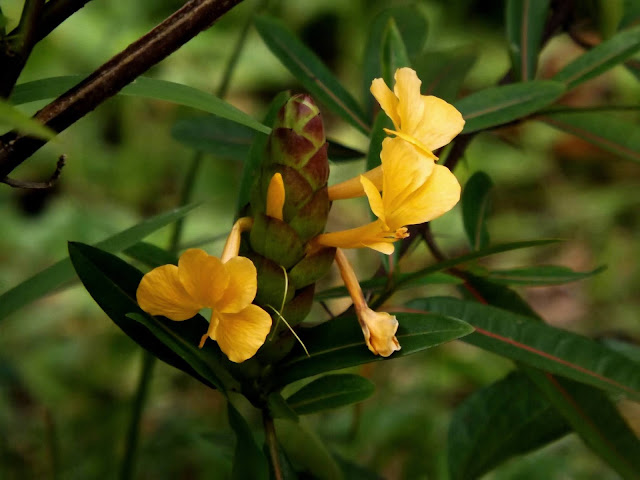
Shurma  or  Hophead barleria ( Baleria lupulina , family: Acanthaceae) is a thorny shrub with numerous branches, attaining a height of 1-1.5 m. Stem is glabrous. Branches and young shoots are reddish and quadrangular. The hard and pointed thorns are originated from the leaf axil. It is found in gardens, medicinal gardens and botanical gardens in Bangladesh. It is also found in the countries of tropical Asia and tropical Africa.   Other names:   Kata bishollakoroni , Katabishala, Shonomukhi, Shorno jhinti. Leaves are dark green, linear-lanceolate, 7-15 cm long and 2-4 cm wide, midrib reddish, short petioled. Flowers are yellow having overlapping bracts, borne on terminal inflorescene; corolla is tubular, 3 cm long, lobes 5. Flower blooms in autumn.  Fruit is a capsule, 2-seeded. Propagation of the plant is caused by seeds and cuttings. It is used in cold, fever, weakness, pain and swelling. Leaves are used in dogbites...

Kulekhara or Talmakhna, Hygrophila auriculata

Image
Kulekhara or Talmakhna ( Hygrophila auriculata , family: Acanthaceae) is a stout and erect herb with straight and undivided stem. The spiny plant is very popular as a medicinal plant in Bangladesh as well as the Indian subcontinent. Other names: Kulekkha, Kuiley-rekha,  Kanta kalika, Shoolmordon. Leaves are lanceolate, subsessile, acute at both ends with long whitish hairs, dense with straight and stout thorns that grow from each node. Outer leaves are longer than the inner ones. Both leaves and thorns remain in upward direction.   Flowers in axillary whorls. They are bright violet or bluish purple and red, sometimes whitish with soft and minor hair, corolla 2-lipped. Flower blooms in the winter. Fruit a capsule, 4-8-seeded. Seeds are ovoid (not in the pic). The body of the plant contains alkaloids, phytosterols, stigmasterol, lupeol and essential oils. Its seeds contain oil, enzymes and sterols. The plant is cooling and diuretic...

Kalmegh or Green chirayta, Andrographis paniculata

Image
Kalmegh or Kalomegh, Green chirayta ( Andrographis paniculata , family: Acanthaceae) is a bushy herb attaining a height of 1 m. Stem and branches are quadrangular. It is well-known medicinal plant in Bangladesh as well as in Indian subcontinent. The whole plant is bitter.   Leaves are deep green, simple, opposite, narrow, 5-8 cm long, dented; veins and midribs are clearly visible. leaves taste bitter.  Flowers are small, white with pinkish shade; tomentose; they will be red too. They bloom from late autumn to spring (November-March).  Fruit is a capsule. They are narrow, upwards, small in size. There are numerous seeds in a pod. It propagates through seeds. The plant grows on fallow lands as weed in Bangladesh. Nowadays it is grown in homestead or farmland for its medicinal value.  It is used in dysentery, fever, worm, sore and stomach disorder. Liver tonic is prepared from the plant. The leaves are used to clean rotten woun...

Nil bonolota, Bengal trumpet, Thunbergia grandiflora

Image
Nil bonolota or Bengal trumpet ( Thunbergia grandiflora , family: Acanthaceae) is a vigorous perennial climber. The climber is native to Indian subcontinent as well as Southeast Asia.  Common names: Nil lota, Nil bonolota, Bengal clock vine, Bengal trumpet, Blue thunbergia. Flowers are big, pale blue, on pendulous racemes. Sepals 5, petals 5. Flower-buds of thunbergia grandiflora. Leaves are angularly cordate and lobed, rough on both surfaces, 10-16 cm long.     The plant in its original habitat, Khoiachhora, Mirshorai It continuously produces flowers in summer through rainy season.  It is grown on fence, pergola or wall in Bangladesh. Root of the plant counteracts poison of snake. Leaf juice is stomachic. Propagation of the plant is caused by cuttings.

Potpoti, Minnieroot, Ruellia tuberosa

Image
Potpoti or   Minnieroot ,  ( Ruellia tuberosa , family: Acanthaceae) is a perennial herb, attaining 30-40 cm height, with branches. Leaves are green, hairy, 5-7 cm long. Common name: Potpoti, Chotpoti (Bangla); Sheep Potato, Minnieroot, Snapdragon Root, Cracker plant (English). Flowers are showy, violet in color, funnel-shaped, sepals 5, petals 5. In Bangladesh its flower blooms in summer.   Flower-buds are also nice to look at. It is called Cracker plant (in Bangla 'Potpoti') by the folk people come from the fact that children like to play with its dry pods that pop when rubbed with spit or water. The plant is propagated by seeds. It grows in fallow land as weed but can be cultivated in garden as decorative plant for its attractive, showy & nice colored flowers.  Root extract is used for nervous breakdown & anemia.