Posts

Showing posts with the label Lamiaceae

Bon-jui or Glory bower, Volkameria inermis
Image
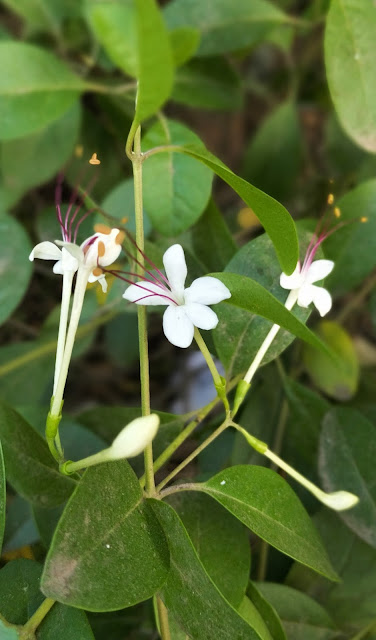
Bon-jui or Glory bower ( Volkameria inermis , Lamiaceae) is a semi-erect beautiful mangrove shrub, attaining a height of 3-4 m. The salt-tolerant plant's stem is woody. Yong shoots, petiols, leaf blades are usually glabrous but sometimes covered with minutely hairs.  Its geographical extent is quite large. It can be found in the countries of East Asia as well as South and Southeast Asia. It can also be found in Australia and Pacific Islands, such as New Guinea too. In Bangladesh, the flowering plant is found standing beside the muddy, wet and saline soils of cannals and other waterbodies of mangrove forests or edge of mangrove forests. In the country, it has long been planted as an ornamental shrub along roadsides and road islans. In some places it is also used as a hedge in gardens.        Other names:  Koklota, Bakri, Batraj, Chitka bhat (Bang); Garden quinine, Seaside clerodendron.  The shrub's richness is due to the leaves. These are quite beauti...

Dunil or Koya-jarul, Premna bengalensis

Image
Dunil or Koya-jarul ( Premna bengalensis , famliy: Lamiaceae) is a medium-sized evergreen tree often with fluted trunk and somewhat quadrangular branches and shoots. Its stem, reddish young shoots, leaves and inflorescence are stellately tomentosed. Bark is ashy-grey and it removes papery flakes from its body. The geographical extent of the plant is not so large. It is found in hilly and plain lands of Bangladesh as well as India, Nepal, Vietnam and Myanmar.  Other local names: Pakirhara, Pakhir-har, Aholauja, Phongta. Leaves are simple, thin, shiny and light green, coriaceous, elliptic to ovate-oblong, 8-24 cm long and 4-10 cm wide, petioled, usually entire, sometimes irregularly dented, tip acuminated, opposite.  Flowering occurs in May-September. Tiny flowers are borne in large terminal inflorescence. These are bisexual, greenish white, white or yellowish with 2-lipped corolla, calyx tubular, 4-5-lobed.  Fruit is a drupe, round, 4-5 mm in diameter, it turns black whe...

Tulsi or Sacred basil, Ocimum tenuiflorum

Image
Tulsi o r Sacred basil ( Ocimum tenuiflorum , family: Lamiaceae) is an odorous perennial herb or undershrub with many branches attaining a height of 1-1.5 m. Almost whole body of the plant is covered with hairs. Stem is woody, furrowed and quadrangular. Like many other herbs (Dhutra, Begun, Pepper) the plant can be purple. It is found everywhere in Bangladesh as a medicinal as well as sacred plant to Hindu community. It has spread across a huge global range, extending from the Arabian Peninsula to East Asia as well as Pacific Islands to Australia.  Other names: Kalo tulsi (Bang); Tulasi, Ajaka (Sans); Holy basil (Eng).  Leaves are strongly scented, green or purple, hairy, ovate-broadly elliptical, 2-5 cm long and 1-1.5 cm wide, opposite, irregularly dented, petiole 2-3 cm long.  Flowers are tiny, white or purplish, 3-8 on terminal inflorescence (12-25 cm long). Corolla bilabiate, petals 5, calyx divided into two parts, Stamens 4. It produces flower almost round the yea...

Tokma or Pignut, Hyptis suaveolens

Image
Tokma or Pignut ( Hyptis suaveolens , family: Lamiaceae) is an annual herb with woody stem and profuse branches, attaining a height of 2 m. The whole body of the plant is filled with strong odor and minute hairs. It smells like Tulsi and is called Gonga tulsi or Bilati tulsi. The stem and branches are usually round but quadrangular when young. It is easily identifiable for its many characteristics.  Other names:  Tokmari, Gonga tulsi, Bilati tulsi; Chonga dana (Chakma).  The plant is not indigenous, but it has adapted very well to the country's condition. That is why it is found in the hilly area, as well as in fallow lands and along roadsides of the plains. The plant is indigenous to tropical America. Leaves are odorous, hairy, giving a velvety feel. The size and shape of the leaves vary. Its shape can be round, but most of the time it is quite triangular with cordial base; 2-12 cm long and 2-8 cm wide, with deep and irregularly toothed edges. Petiole is long.  Fl...

Congea or Wooly congea, Congea tomentosa

Image
Congea or Wooly congea ( Congea tomentosa , family: Lamiaceae) is a woody and extensive creeper, covering with shaggy hair in young shoots and branches. Its beauty during the flowering season is so unique that it surpasses many other plants in the garden. This beauty is mainly for its surprising and unique bractioles.  Although it is not indigenous to Bangladesh but it is originated in neighboring India, Myanmar and Malaysia as well some of the countries of Southeast Asia. In Bangladesh it is found in parks and botanical gardens as an ornamental plant. Leaves are simple, 10-12 cm long and 5-10 cm wide, entire, short petioled, opposite, ovate-lanceolate. There are dense hairs on both sides of the leaf, more on the underside. Rough branch of the inflorescence bears 3-9 flowers. There are small velvety bracts at the bottom of the inflorescence and three bractioles at the top of it, taking the shape of the cup. Sepals 5, bilabiate, tubular, with dense hair. S...

Rokto-dron or Red verticilla, leonurus sibiricus

Image
Rokto-dron or Red verticilla ( Leonurus sibiricus , family: Lamiaceae) is an annual herb from Shetodron family attaining a height of 90-110 cm with upright and quadrangular stem. It is usually found in crop fields in Bangladesh and is treated as weed. The plant is native to Indian subcontinent.  Other local names: Gumajoma, Jajura, Goma, Dibbopushpi, Shupushpa, Hejurchi, Chitropotrika. Leaves are dark green, opposite, petioled. The leaves of its upper part are simple, lanceolate and linear but in lower parts those are divided into few parts, almost palmate.  Flowers are tubular, small, pink with violet shade with permanent calyx, clustered on inflorescence verticillaster. Petals are bilipped or bilabiate. Fruits are four-seeded, 1-1.5 cm long. It is propagated by seeds.  Though the plant is not recognized as ornamental, but its flowers are very eye-catching indeed. Flowers and fruits are seen throughout the year. White-co...

Danda-kolosh, Shetodron, Leucas aspera

Image
Danda-kolosh or Shetodron ( Leucas aspera , family: Lamiaceae) is an annual herb with soft, hairy and qudrangular stem. The weed is found in South and Southeast Asia. It prefers dry, open and sandy soil. The under-shrub can reach a height of 30-50 cm. Other local names: Dolkolosh, Julfi, Holkosha, Debdron. Flowers rise from axillary whorls are pure white, small and showy. Petals 5, sepals 5, bilabiate. It blooms in March-April mainly. Flower contains nectar. Leaves are short petioled, entire, oblong-lanceolate, taper at the base; 6-8 cm long and 1-2 cm wide. In Sanskrit, it is called 'Dronapushpi'. Oblong fruits are nutlets, brown in color; 2-3 mm long. Propagation of the plant is caused by seeds. The plant is full of medicinal qualities. Whole plant is used to prepare medicine, which is effective in cold and headache. The leaves contain antibacterial elements. It is used to cure psoriasis and scabies. Those are eaten as vegetable ...