Posts

Showing posts with the label wild_flowers_of_bangladesh

Horgoja or Sea Holly, Acanthus ilicifolius

Image
Horgoja or Sea Holly ( Acanthus ilicifolius , family: Acanthaceae) is an evergreen spinous mangrove shrub with semi-woody base and shallow tap-roots, attaining a height of 3 m. Its green stems and branches have dark brown spots. Stems, as well as leaves, have long strong spines. In the urge of life it is sometimes seen to produce stilt roots. They live together like colonies in the brackish mud of the sea. The salt-tolerant plant can be found throughout the mangrove-habitated Southern coasts of Bangladesh. The armed plant is also found in South and Southeast Asian countries, like Sri Lanka, India, Pakistan, China, Philippines, Malaysia and in Northern Australia and Polynesia. Other names: Hargoja, Horkuch kata (Bangla), Holly-leaved Acanthus, Holly Mangrove (Eng), Harikush (Sans). Having unusual pattern and vigorous, acute spines the leaves may remind us of the leaves of Creeping thistle ( Cricus arvensis ). These are strange, crooked, shiny green and unevenly multi-lobed; 6-12 cm l...
Kushum or Ceylon oak, Schleichera oleosa

Image
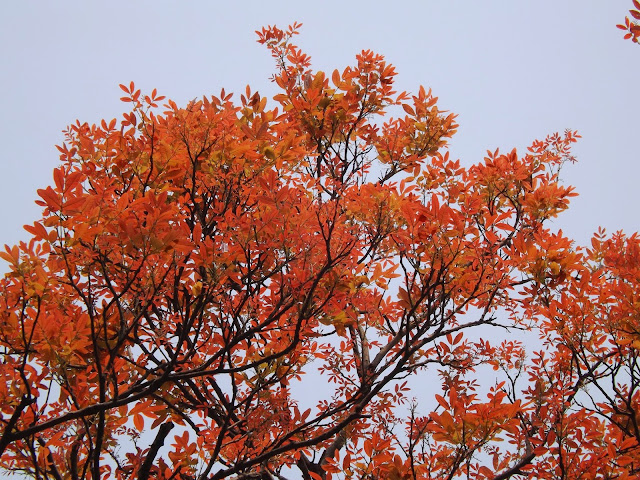
Kushum or Ceylon oak ( Schleichera oleosa , family: Sapindaceae) is a large-sized deciduous tree with spreading canopy and huge trunk, attaining a height up to 40 m. The diameter of the trunk can be up to 2 meters. Bark is grey and smooth. The leaves fall at the end of winter and new leaves come in spring. The leaves are surprisingly red.    Other names:  Joyna, Lakkha, Gum tree, Honey tree. This giant tree can be easily recognized by shiny red leaves. The fruits look a lot like Lotkon and are called by this name somewhere. It can be seen scattered in Chittagong and Chittagong Hill Tracts including the northern part of the country. It is originated in the Southeast region of Asia, especially in India, Sri Lanka and Myanmar.  Leaves are compound, sessile; leaflets elliptic-obovate, 4-20 cm long and 3-9 cm wide, opposite. The extraordinary young leaves are brilliant red in color. These are seen several times a year. Raceme inflorescence 6-15 cm long. Flowers are gre...

Chotro-pushpo or lady's umbrella, Holmskioldia sanguinea

Image
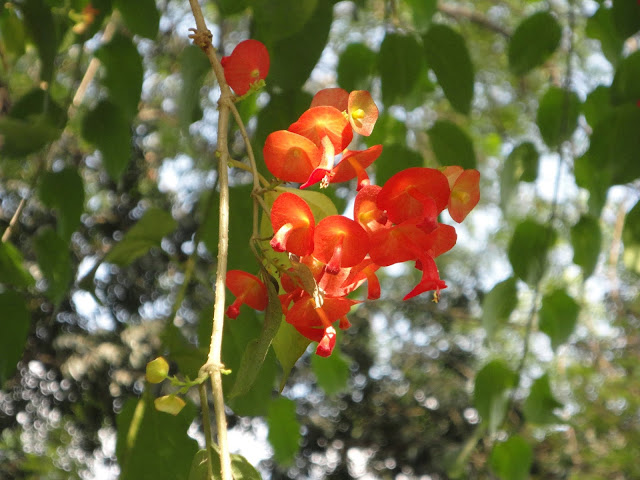
Chotro-pushpo or lady's umbrella ( Holmskioldia sanguinea , family: Verbenaceae) is a woody and creeping shrub with drooping branches. It looks a lot like Bougainvillea from a distance. Bark is grey and smooth. The flowers of the deciduous plant are so unique that it is easily recognizable. It is found in the hilly forests of Sylhet of Bangladesh. The shrub is a native species of the Indian subcontinent.  The other Bangla name of the plant is Kushumika. Leaves are pubescent, dark green, elliptic-lanceolate, round or subcordate at the base, 4-6 cm long, opposite, dented with elongated and pointed apex.    The corolla of the flower is tubular, 2 cm long, red in color. Calyx almost looks like a upper side of lady's umbrella or a Chinese hat, orange-colored. Bisexual flowers bloom throughout the year but these bloom in abundance in winter and spring.  Fruit is ovoid, 1 cm wide. Seeds 4. It is propagated by seeds and cuttings.  This...

Hapormali or Bread Flower, Vallaris solanacea

Image
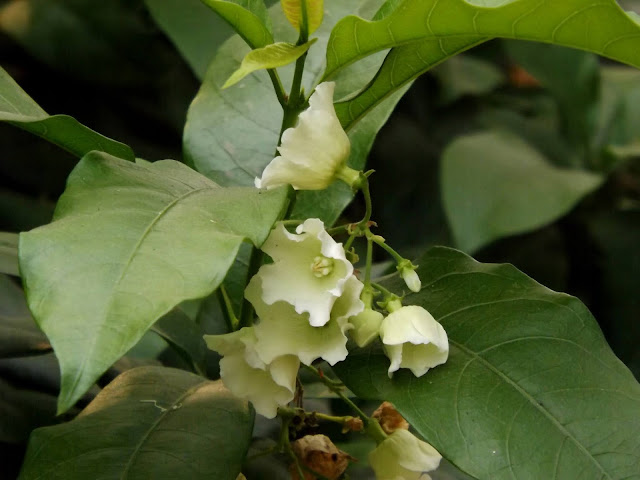
Hapormali or Bread Flower ( Vallaris solanacea , family: Apocynaceae) is a slightly woody and extensive creeper with pure white and highly scented flowers. The whole body of the plant is filled with milky latex. It is mainly found in the hilly forests of Bangladesh. In addition, it will be seen in some gardens and botanical gardens of the country. It is also found in South and Southeast Asia. Oher names: Mali, Ramsor, Hadpur. Leaves are big, 12-15 cm long and 4-6 cm wide, pale green, ovate-lanceolate with pointed apex, opposite, petioled. Fragrant flowers bloom in large clusters, usually 5-6 flowers. These are white, cup-shaped, abot 3 cm wide, peatals 5, sepals 5. The smell of the flower is so sweet that erasing it from our memory is a very difficult task. Flowers bloom in spring.  Milky latex is used in skin diseases somewhere. The plant is propagated by cuttings. It needs to be conserved in different parts of the country as it is limited to certai...

Buddho narikel or Buddha coconut, Pterygota alata

Image
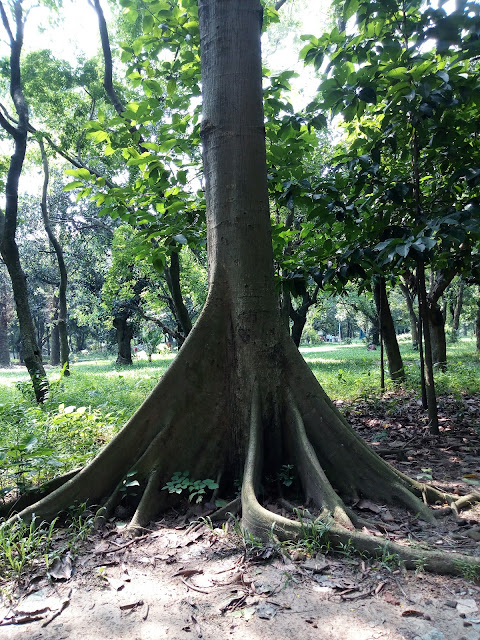
Buddho narikel or Buddha coconut ( Pterygota alata , family: Sterculiaceae) is a large erect tree with branches, reaching up to 50 m in height. Trunk is huge and stout. Bark is smooth and  grey in color.  The deciduous mighty tree is found in the hilly forests of Chittagong and Chittagong Hill Tracts and Sylhet of Bangladesh.  The tree is also found in South India, Sikkim and Andaman Islands. In Bangladesh it is planted in parks and botanical gardens as an ornamental plant.  Leaves are dark green, big, cordate, glabrous, 10-25 cm long and 7-20 cm wide, alternate; long-petioled: 10-14 cm long. Midrib and veins are clearly visible. Flowers are reddish inside, outside brownish yellow, scented, petals 5. It produces flowers in spring. Fruit is big, round, hard, dehiscent, dark brown in color. Seeds are winged, numerous. Fruit pulp tastes almost like Coconut.   The native plant is propagated by seeds. Seed is edible too. It...

Braziler Paat or Brazil jute, Malachra capitata

Image
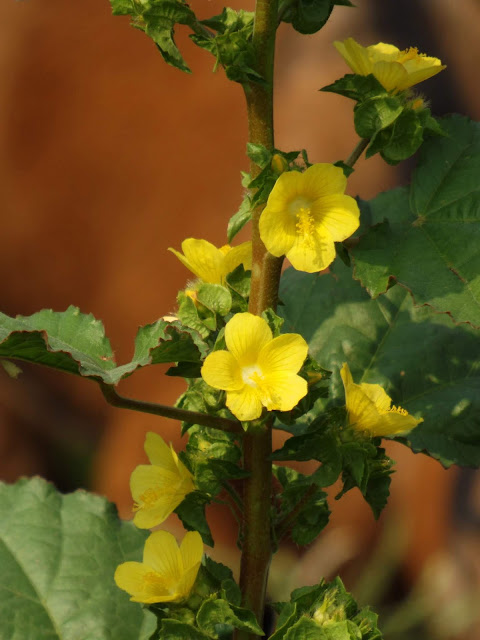
Braziler Paat or Brazil jute (M alachra capitata , family: Malvaceae) is a useful tropical erect herb or undershrub with hairy body. Stem is slender and reddish. The leaves have also reddish marks at the edge. It can get a height of up to 2 m. The annual (or perennial) is found throughout the tropical regions of the world.    Other name: Bon vingdi. The size and shape of the leaves may vary. It can be orbicular to suborbicular or ovate, many-lobed, cordate at base, blunt or acute at tip, edge serrated, alternate, 6-16 cm in diameter; long-petioled, almost the half of the length of leaf. Both sides of the leaf is hairy. The petiole is not directly connected to the blade but connected by creating angles to the bottom.  Flowers usually in axillary heads, often also in terminal heads. Each head contains 2-5 bright yellow-colored flowers with white eye. There are 3-4 leafy bracts surrounding the flowers. Short-petioled flowers are cupular, 5-petaled. Peta...

Kachchhara or Ceylon hydrolea, Hydrolea zeylanica

Image
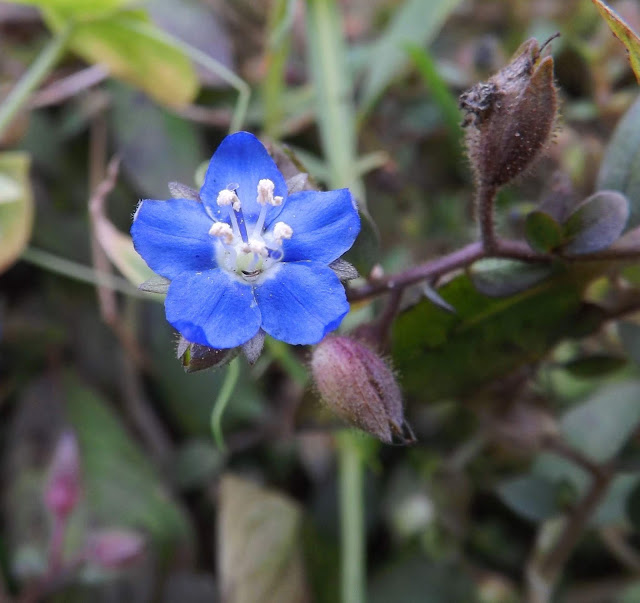
Kachchhara or Ceylon hydrolea ( Hydrolea zeylanica , family: Hydrophyllaceae) is a trailing or semi-erect annual herb with branches. It can get a length of 30-40 cm. By the roots, produced from nodes, it survives on the ground. The branches are reddish and tomentose. Other  Bangla   name:     Ishanguli .  Despite its beautiful flowers, it is still not popular among the gardeners of Bangladesh. Short-petioled leaves are simple, lanceolate, entire. Showy flowers borne in terminal or axillary inflorescence, subsessile. Petals 5, sepals 5, stamens 5. Sepals are lanceolate, pubescent, persistent. Flowering occurs in late autumn to winter (Oct-Jan).  Fruit is a capsule, thin, transparent, globose, many-seeded. Propagation is caused by seeds.  The plant is often used as fodder. The leaves have antiseptic properties that are used in wounds. The leaves are also used to the treatment of ulcer. It is found in sha...

Nilkanthi or Blue Snakeweed, Stachytarpheta urticifolia

Image
Nilkanthi or Blue Snakeweed ( Stachytarpheta urticifolia , family: Verbenaceae) is a semi-erect herb with branches. Stem is quadrangular and slightly woody. It can get a height of 2 m. In Bangladesh it is found in Chattogram and Chattogram Hill Tracts and greater Sylhet area. The beautiful flowering plant has not yet become popular in the country. The propagation of the perennial plant is caused by seeds. Due to its dazzling purple or bluish flowers the plant is very popular throughout the tropical regions of the world.  Serrated-leaves are shinny green, simple, opposite, elliptic, 4-7 cm long, 2-5 cm wide, sessile. Midrib and veins clearly visible. Flowers are very attractive, scented, purple in color with white mark in the centre, sepals 5, petals 5, borne on very long terminal inflorescence, quite curved, looks like snake tail or rat tail. Flowering occurs in the rainy season. Fruit is a capsule, oblong, blackish. It has some medicinal values...