Posts

Showing posts with the label stolon

Shalu kocu or Shola kochu, Alocasia fornicata

Image
Shalu kocu or Shola kochu ( Alocasia fornicata , family: Araceae) is an erect perinnial herb with rhizome and stolon, attaining a height of 1 to 1.5 m. Stolon grows horizontally. Roots are whitish. It is found everywhere, specially in ditch and damp places in Bangladesh along with Pipul ( Piper longum ), Bhat ( Clerodendrum viscosum ), Asam lota, ( Mikania micrantha ) and other species of ferns. It is also found in South and Southeast Asia. All parts of the plant is eaten as vegetable in the country.  Leaves are broad, thin, triangular, pale but deep green, glabrous, shiny, 30-40 cm long, bottom part cut apart. Petiole is thick and almost as long as the total height of the plant, 40-45 cm. Like other members of the genus Alocasia, new leaves develop slowly from its wrapped state. New leaves are spectacular. Numerous small and yellow-colored flowers are clustered on spadix inflorescence, covered with eye-catching white-colored spathe. In the initial stage the inflorescence is full...

Kochu or Taro, Colocasia esculenta

Image
Kochu or Taro ( Colocasia esculenta , family: Araceae) is a perennial aquatic herb with stolon and rhizome, attaining a height of 1.5 m. It is found by water or standing in water. The fast-growing plant is found almost everywhere in Bangladesh. Although it is originated mainly in Southeast Asia, it has gradually become naturalized in the tropical world. It is one the oldest cultivated crops in Asia. The whole part of the plant, like leaf, stem, petiole, rhizome, stolon--everything can be eaten as vegetable. Other names: Mukhi kochu, Gura kochu, Kuri kochu, Chhora kochu, Duli kochu, Binni kochu. Leaves are showy, large, green, glabrous, triangular-ovate, 30-40 cm long and 20-26 cm wide. Petiole is thick and juicy and it can be almost equal to the height of the plant. New leaves grow from the rhizome. Neumerous small flowers are clustered on spadix inflorescence, covered with giant bract leaf, spathe; the spadix is three-fifths of the spathe. In initial stage the inflorescence is full...

Durba-ghash or Bermuda grass, Cynodon dactylon

Image
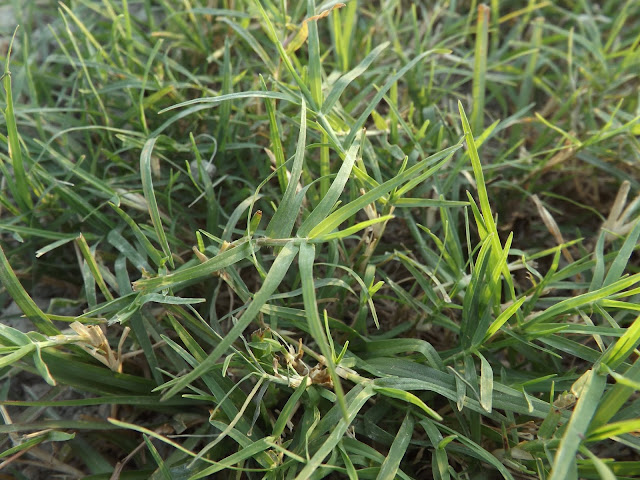
Durba-ghash or Bermuda grass ( Cynodon dactylon , family: Gramineae) is a perennial grass with cylindrical nodes and internodes. It creeps on ground by creating roots from nodes of stem. Stem (up to 45 cm long) is usually green, sometimes reddish. The creeping herb is a traditional medicinal plant of the Indian subcontinent.  It is found all over the country as a crop weed. It is also found in South and Southeast Asia and The tropical region of Africa. Although its roots do not go deep into the soil, it retains the soil quite well. Otherwise, in a rainy country like ours, it would have been impossible to prevent soil erosion. Leaves are narrow or linear with pointed tip, pale green, minutly hairy, 2-8 cm long. The leaf ligules are covered with thin white hairs. Inflorescence is brownish green, divided in to 5 parts, each part 2-5 cm long. Flowering occurs almost round the year. It is propagated by seeds, rhyzome and stolon. The plant contains trit...