Posts

Showing posts with the label spike_inflorescence

Ulu or Cogon grass, Imperata cylindrica

Image
Ulu or Cogon grass ( Imperata cylindrica , family: Poaceae) is a beautiful perennial grass with cylindrical and solid stem and creeping rhizomes, attaining a height of 1 m. The herb is one of the most beautiful flowering plants of Bangladesh. The water-loving grass is found all over Bangladesh. Its original home is Indian subcontinent.   Other names: Ulu-ghash, Ulu-khor, Lalong, Shon, Chhon, Chhau, Sarkanda. Leaves are green, rough, linear-lanceolate, 20-50 cm long with pointed apex.  Flowers are pure white, silky, on spike inflorescence. Although the initial color of the flower is purple-white, it gradually changes to shiny white. It blooms from rainy season to autumn.  Fruits are caryopsis, winged. Fruits and flowers can be seen at a time on different plants. It is propagated by rhizomes and seeds.  When they bloom over a large area, a truly eye-catching scene unfolds. Only Kaash (Saccharum spontaneum) can be compared to its blossoming. It is used in diabete...

Kathal or Jack fruit, Artocarpus heterophyllus

Image
Kathal or Jack fruit ( Artocarpus heterophyllus , family: Moraceae) is a medium-sized leafy tree with many branches. It is the national fruit of Bangladesh as well as Sri Lanka. The fruits are unique in taste, well-smelled, nice-colored and juicy too.  It is one of the most largest fruits of the world. The evergreen tree has milky latex all over its body. The bark of the tree is rough and sometimes it removes scale. Bangladesh and India are the original home of the plant. The leaves are entire, having bract, ovoid, 15-20 cm long and 10-12 cm wide, alternate, apex acute, coriacious; veins and midribs are clearly visible and those are stout too. Flowering occurs in December and it continues to March. Flowers borne on spike inflorescence and those are covered with two bracts. In the same tree, the female and male flowers are seen differently. From the main branch of the tree, the female flowers appear. The peduncle, ovary and perianth, all of them...

Kamela or Monkey-face tree, Mallotus philippensis

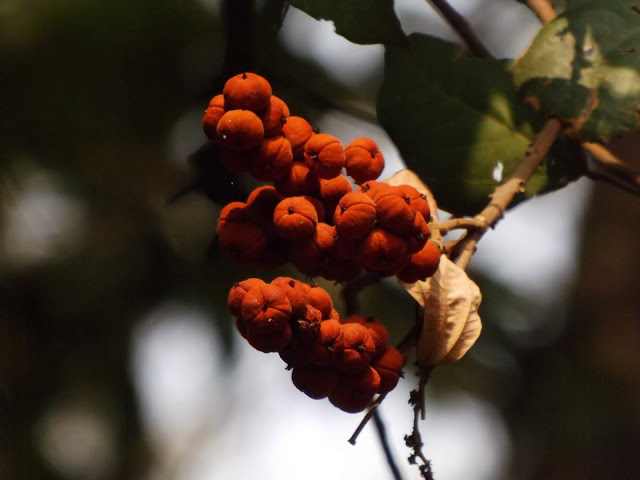
Image
Kamela or Monkey-face tree ( Mallotus philippensis, family: Euphorbiaceae) is a small-sized tree, usually 8-12 m in height. The bark of the evergreen tree is grey, smooth and wrinkled. Young shoot, leaves and inflorescence are covered with rust-colored hair. The tree is found everywhere in Bangladesh. It is also found in South and Southeast Asia. Other names: Shinduri, Kamala, Kapila, Komolaguli.  Leaves are simple, green, alternate, petioled, ovate-lanceolate, edge slightly undulated, acuminate at the apex, 8-20 cm long and 3-6 cm wide. The lower side of the leaves contain many glands. Petiole is 1-8 cm long and has a pair of gland at the bottom. Flowers are small, reddish brown, borne on spike inflorescence. Male and female flowers bloom on separate inflorescences.  Fruit is a capsule, globose, having three lobes, covered with red powdery substance, almost 1 cm in diameter. Seeds are blackish, subglobose.  Flowers and fruits are fou...

Bokkon or Frogfruit, phyla nodiflora

Image
Bokkon or   Frogfruit   ( phyla nodiflora , family: verbenaceae) is a creeper, 15-90 cm long. Stem is branched, nodes giving rise to aerial roots. The plant is is native to South America and the United States and has become naturalized in the warmer parts of the world. It grows on fallow land in Bangladesh.  Common names:  Bokkon, Frogfruit, Turkey tangle frogfruit, Capeweed Flowers are small, violet, whorled on the top of 2-7 cm long spike inflorescence. Leaves are small, sessile, obovate, front part serrate.  The plant bears flower in the nodule. For this reason, the species has been named nodiflora. In Sanskrit, it is called Vasir and Vasuka. A lar g e colony The plant is propagated by seeds, root division and cuttings.  Leaves are eaten as vegetables in rural areas to reduce pain and swelling of body. It is also used to destroy insects. Leaves are consumed as alternative to tea especially in the Philip...

Arjun or Arjuna, Terminalia arjuna

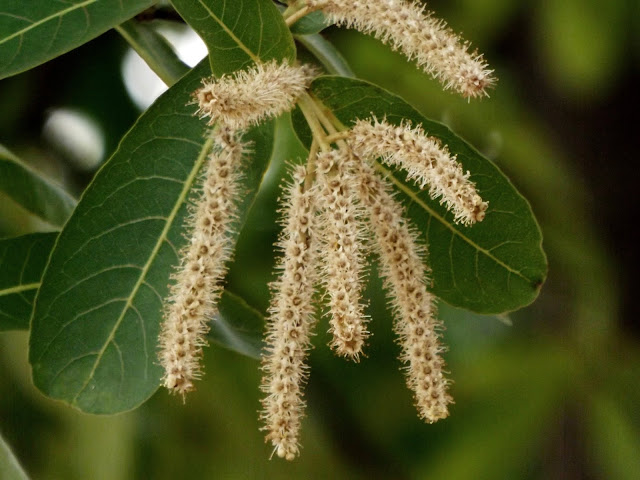
Image
Arjun or Arjuna ( Terminalia arjuna, family: Combretaceae) is a medium or large-sized deciduous tree, of about 20-25 m height, with numerous drooping branches and large canopy. Bark is thick, whitish grey, smooth and loose. Wood is hard. It has long been used as one of the most popular medicinal plants in the Indian subcontinent. The tree is native to Bangladesh as well as Indian subcontinent. It is also found in some countries of South and Southeast Asia. Common names:  Arjuna, Arjun tree. Leaves are simple, green, oblong and surprisingly conic, 10-20 cm long and 8-10 cm wide, sessile or less petioled, opposite, tip blunted. Flowers on spike inflorescence, are small and whitish yellow. Flowering occurs in April-May with the arrival of new leaves. Fruit is somewhat 5-angular and winged, woody, 2.5-3.5 cm long. Propagation is caused by seeds. Propagation is caused by seeds. Local herbalists and enthusiasts do not allow the trunk of this tree to remain intact in order to ...