Posts

Showing posts with the label flora_of_Bangladesh

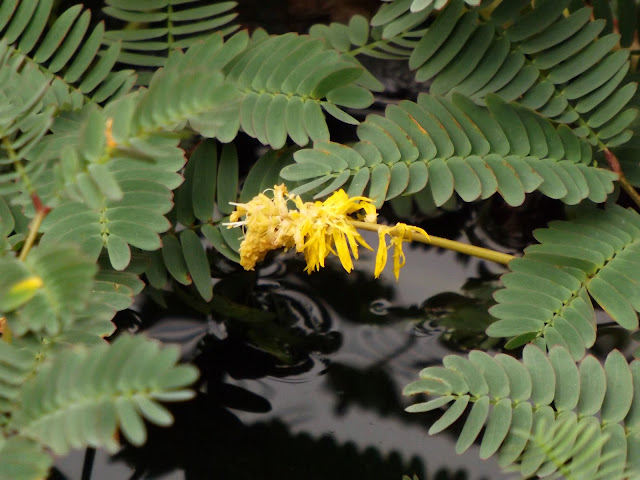
Pani najok or Water mimosa, Neptunia oleracea
Image
Pani najok or Water mimosa ( Neptunia oleracea ) is a creeping perennial aquatic herb, rooting at the nodes with spongy and slender stems, attaining a length of 2-3 m. The sensitive plant without prickles is found near or in water bodies, ditches, ponds and swamps all over Bangladesh sporadically. There are some doubts about the place of its origin. However, it has spread to both tropics. Other names: Pani lajok, Pani lojuk, Pani lojjaboti (Bang); Sensitive neptunia (Eng). Leaves are sensitive as other members of Mimosa, like Sensitive plant ( Mimosa pudica ). These are pinnately compound, petioled; leaflets 8-36, tiny, opposite.   Flowers are bright yellow, in pedunculated spike inflorescence, consisting of 30-50 flowers. Upper flowers are bisexual and lower flowers sterile. Flowering occurs at the end of rainy season. Fruits are pods, flat, 2-3 cm long, dehiscent; seeds 4-8, obovoid, compressed. It is propagated by seeds and vegetative parts. The plant is cultivated and c...

Jhunjhuni or Smooth crotalaria, Crotalaria pallida

Image
Jhunjhuni or Smooth crotalaria ( Crotalaria pallida , family: Fabaceae) is an annual or perennial erect herb with trifoliate leaves, attaining a height up to 2 m. Young branches are quadrangular, sometimes reddish, pubescent. When the dried fruits are shaken that make rattling sound. The Bangla name of the plant Jhunjhuni is derived from this special feature. It is found in croplands, grasslands, along roadsides and village thickets in Bangladesh. It is also found throughout the tropics. Other names: Jhonjhoni, Jhumjhumi, Jhunjhuna (Bang); Striped rattlepod, Ding ding (Eng). Leaves are trifoliate, light green; leaflets membranous, elliptic to elliptic-ovate, 3-7 cm long and 2-4 cm wide, upper part glabrous, lower puberulous, apex rounded or retuse. 20-30 flowers are in terminal or axillary inflorescence, erect, up to 30 cm long. Flowers are bright yellow with claw and reddish-brown lines along the veins on the outer sides. Flowering occurs in summer and it continues to late autumn. ...

Kularuki or Pouzolzia, Pouzolzia zeylanica

Image
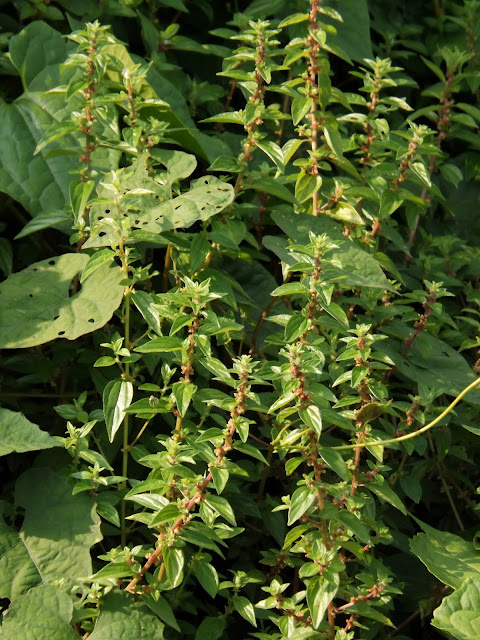
Kularuki or Pouzolzia ( Pouzolzia zeylanica , family: Urticaceae) is a soft but erect herb with soft hairs, upright branches and creeping basal part, attaining a height of 30-40 cm. Stem is multiangled and soft green, sometimes reddish. It is found almost everywhere in Bangladesh. It can be seen in village thickets, waterside area, crop fields and fallow lands. Outside of the country the perennial plant is found in Southeast Asia to Australia. It has been introduced in Central America nowadays.   Other name: Graceful Pouzolz's Bush. Leaves are short-petioled, upper part alternate, but opposite in lower part; broadly ovate or elliptic ovate, 1-5 cm long, entire with acute apex, base rounded or cordate. Flowers are monoecieous, in axillary globose clusters, greenish white, glabrous or slightly pubescent. Flowering occurs in the rainy season. Fruit an achene, ovoid or elliptic, 2 mm long, shinning black. The plant is propagated by seeds and cuttings.  As an medicinal plan...

Shada kolmi or Hogvine, Camonea umbellata

Image
Shada kolmi or  Hogvine ( Camonea umbellata , family : Convolvulaceae) is a extended twiner or trailer with milky latex and beautiful foliage. In Bangladesh, the woody vine is found in the districts of Dhaka, Gazipur, Rangamati, cox's Bazar, Jamalpur and Sylhet. It can be seen occupying a vast of area in waterside area, ditches and fallow lands or hanging on a tree in a huge shape. Outside the country it can be found from Indian subcontinent to Andaman Islands, and in Malaysia and Indo-China area. Other names: Bon kolmi, Din kolmi, Chata kolmi (Bang); Yellow merremia, Yellow wood rose (Eng). There is some variation in the size and shape of the leaves. These are quite different from those of other members of the Morning glory family. Its leaves are beutiful to look at. These are thin, almost glabrous, long-petioled; ovate, lanceolate or oblong, 4-7 cm long and 5-7 cm wide, base usually cordate but can be be found rounded sometimes, tip usually acuminate. Flowering occurs in the sp...

Bon nil or Wild indigo, Tephrosia purpurea

Image
Bon nil or Wild indigo ( Tephrosia purpurea , Family: Fabaceae) is an annual or biennial leafy and bushy herb or undershrub with spreading branches, attaining a height of .75-1 m. Branches are glabrous or slightly hairy. It is found in thickets and forests all over the country. It is also found in tropical Africa, Indian subcontinent, some countries of Southeast Asia and some parts of Australia.     Other names: Lohamari, Jongli nil, Buno nil (Bang); Purple tephrosia, Fish poison (Eng). Leaves are light green, pinnately compound, 6-10 cm long, leaflets 15-21, paripinnate or imparipinnate, opposite, ovate-oblanceolate, glabrous above, silky hairs bebeath. Flowers are Pea-like, 2-lipped, purple, 8-10 mm long, The corolla is two times longer than the calyx. 2-4 flowers in axillary inflorescence (6-18 cm long). It flowers in autumn (Sep-Nov). Fruit is legume, 4-6 cm long, linear, slightly curved at the top, dark brown when dry, dehiscent. Seeds are inedible, 5-9. Flowers a...

Tulsi or Sacred basil, Ocimum tenuiflorum

Image
Tulsi o r Sacred basil ( Ocimum tenuiflorum , family: Lamiaceae) is an odorous perennial herb or undershrub with many branches attaining a height of 1-1.5 m. Almost whole body of the plant is covered with hairs. Stem is woody, furrowed and quadrangular. Like many other herbs (Dhutra, Begun, Pepper) the plant can be purple. It is found everywhere in Bangladesh as a medicinal as well as sacred plant to Hindu community. It has spread across a huge global range, extending from the Arabian Peninsula to East Asia as well as Pacific Islands to Australia.  Other names: Kalo tulsi (Bang); Tulasi, Ajaka (Sans); Holy basil (Eng).  Leaves are strongly scented, green or purple, hairy, ovate-broadly elliptical, 2-5 cm long and 1-1.5 cm wide, opposite, irregularly dented, petiole 2-3 cm long.  Flowers are tiny, white or purplish, 3-8 on terminal inflorescence (12-25 cm long). Corolla bilabiate, petals 5, calyx divided into two parts, Stamens 4. It produces flower almost round the yea...

Kath-shola or Budda pea, Aeschynomene indica

Image
Kath-shola or Budda pea ( Aeschynomene indica , Family: Fabaceae) is a woddy annual or perennial erect undershrub with some narrow and slender branches and sensative leaves, attaining a height of 1 to 1.5 m. Stem is corky, greenish and glabrous. It loves to grow near the water bodies and in ditches, fallow lands and muddy soil in Bangladesh. It is also found throughout Asia. Other names: Shola (Bang); Indian jointvetch (Eng).  Leaves are light green, compound, bipinnate; blades 40-60, tiny, linear-oblong, alternate, petiole short, no veins except the midrib. In the absence of sunlight, the leaves curl up like most other members of Fabaceae. Flowering occurs in rainy season. These are in axillary raceme, 2-4, tiny, reddish yellow, 1-1.5 cm long. Sepals 5 with connecting 2-lipped calyx. Upper part of the calyx is entire, lower entire or 3-lobed. Corolla caducous, two times larger than calyx. Peduncle and pedicel are glutinous and slightly hairy.     Fruit is legume,...

Shonkorjota or Prishniparni, Uraria picta

Image
Shonkorjota or Prishniparni ( Uraria picta , family: Fabaceae) is a semi-woody erect herb with some velvety branches, attaining a height of 1-2 m. Its flowers and leaves are beautiful and bracts are stunning. The perennial undershrub is very importantly mentioned in the Ayurvedic scriptures as an medicinal plant. The plant itself is quite beautiful. It is found in fallow lands, village thickets and medicinal gardens in Bangladesh. Outside the country, it is found from some countries of tropical Africa and Asia to Australia.  The plant can be easily identified by its unique leaves. The midrib of blade has long white spot from the tip to the base, which is called variegated. However, complete green leaves may also be found in some plants of this species. These are linear-oblong, imparipinnate (solitary blade at the top of a pinna), 3-9 blades, firm and coriaceous, 8-20 cm long, base rounded, apex acute. The upper part is hairless, lower part covered with rough hairs. Petiole 3-6 cm...

Shilbhadi or Grey downy balsam, Garuga pinnata

Image
Shilbhadi or Grey downy balsam ( Garuga pinnat a, family: Burseraceae) is a medium to large-sized tree with rounded crown, attaining a height of 20-40 m. The bark of the deciduous tree is thick and grey or brown-colored. Young shoots are pubescent. Often mature trees have buttress roots. It is mainly found in the hilly forests of Sylhet and Chattogram division. Outside the country it can be seen in some countries of South and Southeast Asia. Other names: Bhadi, Nilbhadi, Jiolbhadi, Pahari jiga, Jum, Dabudabi. Leaves are compound, 12-35 cm long; leaflets 7-10 pairs, 8-10 cm long and 2-3 cm wide, short-petioled, opposite, ovate-lanceolate, dented, tip elongated and almost blunt. Young leaves are reddish. Leaves fall off in winter and new foliage arrives in spring.  Flowers appear in spring with the new foliage in large pubescent and compound panicle. These are tiny, yellowish, with tubular calyx. Flowers are 5-merous (petals and sepals number 5). Fruits are drupe, round, blackish ...

Lohakath or Burma Ironwood, Xylia xylocarpa

Image
Lohakath or Burma Ironwood ( Xylia xylocarpa , family: Fabaceae) is a large-sized deciduous tree with straight, cylindrical and huge trunk, attaining a height of 40 m. Its trunk can be up to 60 cm in diameter. Bark is rough and thick but brittle, brown-colored. Young shoots are covered with brown hair. Its wood is very hard, heavy and durable. Heartwood is reddish. It is found in the hilly forests, especially in greater Sylhet in Bangladesh. Outside the country the giant tree is found in India, Myanmar, Thailand, Cambodia and some countries of South and Southeast Asia.  Leaves are compound, leaflets per pinnae 5-7 pairs; leaflets elliptic-oblong, 3-15 cm long and 3-6 cm wide, shiny, green, short-petioled, opposite, tip pointed.   Flowers are scented, small, yellowish, on long peduncled heads. The bisexual flowers occur in March-April. Fruits are pods, 9-15 cm long, brownish, dehiscent, 6-10-seeded. Seeds are consumed as vegetable somewhere. Propagation of the plant is c...

Babla or Babul, Vachellia nilotica

Image
Babla or Babul ( Vachellia nilotica , family: Fabaceae) is medium-sized deciduous tree with profuse branches and spines, attaining a height of 15-20 m. Bark is grey. There are spines (3-4 cm long) and soft hairs in branches. Sapwood is hard and reddish white. The fast-growing tree is drought tolerant. Reddish gum comes out from its stem. Its pods also give gum. It is found mostly in the Northwest region of Bangladesh. Outside the country it is found in the tropical and suptropical areas of Africa and Asia. Other names: Thorny acacia, Gum arabic tree, Egyptian acacia, Thorn mimosa. Leaves are bipinnate, 10-20 leaflets in each pinnae, tiny, light green, pubescent. Flowers are bright yellow in axillary round head, 2.5-3 cm wide. Flowering occurs in summer. Fruits are pods (10-12 cm long) with whitish hairs. Seeds 8-12. The propagation of the plant is caused by seeds. It is used in diarrhoea, typhoid, spraining, malnutration and breast sore. Pods increase the flow of cow milk. Its sap i...