Posts

Showing posts with the label bisexual_flowers

Lohakath or Burma Ironwood, Xylia xylocarpa

Image
Lohakath or Burma Ironwood ( Xylia xylocarpa , family: Fabaceae) is a large-sized deciduous tree with straight, cylindrical and huge trunk, attaining a height of 40 m. Its trunk can be up to 60 cm in diameter. Bark is rough and thick but brittle, brown-colored. Young shoots are covered with brown hair. Its wood is very hard, heavy and durable. Heartwood is reddish. It is found in the hilly forests, especially in greater Sylhet in Bangladesh. Outside the country the giant tree is found in India, Myanmar, Thailand, Cambodia and some countries of South and Southeast Asia.  Leaves are compound, leaflets per pinnae 5-7 pairs; leaflets elliptic-oblong, 3-15 cm long and 3-6 cm wide, shiny, green, short-petioled, opposite, tip pointed.   Flowers are scented, small, yellowish, on long peduncled heads. The bisexual flowers occur in March-April. Fruits are pods, 9-15 cm long, brownish, dehiscent, 6-10-seeded. Seeds are consumed as vegetable somewhere. Propagation of the plant is c...
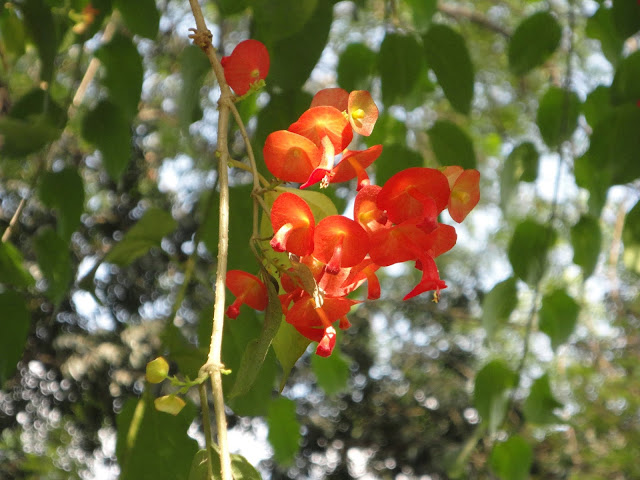
Chotro-pushpo or lady's umbrella, Holmskioldia sanguinea

Image
Chotro-pushpo or lady's umbrella ( Holmskioldia sanguinea , family: Verbenaceae) is a woody and creeping shrub with drooping branches. It looks a lot like Bougainvillea from a distance. Bark is grey and smooth. The flowers of the deciduous plant are so unique that it is easily recognizable. It is found in the hilly forests of Sylhet of Bangladesh. The shrub is a native species of the Indian subcontinent.  The other Bangla name of the plant is Kushumika. Leaves are pubescent, dark green, elliptic-lanceolate, round or subcordate at the base, 4-6 cm long, opposite, dented with elongated and pointed apex.    The corolla of the flower is tubular, 2 cm long, red in color. Calyx almost looks like a upper side of lady's umbrella or a Chinese hat, orange-colored. Bisexual flowers bloom throughout the year but these bloom in abundance in winter and spring.  Fruit is ovoid, 1 cm wide. Seeds 4. It is propagated by seeds and cuttings.  This...

Parul or Fragrant padri tree, Stereospermum chelonoides

Image
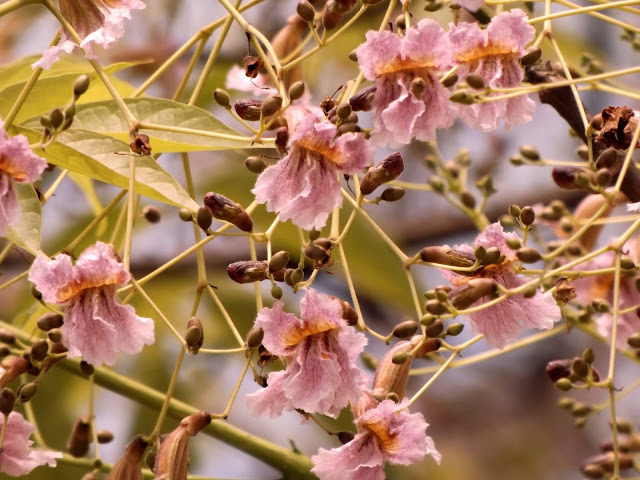
Parul or Fragrant padri tree ( Stereospermum chelonoides , family: Bignoniaceae) is a medium or large-sized deciduous tree with branches, attaining a height of 25 m. Young shoots are pubescent. Bark is grey.  About this flower, a kind of literary madness has been found for a long period of time among the Bengalees. Although it is mentioned numerous times in Bangla literature, the tree is quite difficult to find in Bangladesh.  The great news is, 5 of its trees are found in the courtyard of Bangladesh Security Printing Press School in Gajipur. India is the original home of the plant. Leaves are compound, 60 cm long; leaflets are entire, 5-11, deep green, glabrous, petioled, elliptic-oblong, 10-15 cm long and 3-6 cm wide, apex acuminate. Flowers are sweet-scented, purplish, yellow at center, campunulate, 3-5 cm long, curved at the base and bronze in color, on terminal panicle; corolla tubular with short petals, petals 5. Flower buds are black a...

Shomudro joba or Sea hibiscus, Talipariti tiliaceum

Image
Shomudro joba or Sea hibiscus ( Talipariti tiliaceum , family: Malvaceae) is a small bushy tree with many branches and nice curved canopy, attaining a height of  12-13 m. Trunk is grey with many reddish spots. Its roots do not go deep into the soil.  It is found in the coastal regions of Bangladesh. The evergreen plant is also found throughout the tropical and subtropical sea beaches of the world. It is salt-tolerant and can grow in water logging condition and on coral sands. Other names : Bhola, Bela, Bola, Chhelba (Bangla), Beach hibiscus (Eng.) Leaves are cordate with long petiole (up to 10 cm long); soft green in color, whitish green, tomentose below, alternate, coriacious, slightly dented, apex pointed, 8-15 cm long and 8-14 cm wide. Flowers are large, bisexual, 4-6 cm wide, eye-catching, beautiful, almost like Porosh pipul ( Thespesia populnea ) . They are solitary, axillary or terminal, funnel-shaped, yellow with blackish mark at the centre....

Bel or Wood apple, Eegle marmelos

Image
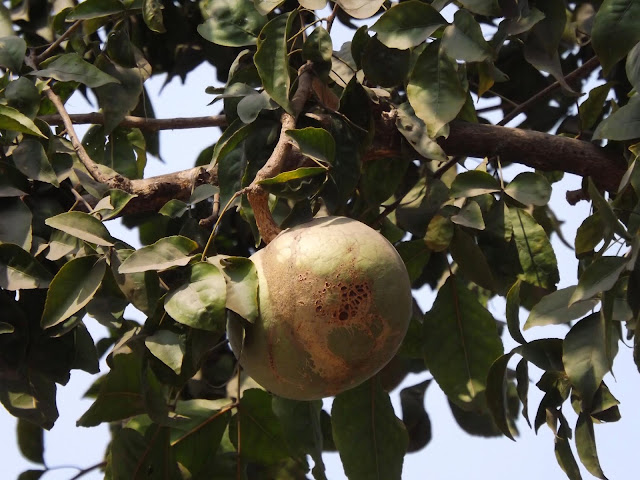
Bel or Wood apple ( Aegle marmelos , Rutaceae) is a spiny deciduous tree with many branches, attaining a height of 10-12 m. Bark is grey, soft. The tree has been regarded as sacred plant to Hindu community. The medium-sized tree is a very popular homestead tree.  It has been planted in Hindu temples in the subcontinent for thousand of years. The leafy tree can be planted by roads and highways and in park and gardens as an ornamental plant.  Leaves are tri-foliate, wild-scented, alternate, green. There are hard thorns at the bottom of leaves. Leaves fall off in summer. Leaflet is lanceolate, 8-10 cm long and 4-6 cm wide. Flowers are white with greenish touch, bisexual, sweet-scented. Petals 4, fleshy, calyx shortened, stamens numerous. Flowers bloom in March-May.  Fruits are round, big, woody, edible, sweet-scented. The fruit matures for almost 8 months after the flowering occurs. Propagation is by seeds. It has a valuable medicina...

Kajubadam or Cashew nut, Anacardium occidentale

Image
Kajubadam  or Cashew nut ( Anacardium occidentale , family: Anacardiaceae) is an evergreen medium-sized (30-40 feet) leafy tree with spreading branches. Stem is crooked. It is not indigenous in Bangladesh, though it has been planted in different parts of the country. Other names: Kaju, Hijli badam. Leaves are simple, green, 10-18 cm long and 6-10 cm wide, obovate, rough, entire, round at he end and narrow at the base. Flowers are small, yellowish brown, on terminal inflorescence. each cluster contains 400-1200 tiny flowers. Flower blooms in April-May. Male and bisexual flowers can be seen in a tree. Fruits are born from the bisexual flowers. Fruit is nutty drupe, kidney-shaped, about 2.5 cm long, grey, with hard cover. Immatures fruits are green, turns yellow and red when ripe. Seeds are found naked below the hanging fruits. Propagation is caused by sees and air layering. It is cultivated for its fruits. Ripe fruit is juicy and tastes good. It is...

Kath-badam, Bengal almond, Terminalia catappa

Image
Kaat-badam  or  Bengal almond ( Terminalia catappa , family: Combretaceae) is a large deciduous tree with spreading horizontal branches. It is found in the tropical Asia, Africa and Australia. Common names: Katbadam, Deshi badam, Bengal almond, Indian almond, Tropical almond. During winter the beautiful green leaves of terminalia catappa turn to red. Leaves are simple, 15-25 cm long and 8-15 cm wide, obcordate, alternate or whorled.  Flowers appear in the summer. Flowers are small, grey white, clustered on axillary or terminal spike. Flowers on the upper part of the inflorescence are male and those are on the lower part are bisexual.  Fruit is elliptical, 4-6 cm long, red when ripe.   The tree with nice canopy is planted in avenues and gardens as ornamental tree in Bangladesh. Propagation of the plant is caused by seeds.