Posts

Showing posts with the label bipinnate

Bon shupari or Fishtail palm, Caryota urens

Image
Bon shupari or F ishtail palm   ( Caryota urens , family: Arecaceae) is a straight trunked monocarpic palm tree attaining a height of 12 m. The plant is native to the hilly areas of South and Southeast Asia. In Bangladesh, it is found in the forest of Sylhet. It is cultivated as an ornamental and houseplant tree (when smaller) in Bangladesh, as well as the tropical and sub-tropical world.  Common names: Bon shupari, Chao-gota, Golshagu, Sago, Chaur, F ishtail palm, Jaggery palm The  one-seeded  fruit is a drupe, 1 cm, reddish or purple-colored.  From the axil of each giant leaf, about 3 m long hanging inflorescence is grown.  Flowers are  numerous, white in color, unisexual. The bipinnate and  triangular  shaped  leaves are deep green in color. The genus name of the species 'urens' is derived from the presence of stinging chemicals in the fruit. 

Jilapi Babul, Blackbeed tree, Pithecellobium dulce

Image
Jilapi Babul or Blackbeed tree ( Pithecellobium dulce , family: Leguminosae ) is a medium-sized evergreen tree with pofused branches and spreading crown.  The tree can reach a height of 10-15 m. Trunk is spiny. Bark is grey.  The tree is native to Americas. It is introduced to South and Southeast Asia.  Common names: Khoia babla, Jilapi babul,  Jilapi,  Dokkhini babul, Blackbeed tree, Manila tamarind. Leaves are bipinnate, each pinna has a single pair of ovate-oblong leaflets. Young leaves are brownish.  In Bangladesh  flower blooms in spring, They are small, fragrant, greenish-white, 1 cm in diameter, borne in globose head.  The edible fruit is a pod, 10-15 cm long. When ripe (in summer) it turns tightly-coiled shape and reddish-brown in color and this is the main characteristic of the tree.  Fruit tastes sweet and sour.  Seeds are shiny, black in color.  Leaves and raw fruits are used as...

Shirish or Lebbek tree, Albizia lebbeck

Image
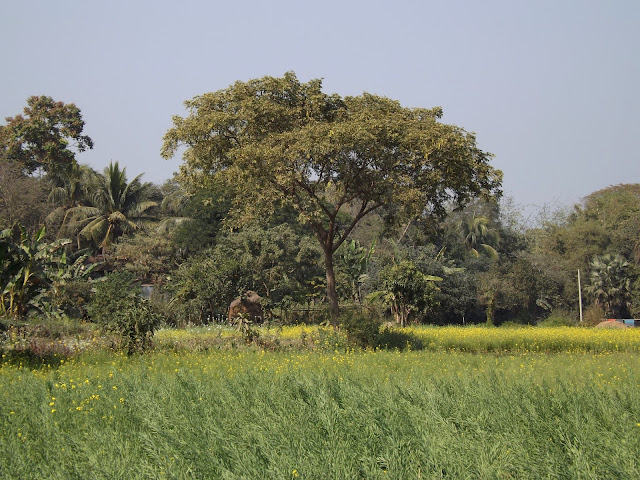
Shirish or Lebbek tree ( Albizia lebbeck , family: Fabaceae) is a large deciduous tree with spreading crown, attaining a height of 15-20 m. The black bark tree is native to Bangladesh as well as Southeast Asia and Australia. Common names: Shirish, Siris, Kalo koroi, Lebbek tree, Frywood. Leaves bipinnate with a large gland on the base of petiole, pinnae 2-5 pairs. Leaflets 2.5-4 cm long and 1.5-2 cm wide, ovate, oblong, pale green.  Flowers bloom in April-June.  Flowers are  very  fragrant,  greenish white, heads globose, containing many flowers. Stamens are longer than petals and sepals. The fruit is a legume, 12-30 cm long and 2-5 cm wide. It contains 6-12 seeds. Propagation of the plant is caused by seeds.  Albizia lebbeck is a  good timber tree, fast growing and suitable for a forestation.  Bark prevents skin diseases and leaf night blindness. It is also useful in tuberculosis, diarrhea and leprosy.