Posts

Showing posts with the label asteraceae

Namuti or Madras Carpet, Grangea maderaspatana
Image
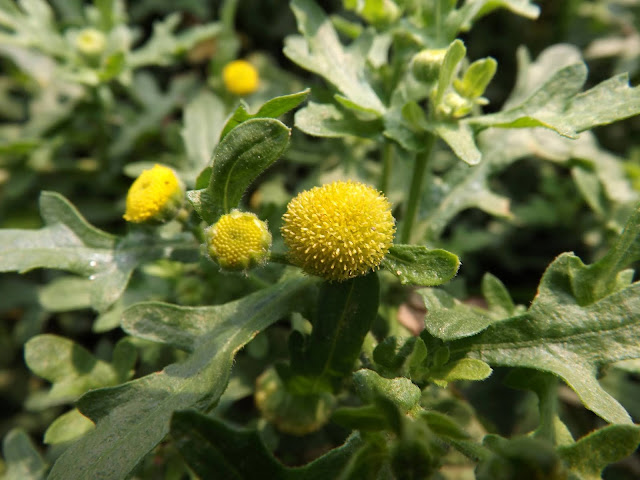
Namuti or Madras Carpet ( Grangea maderaspatana , family: Asteraceae) is an annual prostrate and aromatic herb with branches at the base and centre, extends from 15 to 30 cm. Branches and leaves are hairy. As a medicinal plant it is mentioned in Ayurveda. It grows mostly in moist places, crop fields, ditches, on fallow lands and beside the roads all over the country. It is also found in tropical and subtropical regions of the world. Other names: Guz, Nimuti, Holde nim, Shubeda ghash. Leaves are multilobed, thick, hairy, light green-colored, 3-10 cm long, opposite, sessile.  Flowers are small, yellow, borne on round peduncled head rising from leaf axil, disk flatened. Both male and female flowers are gathered on the same disc. Flowers bloom throughout the dry season (Dec-Apr).  Fruit is cypsela. The calyx turns into pappus and covers the fruit. Propagation of the plant is caused by seeds.  The juice of the leaves reduces ear pain, reduces abdominal pain and enhances eye...
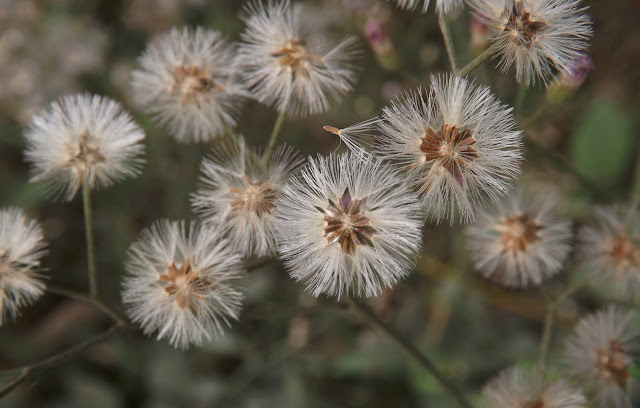
Kukshim or Little ironweed, Cyanthillium cinereum

Image
Kukshim or Little ironweed ( Cyanthillium cinereum , Family: Asteraceae) is a annual or perennial herb with aromatic branches and wooly hairs all over the body, attaining a height of 20-40 cm. The roots have a mixed scent of rose and sandalwood. The plant is found all over Bangladesh. The original home of the erect herb is tropical Asia and Africa. It is now widespread throughout the tropics. Other names:  Shohodebi, Choto kukshim, Dankuni (Bang); Ash-colored fleabane, Goat-weed (Eng). Leaves are dark green, petioled, oblanceolate or obovate, 2-6 cm long and 1-3 wide. Flowers are in composite inflorescence, violet or white, borne on peduncled head. The tiny flowers bloom all year round.  Fruits are achene, on globose or subglobose head. Seeds can easily propagated far and wide with the help of floating seeds. The plant is propagated by seeds. Leaf juice is bitter and used to kill intestinal worms. Leaf is also used in skin diseases. Flower is effective in fever, common ...

Boro shialmuti or Siam weed, Chromolaena odorata

Image
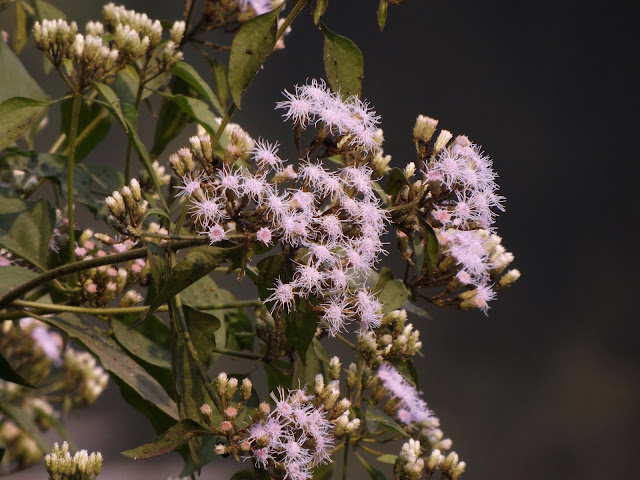
Boro shialmuti  or Siam weed ( Chromolaena odorata, family: Asteraceae) is a fast growing and highly reproductive perennial herb with many branches. In suitable condition, it can grow up to 10 m. Branches are hairy and glandular, stem woody. It grows in fallow land, in jungle and on the side of roads. It is regarded as an invasive plant round the globe. It has been said that, in Bangladesh, it escaped from the botanical gardens of Dhaka in the 19th centuary. It is originated in Americas, from USA to South America.  Leaves are green, triangular-ovate, 3-10 cm long, 2-5 cm wide, deeply dented with pointed end, opposite. The leaves give off a pungent scent when crushed. Bunch of flowers bloom in the shape of head. Flowers are small and light violet.   Fruits are round. Seeds are achenes, hairy. Propagation of the plant is caused by seeds. The seeds usually float in the air and travel long distances. However, it can go to different places through the body of  anim...

Kalokeshi or False daisy, Eclipta prostrata

Image
Kalokeshi or False daisy ( Eclipta prostrata , family: Asteraceae) is an annual erect herb with soft and slender stem, with reddish and hairy stem. The plant does not reach a height of more than 70 cm. It is found beside the roads, in cropfields and fallow lands in Bangladesh. It is originated mainly in South America. Other names:  Keshoraj, Keshoti, Keshkala, Kalokeshori. Leaves are simple, dark green, hairy, linear-lanceolate with serrated edge and pointed tip, opposite. Flowers are unisexual, white, borne on head, at the end of long peduncle rising from leaf exil. Fruits are cypsela, single-seeded, indehiscent. Propagation is caused by seeds. Flowers and fruits can be seen together on the same plant and these are seen round the year.   The plant is good for hair care. It prevents balding and blackens hair. It is also used in cut or bruise. The children play cooking games with these fruits as fake Cauliflower. 

Ghaghra or Bon okra, Xanthium strumarium

Image
Ghaghra or Bon okra ( Xanthium strumarium , family: Asteraceae) is an annual upright herb with rough hairs, attaining a height of 150 cm. Stem is black or brown-spotted and short with fewer branches. The plant is found everywhere in Bangladesh. Other names: Bicha-phol, Lehora, Khagra, Hagra, Choto khagra,  Leaves are hairy in in both parts, opposite, 5-12 cm long, triangular, dentate, almost look like Brinjal leaf; long-petioled.  Flowers are borne in disc inflorescence, terminally in pairs, whitish.  Fruits are ovoid, thorny and easily caught by clothes and bodies of animals. Each fruit contains two flattened black-seeds.  The plant produces flower in spring and fruits in the summer. Propagation of the plant is caused by seeds. It is grown in fallow land, in field and roadside. It boosts energy, sex potency, breast milk and cures blood dysentery, gonorrhea and rheumatism.  Roots taste bitter. Village doctor...

Keteli or Creeping thistle, Cricus arvensis

Image
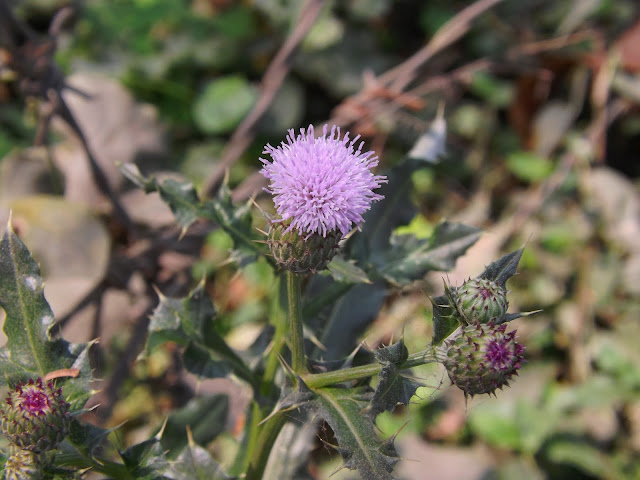
Keteli or Creeping thistle ( Cricus arvensis , family:  Asteraceae) is an erect perennial herb, attaining a height of 40-120 cm. It grows on cropland or on the edge of lands in Bangladesh. Its stem and leaves are covered with cobwebby hairs. Spiny leaves are simple, dented, unevenly wavy, sessile, usually 7-10 cm long and 1-3 cm wide. Other name: Kanta dudhley, Kanta kandailey, Shilkanta, Logakanta. Flowers are small, pink, borne on head. Single flower is soft as a feather. Male and female flowers bloom on separate inflorescences. The infloresence bearing male flowers is round and the one bearing female flowers is oblong. The fruit is an achene, having brown pappus and looking glaucous and glabrous. Mature seeds are cotton-like fiber which can spread far and wide.  It is mostly found in the rural areas of the country. By the by, the flowering time of the plant is spring.

Asam lota or Bitter vine, Mikania micrantha

Image
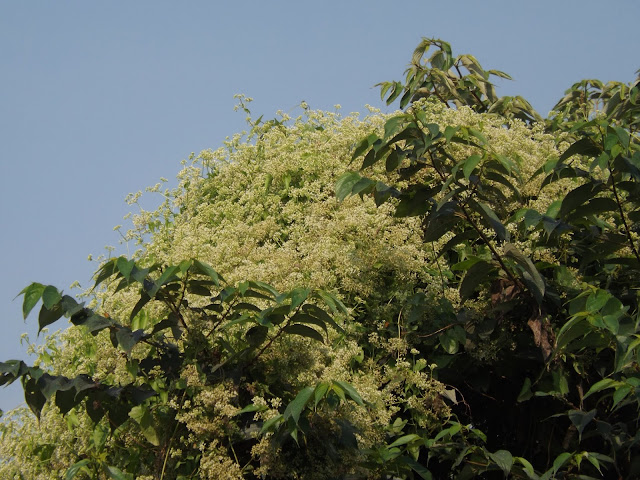
Asam lota or   Bitter vine ( Mikania micrantha , family: Asteraceae) is a perennial extensive climber.  It can be easily found in fallow lands, crop fields and roadside areas in Bangladesh.  It is an invasive species. Usually with the help of a tree it climbed up. In case of small tree it does serious damage. Other names: Bharoti-lota,  Rabon lota, Tara-lota.  Leaves are opposite, green, ovate to cordate, edge sometimes uneven, sometimes wavy, petiole long, sometimes dark green, sometimes pale.  The size of the vine or its leaves differ on the basis of soil fertility. Branched inflorescence comes out from leaf axil. Flower is white or pale white. Each branch contains three to four white flowers.  Numerous branches occurs together. Therefore, the flower cluster seems quite large.  It spreads quickly in rainy season. So it causes serious damage to crops then. Especially it does a great damage to Sal f...