Posts

Showing posts with the label Peduncle

Shonkorjota or Prishniparni, Uraria picta

Image
Shonkorjota or Prishniparni ( Uraria picta , family: Fabaceae) is a semi-woody erect herb with some velvety branches, attaining a height of 1-2 m. Its flowers and leaves are beautiful and bracts are stunning. The perennial undershrub is very importantly mentioned in the Ayurvedic scriptures as an medicinal plant. The plant itself is quite beautiful. It is found in fallow lands, village thickets and medicinal gardens in Bangladesh. Outside the country, it is found from some countries of tropical Africa and Asia to Australia.  The plant can be easily identified by its unique leaves. The midrib of blade has long white spot from the tip to the base, which is called variegated. However, complete green leaves may also be found in some plants of this species. These are linear-oblong, imparipinnate (solitary blade at the top of a pinna), 3-9 blades, firm and coriaceous, 8-20 cm long, base rounded, apex acute. The upper part is hairless, lower part covered with rough hairs. Petiole 3-6 cm...

Kathal or Jack fruit, Artocarpus heterophyllus

Image
Kathal or Jack fruit ( Artocarpus heterophyllus , family: Moraceae) is a medium-sized leafy tree with many branches. It is the national fruit of Bangladesh as well as Sri Lanka. The fruits are unique in taste, well-smelled, nice-colored and juicy too.  It is one of the most largest fruits of the world. The evergreen tree has milky latex all over its body. The bark of the tree is rough and sometimes it removes scale. Bangladesh and India are the original home of the plant. The leaves are entire, having bract, ovoid, 15-20 cm long and 10-12 cm wide, alternate, apex acute, coriacious; veins and midribs are clearly visible and those are stout too. Flowering occurs in December and it continues to March. Flowers borne on spike inflorescence and those are covered with two bracts. In the same tree, the female and male flowers are seen differently. From the main branch of the tree, the female flowers appear. The peduncle, ovary and perianth, all of them...

Panikola or Duck lettuce, Ottelia alismoides

Image
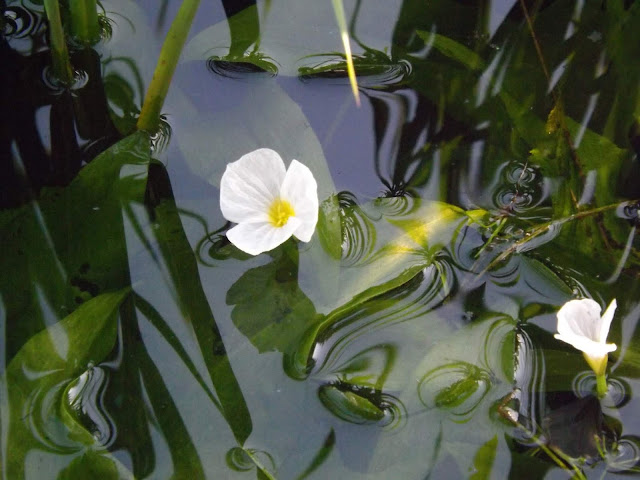
Panikola or Duck lettuce ( Ottelia alismoides, family: Hydrocharitaceae) is an annual submerged herb grows in the paddy fields and at the edge of water bodies. The short-stemmed aquatic plant prefers shallow water bodies and can survive in strong light. Its roots along with rhizome are ingrained in soil. It is found in the tropical and subtropical Asia, Africa and Australia. Other Bangla names              Ram korola, Kaobali, Torukola, Shyamkola, Kuchkolai, Jol-kolosh, Pani-kolosh, Jol-kola. Leaves grow up with the rise in water level. Size and shape of the leaves are different. They are usually oblong-cordate, slightly clear, fragile, edge undulate. The size of the petiole depends on the level of water too. It generally gets a length of 10-20 cm. Peduncle comes out from the rhizome.  The flower is covered with green spathes in early stage. Mature flower stands erectly on the water. Flower is white or light violet. S...

Maloncho or Alligator weed, Alternanthera philoxeroides

Image
Maloncho or Alligator weed (A lternanthera philoxeroides , Amaranthaceae) is an aquatic or semi-aquatic perennial herb rooting at nodes. Stem is juicy, slender and hollow. So the plant can easily float on the water.  Other names: Heycha, Hechi-shak, Burma-shak, Bormi-shak. Though the floating plant is found everywhere in Bangladesh, surprisingly it is native to Brazil. In the far past it has been introduced to the subcontinent and Southeast Asia. Flowers are very small, white, on head inflorescence, petals 5. Peduncle is very long.  Leaves are green, slightly serrated, linear, elliptic-lanceolate, 3-8 cm long, opposite, acute at the end. Fruit an utricle, ovoid-orbicular or obcordate. Seed is inverse, lenticular, single-seeded. Flowering occurs in the rainy season. Propagation is caused by cutting or seeds. It grows in damp places, near pond and canal etc. Leaves are eaten as vegetables. It is energizing, emollient and reputed ...

Dholshomudro or Elephant ear, Leea macrophylla

Image
Dholshomudro or Elephant ear ( Leea macrophylla , family : Vitaceae) is an annual rhizomatous herb with large green leaves. The height of the plant is barely a meter. It can be usually seen in the edge of the forest, especially in Chottogram and Chottogram Hill Tracts of Bangladesh. Dented leaves are gigantic, beautiful to see; simple, ovate, cordate at base, apex acuminate, 20-60 cm long and 10.16-45 cm wide, edge undulated. Veins and midribs are clearly visible. Petioles are thick and hollow, 10-15 cm long.   It blooms in June-July.  At the tip of the twig is borne large cyme inflorescence with huge number of flowers.  Peduncle 30 cm tall.  Flowers are small, soft, whitish, sepals 5, petals 5. Fruits are also small, globose, tapered, .smooth, 4-6-lobed, 6-1 cm in diameter. Juveniles are green, matures are blackish.  Young leaves are eaten as vegetables. Color can be made from the roots. Power of roots is anti...