Posts

Showing posts with the label Myanmar

Dunil or Koya-jarul, Premna bengalensis

Image
Dunil or Koya-jarul ( Premna bengalensis , famliy: Lamiaceae) is a medium-sized evergreen tree often with fluted trunk and somewhat quadrangular branches and shoots. Its stem, reddish young shoots, leaves and inflorescence are stellately tomentosed. Bark is ashy-grey and it removes papery flakes from its body. The geographical extent of the plant is not so large. It is found in hilly and plain lands of Bangladesh as well as India, Nepal, Vietnam and Myanmar.  Other local names: Pakirhara, Pakhir-har, Aholauja, Phongta. Leaves are simple, thin, shiny and light green, coriaceous, elliptic to ovate-oblong, 8-24 cm long and 4-10 cm wide, petioled, usually entire, sometimes irregularly dented, tip acuminated, opposite.  Flowering occurs in May-September. Tiny flowers are borne in large terminal inflorescence. These are bisexual, greenish white, white or yellowish with 2-lipped corolla, calyx tubular, 4-5-lobed.  Fruit is a drupe, round, 4-5 mm in diameter, it turns black whe...

Lohakath or Burma Ironwood, Xylia xylocarpa

Image
Lohakath or Burma Ironwood ( Xylia xylocarpa , family: Fabaceae) is a large-sized deciduous tree with straight, cylindrical and huge trunk, attaining a height of 40 m. Its trunk can be up to 60 cm in diameter. Bark is rough and thick but brittle, brown-colored. Young shoots are covered with brown hair. Its wood is very hard, heavy and durable. Heartwood is reddish. It is found in the hilly forests, especially in greater Sylhet in Bangladesh. Outside the country the giant tree is found in India, Myanmar, Thailand, Cambodia and some countries of South and Southeast Asia.  Leaves are compound, leaflets per pinnae 5-7 pairs; leaflets elliptic-oblong, 3-15 cm long and 3-6 cm wide, shiny, green, short-petioled, opposite, tip pointed.   Flowers are scented, small, yellowish, on long peduncled heads. The bisexual flowers occur in March-April. Fruits are pods, 9-15 cm long, brownish, dehiscent, 6-10-seeded. Seeds are consumed as vegetable somewhere. Propagation of the plant is c...

Choto betmara or Choto birmala, Calliandra umbrosa

Image
Choto betmara or Choto birmal a ( Calliandra umbrosa , family: Mimosaceae) is a small-sized deciduous tree with narrow and drooping branches, attaining a height of 3 m. It is found at the foot hills and near streams in Chattogram and Chattogram Hill Tracts of Bangladesh. It is also found in Eastern India, Myanmar, China as well as few countries of Southeast Asia. Leaves are large, elliptic-oblong, glabrous, slighty leathery, 3-14 cm long and 3-5 cm, sessile, apex acute or blunted. Pinnae 2, each has 2 leaves but sometimes a smaller one may be present. Stipules 2, tiny. Flowers are usually in globose head, axillary or on old wood, small, white, with numerous stames like other members of Calliandra genus; filaments white. Female and male flowers look similar. It blooms in the rainy season to autumn. [Pure-shaped (Calliandra-looking) flowers were not found due to rain] Fruit is pod, flattened, dark brown, 8-15 cm long and 2-3 cm wide, dehiscent. Seeds 4. When wood is burned, it gives off...

Raj oshok or Pride of Burma, Amherstia nobilis

Image
Raj oshok or Pride of Burma ( Amherstia nobilis , family: Caesalpiniaceae) is an evergreen medium-sized tree with branches, attaining a height of 10-15 m. The slow-growing tree looks like its family member Ashoka . The plant is originated in Myanmar. It is found in the Hill Tracts of Chattogram in Bangladesh as well as some countries of Southeast Asia. It is grown in gardens, parks, botanical gardens and along roadsides for its extraordinary shape of flowers.  Common names: Queen of flowers, Queen of flowering trees, Burma flower, Amherstia, Shokrey.  Leaves are compound, rachis 30-45 cm long. Leaflet is lanceolate, 10-15 cm long. Young leaves with various beautiful shades of pink, copper, mauve or purple hanging loosely from the end of branches, turn bright green on becoming firm.  The hanging inflorescence is spectacular, quite long, 50-75 cm. The flower at the base of the inflorescence blooms first, then the later ones gradually. Flower is bright red-yellow, sepals ...

Congea or Wooly congea, Congea tomentosa

Image
Congea or Wooly congea ( Congea tomentosa , family: Lamiaceae) is a woody and extensive creeper, covering with shaggy hair in young shoots and branches. Its beauty during the flowering season is so unique that it surpasses many other plants in the garden. This beauty is mainly for its surprising and unique bractioles.  Although it is not indigenous to Bangladesh but it is originated in neighboring India, Myanmar and Malaysia as well some of the countries of Southeast Asia. In Bangladesh it is found in parks and botanical gardens as an ornamental plant. Leaves are simple, 10-12 cm long and 5-10 cm wide, entire, short petioled, opposite, ovate-lanceolate. There are dense hairs on both sides of the leaf, more on the underside. Rough branch of the inflorescence bears 3-9 flowers. There are small velvety bracts at the bottom of the inflorescence and three bractioles at the top of it, taking the shape of the cup. Sepals 5, bilabiate, tubular, with dense hair. S...

Padauk or Malay padauk, Pterocarpus indicus

Image
Padauk or Malay padauk ( Pterocarpus indicus, family: Fabaceae) is a large deciduous tree with spreading and drooping branches, attaining a height of 20-40 m. Bark is almost smooth and grey. In early summer the tree floods its entire body with yellow flowers. But those only last for one day. The next day there are no flowers left on the tree. It is found in the hilly areas of Chottogram Division. It is also found in Myanmar, India, Malaysia as well as other Southeast Asian countries. Leaves are imparipinnate (having single leaflet at the pinnate's end), glossy green, oval-lanceolate, undulate. Leaflet is 5-9, 8-10 cm long and 4-6 cm wide.  Flowers are highly scented. Those are small, in terminal inflorescence, yellow-colored. It blooms 3 times a year.  Fruit is round and flat, papery, 3-5 cm wide, indehiscent, single-seeded. It has feather, and because of this it can float in the air and spread far and wide. Propagation is caused by seeds and c...

Bokul or Medlar, Mimusops elengi

Image
Bokul or Medlar ( Mimusops elengi , family: Sapotaceae) is a medium-sized evergeeen tree with dome-shaped crown, attaining a height of 10-15 cm. Trunk is grey, rough and round with spreading branches. Indian subcontinent and Myanmar is the home of the tree. Common names:  Bullet wood, Spanish cherry. Leaves are alternate, wavy-ended, shiny green above and pale green underneath, elliptic, 8-10 cm and and 4-7 cm wide. New leaves come out in spring. Flowers are borne in axillary clusters, 1-6 in a bunch, each flower 1.5 cm in diameter. Sepals 5 but petals numerous. Flowers are small, very fragrant, white in color. Its scent is retained even if it dries. Flowering starts from summer and continues up to autumn. Fruits are oval-shaped, red or orange in color, 2-3 cm long; . 1-2-seeded. Flowers and fruits can be seen at a time.  Propagation of the plant is caused by seeds. It is a suitable tree fot roadside plantation. Its huge canopy provides p...

Boga or White tephrosia, Tephrosia candida

Image
Boga or White tephrosia ( Tephrosia candida , Fabaceae) is an erect shrub with branches attaining a height of 4 m. Upright branches grow from the stem base. Woody stem is velvety, greyish. In Bangladesh, it is found in the tea gardens of Moulovibazar and in parks and botanical gardens.  Other names:   Medla, Bogui. Leaves are pale green, compound, pinnate; leaflets 9-11 pairs, opposite. Flowers are borne in terminal or axillary Inflorescences, 20-40 cm long. Flowers are are brilliant white, sometimes yellow or pink; petals clawed, round, wings ovate, sightly adnate, 2-2.5 cm long and 1 cm wide. Calix is bell-shaped. Flowering season is autumn. The species name 'Candida' is kept due to its pure white-colored flowers. Fruits are like beans, linear, covered with brown hair, 8-15 cm long and 1 cm wide; dehiscent, 8-15-seeded. Flowers and fruits can be seen at a time. Propagation is caused by seeds. Leaves are used for relief from cough and as...

Boro bet, Osier-like rattan palm, Calamaus viminalis

Image
Boro bet or Osier-like rattan palm ( Calamaus viminalis , family: Araceae) is a clump forming spiny large creeper, occasionally takes the form of bushes. Spines are flat and very long. By the support of other plants it climbs. Stem is slender, like most of the canes; brownish and covered with thorny sheath.  It is found mainly in the hill slopes of Chottogram, Chottogram Hill Tracts and Sylhet. It is also found in the Sal forests of Bangladesh. It has spiny climbing stem or tendrils to climb on; that will be 2-3 m long. Leaf sheath whitish green, pubescent, densely covered with hook-like stout spines. Rachis 1-2 m long. Leaflets are green, lanceolate, 30-55 in per side, alternate. In Sal forest of Gajipur Inflorescence is very long, 2-3 m, flagellate. Male and female flowers are borne in different inflorescence; female is shorter than male. Fruits appear in cluster; berry, usually globose, yellowish or whitish, almost 1 cm in diameter, pointed ...

Koinari or Golden gardenia, Gardenia coronaria

Image
Koinari or Golden gardenia  ( Gardenia coronaria , family: Rubiaceae) is a medium-sized deciduous tree with profuse branches at the top. The tree can get a height of  12-15 m. It is found in the hilly areas of Sylhet, Chottogram and Chottogram Hill Tracts of Bangladesh.  Leaves are simple, glossy green, oblong-lanceolate, 10-20 cm long, short-petioled, 3-5 opposite leaves at the top of the branchlets. Veins and midrib are stout in texture. Flowers are yellow, very fragrant, showy, 5-7 cm across, petals 5, having long tube, calyx tubular too. Flower blooms at the spring. Fruit appears single or in a pair, 2-5 cm long, 5-angled. The plant is propagated by seeds. The tree, despite being quite beautiful not so popular in our country. Its wood is used as firewood. The inside of the fruit is eaten by the children. It is found abundantly in India and Myanmar. It is grown in the parks and botanical gardens in the country.  

Modhu-monjori ori Rangoon creeper, Combretum indicum

Image
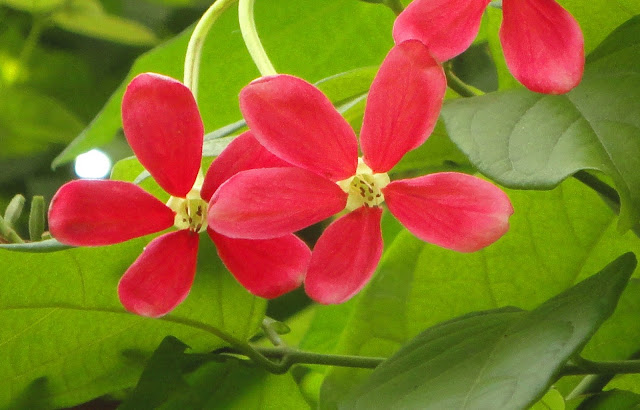
Modhu-monjori or Rangoon creeper (C ombretum indicum , family: Combretaceae) is a extensive woody perennial creeper with red flower clusters. The ornamental vine is native to South and Southeast Asia, specially to Indian subcontinent and Myanmar. The woody climber can reach a length up to 8 m. Common names: Modhu-monjori, Madhuri-lota, Rangoon creeper, Chinese honeysuckle. Flowers are originally red, slightly scented, corolla tubular, petals 5. Flowers bloom mainly in summer and rains.  Leaves are green, rough, opposite, ovate, apex acuminate, edge wavy, 6-14 cm long and 3-6 cm wide.  With the change of time the white flower becomes pink and then it turns red. Fruits are elliptical, 5-winged, dark brown in color.  The Bangla name of the flower (Modhu-monjori) is named by Rabindranath Tagore. It is grown in garden  as ornamental flower plant in Bangladesh. Leaves, roots and seeds are used in skin disease, worm, stomach disorder, ...