Posts

Showing posts with the label Malaysia

Congea or Wooly congea, Congea tomentosa

Image
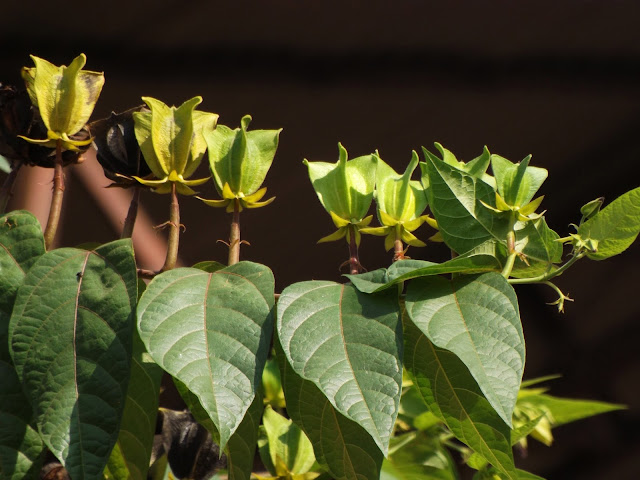
Congea or Wooly congea ( Congea tomentosa , family: Lamiaceae) is a woody and extensive creeper, covering with shaggy hair in young shoots and branches. Its beauty during the flowering season is so unique that it surpasses many other plants in the garden. This beauty is mainly for its surprising and unique bractioles.  Although it is not indigenous to Bangladesh but it is originated in neighboring India, Myanmar and Malaysia as well some of the countries of Southeast Asia. In Bangladesh it is found in parks and botanical gardens as an ornamental plant. Leaves are simple, 10-12 cm long and 5-10 cm wide, entire, short petioled, opposite, ovate-lanceolate. There are dense hairs on both sides of the leaf, more on the underside. Rough branch of the inflorescence bears 3-9 flowers. There are small velvety bracts at the bottom of the inflorescence and three bractioles at the top of it, taking the shape of the cup. Sepals 5, bilabiate, tubular, with dense hair. S...

Padauk or Malay padauk, Pterocarpus indicus

Image
Padauk or Malay padauk ( Pterocarpus indicus, family: Fabaceae) is a large deciduous tree with spreading and drooping branches, attaining a height of 20-40 m. Bark is almost smooth and grey. In early summer the tree floods its entire body with yellow flowers. But those only last for one day. The next day there are no flowers left on the tree. It is found in the hilly areas of Chottogram Division. It is also found in Myanmar, India, Malaysia as well as other Southeast Asian countries. Leaves are imparipinnate (having single leaflet at the pinnate's end), glossy green, oval-lanceolate, undulate. Leaflet is 5-9, 8-10 cm long and 4-6 cm wide.  Flowers are highly scented. Those are small, in terminal inflorescence, yellow-colored. It blooms 3 times a year.  Fruit is round and flat, papery, 3-5 cm wide, indehiscent, single-seeded. It has feather, and because of this it can float in the air and spread far and wide. Propagation is caused by seeds and c...

Kajuput or Weeping paperbark, Melaleuca leucadendra

Image
Kajuput or Weeping paperbark ( Melaleuca leucadendra , family: Myrtaceae) is a medium-sized evergreen tree with narrow and drooping branches, up to 30 m. in height. Bark is thick and white and it has papery scales all over its body. It relieves papery scales all the year round. The beautiful tree is native to Malaysia, Indonesia, Papua New Guinea & Australia. The exotic tree is planted in Parks and botanical gardens in Bangladesh.   Leaves are linear, lanceolate, light green, 10-15 cm long & 1-2 cm wide. Flowers are borne in spike florescence, florets are small, sessile, creamy white, 8-15 cm long. Flowers bloom in June-July. Fruit is capsule with thin skin. Seeds numerous.  The flowers and fruits are very much like a Bottlebrush . Propagation is by seeds and cuttings. It is difficult to collect seedlings from the sown seeds; it probably needs the help of a special fungus. Its bark's juice is used as germicide. Oil made fr...

Bokphul or Vegetable hummingbird, Sesbania grandiflora

Image
Bokphul or Vegetable hummingbird ( Sesbania grandiflora , family: Fabaceae) is a small soft-wooded tree with spreading branches, attaining a height of 10 m. Trunk is straight and tall, brownish and smooth. It is found in Madhupur forest of the country. The deciduous tree is grown in homestead and in parks and gardens for its outstanding eye-catching flowers. The tree itself  is a beautiful one. Leaves are paripinnate, 10-25 pairs of leaflets perpinnae. Leaflets are small, linear, light green, 2-4 cm long. Inflorescence is short axillary raceme. Flowers are red, white or light pink, ending portion is curved, like Heron's beak. It blooms profusely from September to November but found almost throughout the year in limited range. Fruit is linear pod with 30 seeds; almost a metre long, dehiscent. The plant is propagated by seeds. The whole plant is used as medicine. Bark is used as tonic and to prevent chicken pox. Root is used in rheumatism and gonorrh...

Shupari, Betel nut or Areca nut, Areca catechu

Image
Shupari , Betel nut or Areca nut  ( Areca catechu , family: Arecaceae) is an evergreen palm tree attaining a height of 45 m. It is one of the major cash crops in Bangladesh. It is cultivated extensively in the coastal areas of the country.  In Indian subcontinent, its fruit is eaten with the Betel leaf as daily food. It is found in almost every home in the village area. Like any other palm tree, it is also quite a beautiful one. The tree is planted with rows as a decorative tree in gardens and parks. The tree can survive for almost 50 years. There are many gray-colored rings in its green trunk. Its leaves are closely packed together at the top of the tree like all other palms. There are 70-80 leaves in every pinnae. The leaves fall within a year. Flowers are produced in the spadix-like particle. Numerous brown and sweet-scented flowers are gathered in this type of inflorescence. Immature fruits are of green color. Ripe fruits are yellow, orange or ...

Konokchura, peltophorum pterocarpum

Image
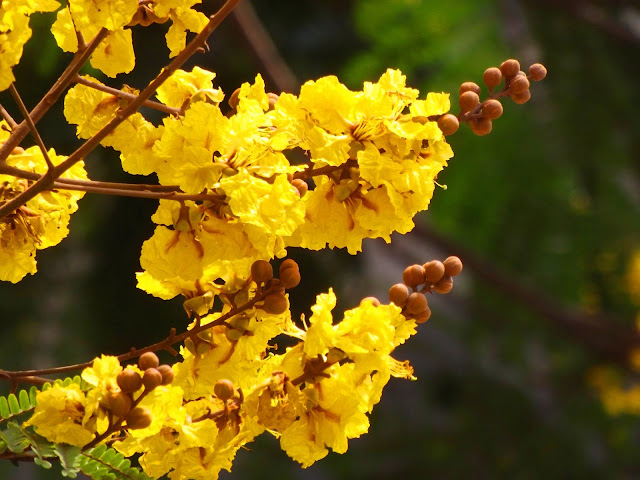
Konokchura (Peltophorum pterocarpum, family : fabaceae) is a medium-sized deciduous tree with profuse foliage, reaching up to 18 m in height. Its main trunk is steep, gray and smooth. The branches are divided into many parts, densely adjusted and shadowy. Dark green leaves are small, elliptic, pinnately compound, rachis 30-45 cm long. In summer, full canopy cover with yellow flowers. Flowers are brilliant yellow, clustered on terminal inflorescence. Sepal 5, petals 5. Flowers are very fragrant. The fruit is flattened, copper-colored, a lot like a shield, long lasting. Propagation of the plant is caused by seeds. Saplings can be easily made from seeds. Its original home is Andaman Archipelago, Sri Lanka, Malaysia and Australia. It is a fast growing tree. So it is suitable for planting as a flower tree. It is planted in gardens and on roadside as an ornamental tree in Bangladesh. The tree is seen in the roads and parks in Dhaka.  Its log is use...

Ulotkombol or Cotton Abroma, Abroma augustum

Image
Ulotkombol or  Cotton Abroma  ( Abroma augustum (family: Sterculiaceae) is a shrub that can reach a height up to 5 m. Entire plant is hairy.  It is very remarkable about this plant that its flowers are basipetal bur fruits are positioned upward!   The beautiful plant is evergreen. It can be easily kept as an ornamental shrub in tropical gardens. In Bangladesh it is found in fallow land.  The plant is one of the most favourite medicinal plants in Indian subcontinent.                                                                                      Common names: Ulot-kombol, Cotton Abroma. Flowers are deep megenta. Petals 5. Flowers bloom in July-September.  Leaves are simple, long petioled, about 20 cm long; cordate or broad...

Holud hurhuri, Asian spider flower, Cleome viscosa

Image
Holud hurhuri  or Asian spider flower ( Cleome viscosa , family: Cleomaceae) is a small-sized annual herb with branches, up to 1 mm in height. The herb is native to tropical Africa, tropical Australia, Malaysia and South Arabia. It has become introduced in South Asia.  Common names: Holud hurhuri,  Asian spider flower, Dog mustard, Yellow Spider Flower, Wild mustard, Sticky cleome. Leaves are palmately compound, leaflets 3-5, odorous, glandular, hairy, viscose, elliptical-ovate, 1-4 cm long. Flowers are pale yellow, on axillary raceme. Sepals 4, 3-6 mm long, hairy and glandular, petals 4 and 8-15 mm long, stamens numerous and 4-8 mm long.  The plant produces flower from January t o  June.  Fruit is 4-7 mm long, viscose and hairy; seed dark brown to black. Leaves are used in paratyphoid, dysentery, bronchitis, gonorrhea, ear-sore and  external application to wounds and ulcers. The seeds are anthelmintic and carminative...

Tomal or Mountain persimmon, Diospyros cordifolia

Image
Tomal  or  Mountain persimmon  ( Diospyros cordifolia,  family: Ebenaceae) is a deciduous small to medium-sized tree with spreading branches and blackish bark, sometimes thorny. This beautiful tree is native to Malaysia, Myanmar, Australia and is introduced to Bangladesh and other subcontinent countries. Not yellow, but black is the ripe fruit! Leaves are simple green, glabrous, petioled, alternate, lanceolate-cordate 5-10 cm long and 2-4 cm wide.  Flowers are small, whitish, with 4 petals. January-February is the flowering time. Male and female flowers usually grow singly from leaf axil while the male ones bloom in cluster on cyme inflorescence.  Poisonous fruit is berry, round,  fleshy  2.5 cm across. Half-matured fruits are ye llow and they turn purplish black when fully ripe. Propagation of the plant is caused by seeds. As a medicinal plant diospyros cordifolia is used in the treatment of fever, pneumo...