Posts

Showing posts with the label Aerial_roots

Keora or Mangrove apple, Sonneratia apetala

Image
Keora or Mangrove apple (S onneratia apetala , family: Lythraceae) is a medium-sized evergreen tree with aerial roots and drooping branches, attaining a height of 15 m. The bark of the mangrove tree is black and smooth. Needless to say, the leafy tree is salt tolerant. The fast growing tree is found through the tidal forests of Bangladesh, Myanmar and India.   Leaves are simple, 5-10 cm long and 2.5-5 cm wide, oblong-lanceolate, coriacous, shinny, tapering at the end, short-petioled. Flowers are greenish white, terminal, single to 3-5 flowers, petal-less, articled with cup-shaped sepal, divided into 4 parts; pedicel long; stamens numerous, style is very much projected from the flower. Flowering occurs from March-August. Fruit is big in size, round-shaped, crowned with persistent sepals. Surprisingly true, seeds germinate on the tree. In fact, the tree is located in the water or in waterside area. So she had to take this kind of act...

Rubber bot or Indian rubber, Ficus elastica

Image
Rubber bot or Indian rubber ( Ficus elastica , family: Moraceae) is a medium or large evergreen tree with aerial prop roots grow from its branches. The fig tree with milky latex in its leaves and shoots can get a height of more than 30 meters. The trunk is smooth, black-colored and has very tiny whitish spots. This tree is well-known as an ornamental plant. In Bangladesh, it is found on roadside area or the edge of forest and in parks and gardens. The beautiful tree is native to South and Southeast Asia. Leaves are spectacular, simple, big, leathery, deep green, sometimes deep purplish, shiny and smooth, elliptic-ovate, 12-30 cm long and 5-12 cm wide, petioled, alternate, acuminate at the top. Florets remain inside the fruit or fig which cannot be seen from outside. Fruiting occurs in the late spring. Fruits develop in the nodes of  the Fruits. They usually round, sometimes slender in shape. Mature fruits are yellow or red in color. The plant is propagate...

Guloncho, Heart-leaved moonseed, Tinospora cordifolia

Image
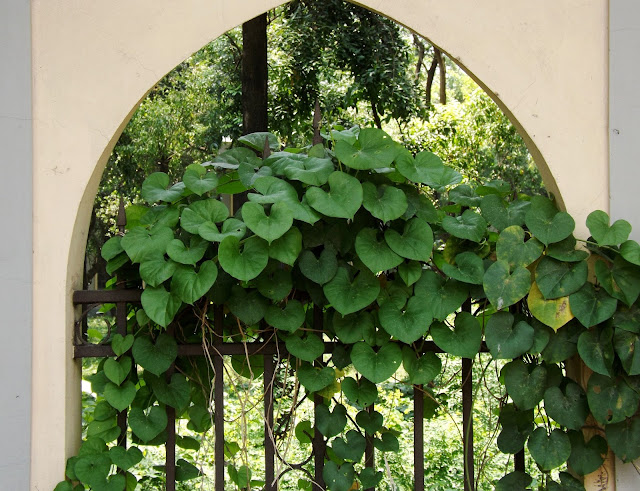
Guloncho or Heart-leaved moonseed ( Tinospora cordifolia , family: Menispermaceae) is a deciduous creeper with hard and long stem, climbing other trees or fences. Bark on the stem is as thin as paper. Aerial roots come out of the stem when the plant grows older. The plant is found everywhere in Bangladesh except southern part. It is also native to South and Southeast Asia.  Common names: Heart-leaved moonseed, Guduchi, Giloy, Guloncho, Guroncho, Padma guloncho. Leaves are simple, green, alternate, cordate, 6-15 cm long and 5-13 cm wide.  Inflorescence, growing from the axil of leaflet branches, bears yellow flowers. Male and female flowers bloom separately. Sepals 6, arranged in two rows, petal 6, pistils 3. Fruit is a drupe, brilliant red when ripe. This attractive fruit is inedible to human.                                        ...