Posts

Showing posts with the label sapindaceae

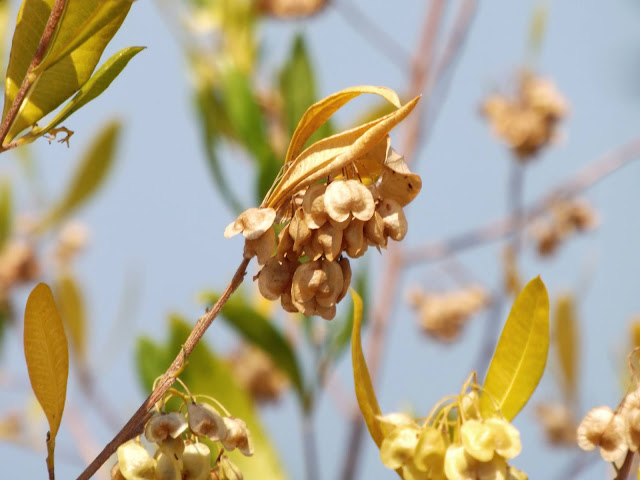
Paniaphul or Hopbush, Dodonaea viscosa
Image
Paniaphul  or  Hopbush  ( Dodonaea viscosa , family: Sapindaceae) is a large shrub or small-sized evergreen tree, attaining a height of 2-8 m. It is usually the size of a shrub. But sometimes it takes the form of a small tree, though it is rare. It usually prefers to grow in sandy soils washed in salt water. It is mainly found in the coastal regions, especially on sandy beaches of South-eastern region of Bangladesh. Its geographical extent is very wide. It is found througout the tropical and subtropical regions of the world. Other names: Aliar (Bang); Sticky hopbush (Eng). The shape of the leaves vary. These are elliptic-obovate or lanceolate, 4-14 cm long and 2-4 cm wide, entire, alternate, petiolate or sessile, apex rounded or acuminate; sticky and leathery.   Flowers are in widely branched inflorescence (3-4 cm long). These are yellow, bisexual or dioecious (female and male flowers are in separate plant). Fruits are capsule, 1-1.5 cm wide, yellow to ora...
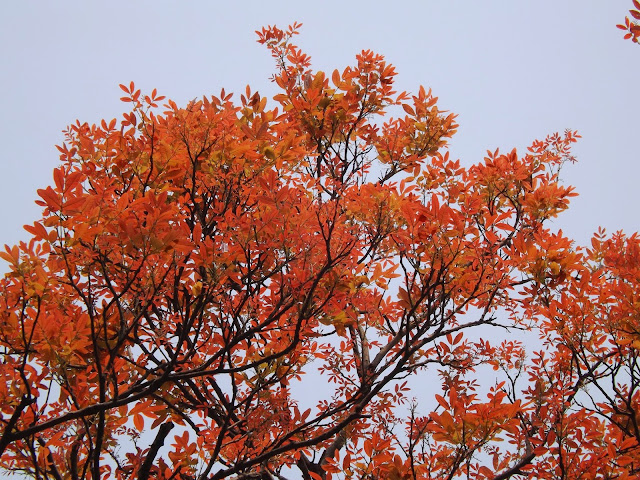
Kushum or Ceylon oak, Schleichera oleosa

Image
Kushum or Ceylon oak ( Schleichera oleosa , family: Sapindaceae) is a large-sized deciduous tree with spreading canopy and huge trunk, attaining a height up to 40 m. The diameter of the trunk can be up to 2 meters. Bark is grey and smooth. The leaves fall at the end of winter and new leaves come in spring. The leaves are surprisingly red.    Other names:  Joyna, Lakkha, Gum tree, Honey tree. This giant tree can be easily recognized by shiny red leaves. The fruits look a lot like Lotkon and are called by this name somewhere. It can be seen scattered in Chittagong and Chittagong Hill Tracts including the northern part of the country. It is originated in the Southeast region of Asia, especially in India, Sri Lanka and Myanmar.  Leaves are compound, sessile; leaflets elliptic-obovate, 4-20 cm long and 3-9 cm wide, opposite. The extraordinary young leaves are brilliant red in color. These are seen several times a year. Raceme inflorescence 6-15 cm long. Flowers are gre...

Horina or Boro horina, Lepisanthes rubiginosa

Image
Horina or Boro horina ( Lepisanthes rubiginosa , family: Sapindaceae) is a small tree with branches, attaining a height of 15 m. It is found in village thickets in Bangladesh. It is also found in South and Southeast Asia and in Australia. The little leafy tree is a beautiful one. It can be planted as an ornamental plant beside roads, in parks and gardens. Leaves are paripinnate (leaves are in pair in a pinnae), Leaflets 6-12, opposite or almost opposite, pale green in color, ovate-oblong, 5-15 cm long and 3-8 cm wide.   Inflorescence 15-30 cm long. Flowers are sweet-scented, very small, brownish white or yellowish, terminal; peatls 4, sepals 4. These bloom in March-April. Fruit is round, 1-3-lobed, almost glabrous, 1-1.5 cm long. When ripe, the fruits turn blackish. Before ripening, the fruits gradually turn yellow and red. And this is one of the easiest ways to detect the tree.  Fruits are sweet-tasted. Children love these. These are fa...

Ritha or Soapberry, Sapindus saponaria

Image
Ritha or  Soapberry  ( Sapindus saponaria , family: Sapindaceae) is a a medium-sized much branching tree attaining a height of 15 m. Its bark is dark with rough scales. The deciduous tree is originated from tropical America. Nowadays it has been naturalized in Bangladesh as well as tropical areas of Asia. The good looking tree is found in the North-West region of the country. Leaves are green, 2-6 pairs per pinnae, 40 cm long, terminal leaf absent. Leaflets almost opposite or alternate, elliptic-lanceolate, 5-15 cm long and 3-6 cm wide, petioled, apex emarginate. After leaving all the leaves in the winter, new leaves arrives in the beginning of spring. Flowering occurs in the summer. Inflorescence up to 25 cm long. Flowers creamy white, tomentose. Petals 5. Fruit is drupe, solitary or pair, fleshy, subglobose, 1 cm in diameter, glabrous. Fruiting occurs in rainy season. The propagation of the plant is caused by seeds. Fibers on inner bark are u...

Lota futki or Balloon plant, Cardiospermum halicacabum

Image
Lota futki or Balloon plant ( Cardiospermum halicacabum , family: Sapindaceae) a large creeper with wiry stems, climbing other trees with tendrils, sometimes completely covering the host. The climber is native to tropical and subtropical Africa and Asia. The plant grows on fallow land as weed in Bangladesh.         Common names:  Kanfutki, kopalfutki, Noafutki, Futka (Bangla), Balloon vine, Love in a puff (English). Leaves are compound, ternate, lanceolate, lobed or serrated, 4-8 cm long. Flowering and budding occurs round the year. Flowers are very small, greenish white. Fruit is triangular, 1.5-4 cm wide, hairy and black when ripe. Calyx develop into the coat of fruit.   These are 3-seeded. Each seed have a heart-shaped mark at the top.                                                 ...