Posts

Showing posts with the label Malvaceae

Kashipala or Largeleaf Rosemallow, Hibiscus macrophyllus

Image
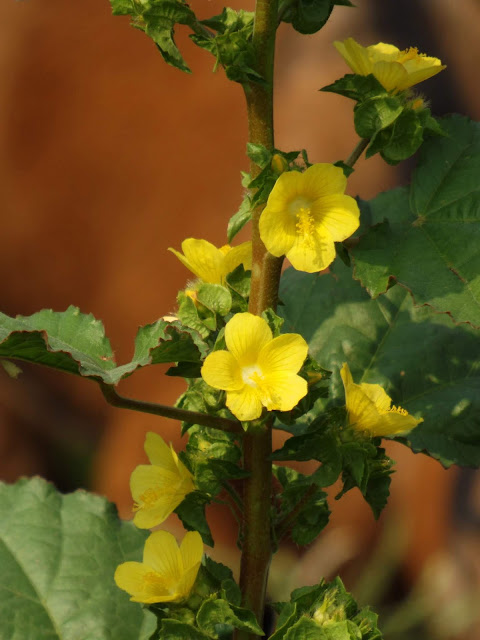
Kashipala or Largeleaf Rosemallow ( Hibiscus macrophyllus , Family : Malvaceae) is a medium-sized tree with large leaves and attractive flowers. The tree can reach a height of about 10 m. The young branches, leaves, inflorescence, fruits, seeds of the plant are too hairy. It goes without saying that the plant takes such protective measures to prevent insects or unwanted creatures from harming its body parts.  The tree can be found in Indo-Malay region (Indonesia, Malaysia and the Philippines) as well as Northeastern India, Myanmar, Southern China. In Bangladesh, it can be found in the forests of greater Sylhet and greater Chattogram.  Other names :  Khasia Udal (Bangla), Hibiscus, Large-Leaved Hibiscus, Large-Leaved Hao (Eng.). Downy and 5-9 nerved leaves are big, 16-45 cm long and 15-40 cm wide. Interestingly, its leaves and petioles are the same size. These are broadly ovate or orbicular, heart-shaped at the base, acuminate at apex. Upper surface is covered with ...

Shomudro joba or Sea hibiscus, Talipariti tiliaceum

Image
Shomudro joba or Sea hibiscus ( Talipariti tiliaceum , family: Malvaceae) is a small bushy tree with many branches and nice curved canopy, attaining a height of  12-13 m. Trunk is grey with many reddish spots. Its roots do not go deep into the soil.  It is found in the coastal regions of Bangladesh. The evergreen plant is also found throughout the tropical and subtropical sea beaches of the world. It is salt-tolerant and can grow in water logging condition and on coral sands. Other names : Bhola, Bela, Bola, Chhelba (Bangla), Beach hibiscus (Eng.) Leaves are cordate with long petiole (up to 10 cm long); soft green in color, whitish green, tomentose below, alternate, coriacious, slightly dented, apex pointed, 8-15 cm long and 8-14 cm wide. Flowers are large, bisexual, 4-6 cm wide, eye-catching, beautiful, almost like Porosh pipul ( Thespesia populnea ) . They are solitary, axillary or terminal, funnel-shaped, yellow with blackish mark at the centre....

Mushok-dana or Musk-mallow, Abelmoschus moschatus

Image
Mushok-dana or Musk-mallow ( Abelmoschus moschatus , family: Malvaceae) is a perennial erect herb or undershrub attaining a height of 3 m. Stem is cylindrical and reddish. Young shoots, pedicel and petiole are retrorsely (opposite direction) hairy. The plant almost looks similar to popular vegetable Okra (abelmoschus esculentus). It is found near the water bodies, fallow lands, roadside areas and forest edges in Bangladesh. It is also found in India as well as Southeast Asia. The another Bangla name of the plant is Kala-kosturi. Lower leaves are angular, upper palmately lobed, dark green, oblong-lanceolate, ovate, 20-24 cm long, serrate or dented, hairy on both sides. Leaf-base has a crown-like portion. Petiole is very long.  Flower axillay, solitary and in terminal clusters. They are big, light yellow with dark purple center, petals 5, unequal; corolla 10 cm across. Epicalyx segments 6-10, linear-lanceolate. Flowering occurs in the rainy season. F...

Porosh-pipul or Tulip tree, Thespesia populnea

Image
Porosh-pipul   or  Tulip tree ( Thespesia populnea , family: Malvaceae) is a medium-sized evergreen tree, attaining a height of 5-10 m with nice dense canopy. Bark is rough and grey in color. As an ornamental plant it can be planted beside roads.  In fact it is one of the most beautiful trees of the Indian subcontinent. It is found in the coastal areas in Bangladesh as well as in Africa, tropical Asia, throughout India and Pacific Islands. Other names : Porosh, Pakor, Pipul, Bolu (Bangla), Portia tree, Umbrella tree. Leaves are deep green, simple, cordate, 15-18 cm long and 10-15 cm wide, alternate, petiole 4-10 cm long, upside is smooth, grey and fibrous beneath.  Flowers are beautiful, big-sized, bell-shaped, solitary or in pair, about 8 cm across, pale yellow. Sepals 5, petals 5.  Flowering occurs mainly in the summer, though flowers can be seen throughout the year. The flower is short-lived, that remain...

Braziler Paat or Brazil jute, Malachra capitata

Image
Braziler Paat or Brazil jute (M alachra capitata , family: Malvaceae) is a useful tropical erect herb or undershrub with hairy body. Stem is slender and reddish. The leaves have also reddish marks at the edge. It can get a height of up to 2 m. The annual (or perennial) is found throughout the tropical regions of the world.    Other name: Bon vingdi. The size and shape of the leaves may vary. It can be orbicular to suborbicular or ovate, many-lobed, cordate at base, blunt or acute at tip, edge serrated, alternate, 6-16 cm in diameter; long-petioled, almost the half of the length of leaf. Both sides of the leaf is hairy. The petiole is not directly connected to the blade but connected by creating angles to the bottom.  Flowers usually in axillary heads, often also in terminal heads. Each head contains 2-5 bright yellow-colored flowers with white eye. There are 3-4 leafy bracts surrounding the flowers. Short-petioled flowers are cupular, 5-petaled. Peta...

Buno Joba or Jongli Ghagra, Urena lobata

Image
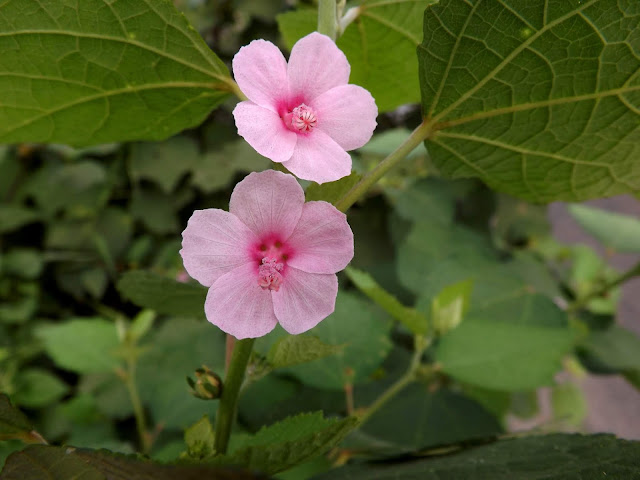
Buno Joba or Jongli Ghagra ( Urena lobata , family : Malvaceae) is an erect branched plant with about 1.5 m height. The plant is covered with tiny hairs all over the body. Other names: Gamera, Bon-okra, Altera, Nageji, Jongli khagra, Kongo pat. Leaves are ovate, round or 5-7 lobbed, 3.5-12 cm long, irregularly toothed, covered with rigid hair. Petiole 2-8 cm long. Flowers are small, violet or pinkish, clustered or solitary, about 1 cm across. Calyx 5-cleft, petals 5, stamens many. The fruit is globose with 5 carpels and is covered with short stiff spines. It blooms almost in all seasons. It is found everywhere in Bangladesh. It grows in abandoned places. Root is used as diuretic and useful in neurological disorder. The flower is called Buno Joba (wild hibiscus) In Bangla.

Jhumko joba, Fringed rosemallow, Hibiscus schizopetalus

Image
Jhumko joba or   Fringed rosemallow   ( Hibiscus schizopetalus , family: malvaceae) is an ornamental flowering shrub with drooping branches.  The evergreen  shrub can be 3 m tall . The plant is very adorable to the amateur gardeners of Bangladesh.  Common names:   Jhumko joba,  Fringed rosemallow, Japanese lantern. Flower is big, orange to red, on oxillary long pedicel. Sepals 5, petals 5. Petals are chopped, curved downwards. About 15 inches long staminal tube rises from middle of the petals. Pistil passes through the staminal tube and stigma is divided into five parts. Leaves are deep green, petioled, ovate-elliptical, deeply serrated. Hibiscus schizopetalus  is native to tropical Africa and eventually has become popular to the most tropical and subtropical areas of the world.  The flower is very unusual than the other members of the hibiscus family. The species name 'schizo' derives from its distinctive sh...

Sthol-padma, Confederate rose, Hibiscus mutabilis

Image
Sthol-padma  or  Confederate   rose  ( Hibiscus mutabilis , family: Malvaceae) is a wonderful Perennial hibiscus that comes from China. The deciduous plant is introduced to Bangladesh as well as Indian sub-continent and USA. This fast growing woody shrub can grow up to 3 meter tall.  Common Name: Sthol-padma , Sthalkamal , Confed erate rose, Dixie rosemallow , Cotton rosemallow . Leaves are simple, alternate, deeply cordate, 3-5 lobed, 8-15 cm long, hairy on both surfaces, petiole long.  Flower blooms in September-December. Propagation is caused by cutting and air layering. The flowers of hibiscus mutabilis are large or small, double or single, 9-18cm in across. white, red or pink. It is called 'changeable rose' as it changes color with the change of time. Leaves and flowers of the plant are are used in piles, abortion and urinary problem. Extract of root is used in menstrual problem.

Shimul or Red silk-cotton, Bombax ceiba

Image
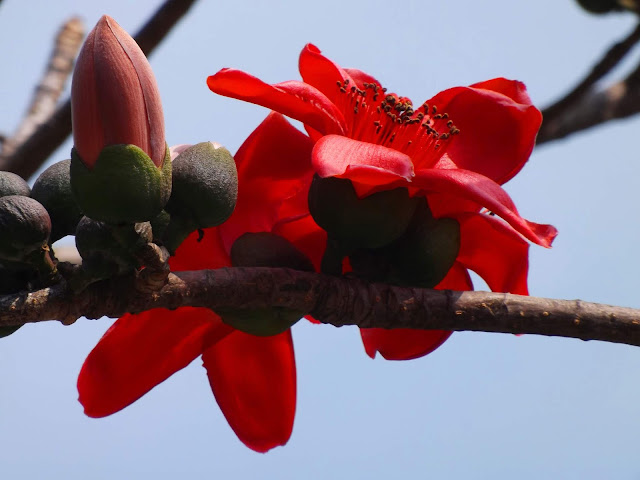
Shimul or  Red silk-cotton   ( Bombax ceiba , family: Malvaceae) is one of the most common trees that found in Bangladesh. This deciduous straight tall tree with thorny trunk and spreading crown is also found in tropical regions of Asia. In Bangladesh, the tree is planted in parks and on highways and beside national monuments for its gorgeous fire-red flowers. It can reach a height up to 60 m. Common names: Shimul, Red silk-cotton, Red cotton tree. Leaves are large, spreading, glabrous, digitate, leaflets lanceolate, entire, 10-15 cm long; petiole is up to 20 cm long.  It blooms in spring (March-April).  Flowers red, numerous, appearing when the tree is bare of leaves, stamens numerous arranged in five outer bundles and one middle bundle.  Fruit capsules, woody valves. 10-13 cm in length. Seeds smooth, black or grey embedded in long white wool. Oh! the flame of the forest! Young plant is used in dysentery, cough, plethor...