Posts

Showing posts with the label plants_of_Bangladesh

Shalu kocu or Shola kochu, Alocasia fornicata

Image
Shalu kocu or Shola kochu ( Alocasia fornicata , family: Araceae) is an erect perinnial herb with rhizome and stolon, attaining a height of 1 to 1.5 m. Stolon grows horizontally. Roots are whitish. It is found everywhere, specially in ditch and damp places in Bangladesh along with Pipul ( Piper longum ), Bhat ( Clerodendrum viscosum ), Asam lota, ( Mikania micrantha ) and other species of ferns. It is also found in South and Southeast Asia. All parts of the plant is eaten as vegetable in the country.  Leaves are broad, thin, triangular, pale but deep green, glabrous, shiny, 30-40 cm long, bottom part cut apart. Petiole is thick and almost as long as the total height of the plant, 40-45 cm. Like other members of the genus Alocasia, new leaves develop slowly from its wrapped state. New leaves are spectacular. Numerous small and yellow-colored flowers are clustered on spadix inflorescence, covered with eye-catching white-colored spathe. In the initial stage the inflorescence is full...
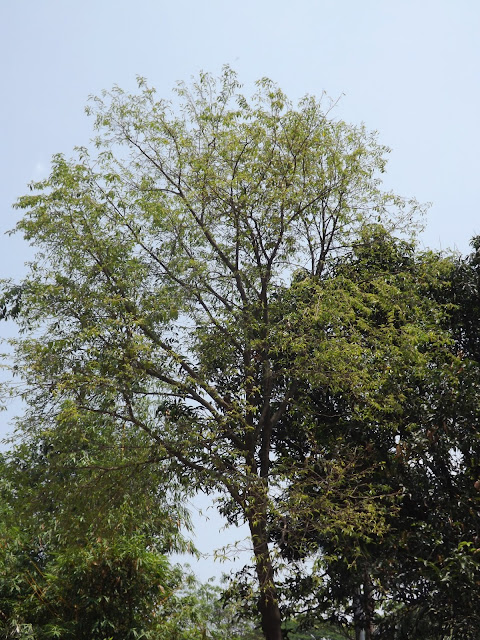
Agor or Lign aloes, Aquilaria agallocha

Image
Agor or Lign aloes ( Aquilaria agallocha , family: Thymelaeaceae) is an large evergreen tree with spreading branches. Trunk is straght, glabrous. Bark is whitish. Wood is soft. Perfume stick Agorbati and various kinds of perfumes are made from its wood. It is cultivated as commercial crops in Bangladesh, especially in the hilly area of Moulovibazar district. It is originally from India. It can be seen scattered in different parts of Bangladesh. Other name: Oguru  Leaves are green, thin, glabrous, lanceolate, petioled, 7-12 cm long and 2-5 cm wide, entire, apex acute, alternate. Flowers are whitish, borne on umbel inflorescence; petals 5. Flower blooms in April-May. Fruit is 2-5 cm long, obovate, covered with thick hair. Brown-colored seeds come out of the fruit and hang for 1-2 days. Propagation of the plant is caused by seeds.   Powder of timber is used to prevent insect infestation. Bark is used to make rope. Resin is obtained as a result of the action of a type of f...

Naglingom or Canon ball tree, Couroupita guianensis

Image
Naglingom or Canon ball tree ( Couroupita guianensis , family: Lecythidaceae) is a soft-wooded lagre deciduous tree, attaining a height of about 25 m. Trunk is stout and rough, brownish grey. The tree has a habit of shedding its leaves all on a sudden and it does the act several times a year.  As an ornamental tree it is planted in parks, gardens, botanical gardens and by avenue. Its original home is South America. Leaves are alternate, oblong-ovate, 20-25 cm long, short-petioled, alternate. The new leaves are light green and eye-catching. The mature leaves are dark green. Flowers are yellow-pink or red with whitish stamens which are curved like the hood of a snake, strongly scented, about 5 cm long and 8 cm wide, on woody, pendulous racemes, 50-0 cm long, springing from old trunk.  Petals 6, outside brown-orange and inside maroon. Flowers bloom mainly in summer but these can be seen throughout the year.  Fruit is quite large and round, almost 15 cm wide, many seeded. I...

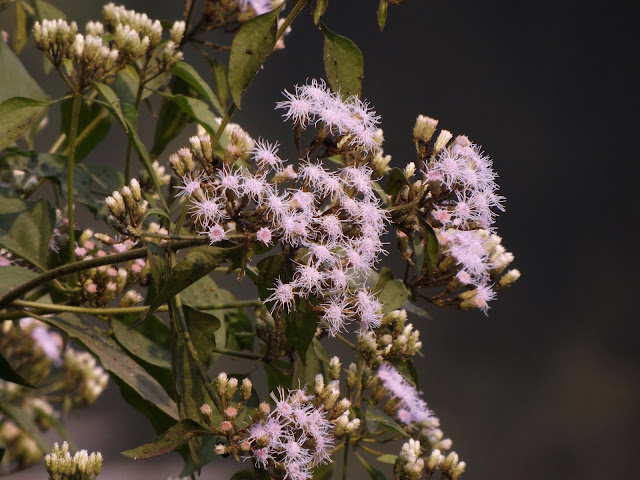
Boro shialmuti or Siam weed, Chromolaena odorata

Image
Boro shialmuti  or Siam weed ( Chromolaena odorata, family: Asteraceae) is a fast growing and highly reproductive perennial herb with many branches. In suitable condition, it can grow up to 10 m. Branches are hairy and glandular, stem woody. It grows in fallow land, in jungle and on the side of roads. It is regarded as an invasive plant round the globe. It has been said that, in Bangladesh, it escaped from the botanical gardens of Dhaka in the 19th centuary. It is originated in Americas, from USA to South America.  Leaves are green, triangular-ovate, 3-10 cm long, 2-5 cm wide, deeply dented with pointed end, opposite. The leaves give off a pungent scent when crushed. Bunch of flowers bloom in the shape of head. Flowers are small and light violet.   Fruits are round. Seeds are achenes, hairy. Propagation of the plant is caused by seeds. The seeds usually float in the air and travel long distances. However, it can go to different places through the body of  anim...

Kochu or Taro, Colocasia esculenta

Image
Kochu or Taro ( Colocasia esculenta , family: Araceae) is a perennial aquatic herb with stolon and rhizome, attaining a height of 1.5 m. It is found by water or standing in water. The fast-growing plant is found almost everywhere in Bangladesh. Although it is originated mainly in Southeast Asia, it has gradually become naturalized in the tropical world. It is one the oldest cultivated crops in Asia. The whole part of the plant, like leaf, stem, petiole, rhizome, stolon--everything can be eaten as vegetable. Other names: Mukhi kochu, Gura kochu, Kuri kochu, Chhora kochu, Duli kochu, Binni kochu. Leaves are showy, large, green, glabrous, triangular-ovate, 30-40 cm long and 20-26 cm wide. Petiole is thick and juicy and it can be almost equal to the height of the plant. New leaves grow from the rhizome. Neumerous small flowers are clustered on spadix inflorescence, covered with giant bract leaf, spathe; the spadix is three-fifths of the spathe. In initial stage the inflorescence is full...
Ulu or Cogon grass, Imperata cylindrica

Image
Ulu or Cogon grass ( Imperata cylindrica , family: Poaceae) is a beautiful perennial grass with cylindrical and solid stem and creeping rhizomes, attaining a height of 1 m. The herb is one of the most beautiful flowering plants of Bangladesh. The water-loving grass is found all over Bangladesh. Its original home is Indian subcontinent.   Other names: Ulu-ghash, Ulu-khor, Lalong, Shon, Chhon, Chhau, Sarkanda. Leaves are green, rough, linear-lanceolate, 20-50 cm long with pointed apex.  Flowers are pure white, silky, on spike inflorescence. Although the initial color of the flower is purple-white, it gradually changes to shiny white. It blooms from rainy season to autumn.  Fruits are caryopsis, winged. Fruits and flowers can be seen at a time on different plants. It is propagated by rhizomes and seeds.  When they bloom over a large area, a truly eye-catching scene unfolds. Only Kaash (Saccharum spontaneum) can be compared to its blossoming. It is used in diabete...

Shushni or Four-leaved clover, Marsilea minuta

Image
Shushni or 4-leaved clover ( Marsilea minuta, family: Marsileaceae) is an annual creeping herb. It is an aquatic fern of Bangladesh, found floating in the water along with Water spinach , Alligator weed and many other aquatic plants during the monsoon season. In addition, it can be seen in waterside area or wet soil. Roots from each node of stem help the plant to creep on ground. It has spectacular four leaves in each stalk. As an ornamental aquatic plant it can be planted in water-tub or lakes and ponds of gardens.  The geographical range of the plant is quite large. It is found throughout the tropical and subtropical regions of the world. Leaves are light green, almost round, leaf blade (3-4 cm across) divided in to four parts. These are almost triangular or ovoid with rounded end. Petiole is narrow and long. If it grows in wet or dry places, the edges of the leaves become dented. The length of the petiole increases as the water level rises. As a...

Boga or White tephrosia, Tephrosia candida

Image
Boga or White tephrosia ( Tephrosia candida , Fabaceae) is an erect shrub with branches attaining a height of 4 m. Upright branches grow from the stem base. Woody stem is velvety, greyish. In Bangladesh, it is found in the tea gardens of Moulovibazar and in parks and botanical gardens.  Other names:   Medla, Bogui. Leaves are pale green, compound, pinnate; leaflets 9-11 pairs, opposite. Flowers are borne in terminal or axillary Inflorescences, 20-40 cm long. Flowers are are brilliant white, sometimes yellow or pink; petals clawed, round, wings ovate, sightly adnate, 2-2.5 cm long and 1 cm wide. Calix is bell-shaped. Flowering season is autumn. The species name 'Candida' is kept due to its pure white-colored flowers. Fruits are like beans, linear, covered with brown hair, 8-15 cm long and 1 cm wide; dehiscent, 8-15-seeded. Flowers and fruits can be seen at a time. Propagation is caused by seeds. Leaves are used for relief from cough and as...

Harjora lota, Veld grape, Cissus quadrangularis

Image
Harjora lota or Veld grape ( Cissus quadrangularis , family: Vitaceae) is a deciduous climber with smooth, stout, succulent, quadrangular stems. It has simple tendrils, born opposed to leaf. The stem of the plant has great repute in the treatment of bone fracture. That's why it has been named 'Harjora lota' or 'Harbhanga lota' in Bangla.  Other local names: Harenga, Kumor-lota It is native to Bangladesh, India and Sri Lanka. The perennial climber is also found in Africa, Arabia, and Southeast Asia. It has been introduced to Americas. The large branched climber's leaves are simple, 3-6 cm long and 2-7 cm wide, fleshy, cordate, 3-5 lobed, toothed, acute to obtuse at apex, petioled, glabrous on both surfaces., opposite. Inflorescence umbellate cymes, glabrous. Flowers are reddish, corolla lobes 4. Fruit is a berry, globose, red when ripe.  An extract is used as a cure for scurvy and irregular menstruation, and in ear and nose ...

Ashok, Saraca asoca

Image
Ashok  ( Saraca asoca , family: Caesalpiniaceae) is one of the most beautiful flowering trees in Bangladesh. The tree is widely distributed in the hilly area of Bangladesh, India, Nepal, Myanmar, Sri Lanka and Malaya area. It gives fragrant flower profusely in the months of February-May, though it may be found round the year. This is as an avenue & garden tree in Bangladesh. It grows well in partial shade and rich porous soil. Common names: Asoka, Ashok. To watch video:  https://www.youtube.com/watch?v=Dv-ML6Lq4yc It is a small to medium-sized evergreen tree with dark brown, rough bark and spreading, drooping branches. Leaves are compound, leaflets alternate, 3-5 pairs, oblong-lanceolate, glabrous, coriaceous, petiolate, 15-39 cm long. 3-7 cm wide. The tree is regarded as a sacred one to the  buddhist  community of   Bangladesh, India, Sri Lanka, & Nepal. Emperor Ashoka was born under the tree. The  plant has many folkloric, religio...