Posts

Showing posts with the label imparipinnate

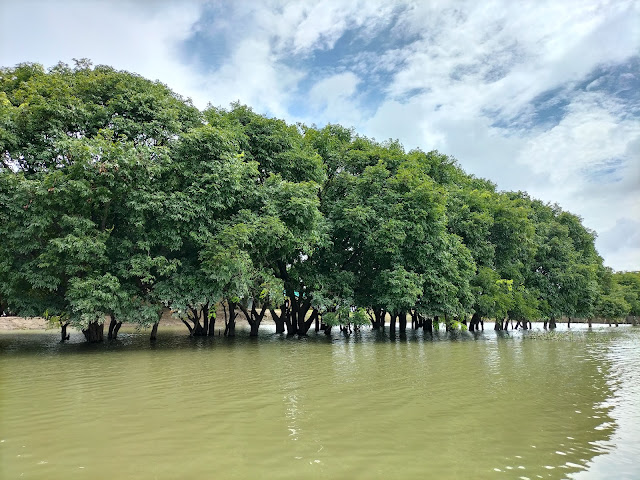
Koroch or Kures, Dalbergia reniformis
Image
Koroch or Kures ( Dalbergia reniformis , family: Fabaceae) is a small or medium-sized bushy tree with spreading branches, attaining a height of 10-13 m. The water-loving tree is native to Bangladesh. The stem and branches are brownish. In the country, it is found throughout the Haors of Netrokona, Sunamgonj and Sylhet districts. It is one of the dominant trees of Sylhet's Ratargul Swamp Forest. It is also found in the wetlands of  India and Myanmar too. The plant has great adaptability to survive almost half-submerged in water. It can remain in this condition for about 6 months! This is one of the most remarkable and strongest characteristics of the tree among the plant world. Leaves are dark green, whitish green beneath, glabrous, compound, 15-32 cm long, imparipinnate; leaflets 7-9, entire, petiolate, oblong-lanceolate, 6-10 cm and 3-5 cm wide with rounded base and acute apex, alternate, coriaceous. New leaves are ovate, shiny and light green with bending apex. Flowers are whit...

Shonkorjota or Prishniparni, Uraria picta

Image
Shonkorjota or Prishniparni ( Uraria picta , family: Fabaceae) is a semi-woody erect herb with some velvety branches, attaining a height of 1-2 m. Its flowers and leaves are beautiful and bracts are stunning. The perennial undershrub is very importantly mentioned in the Ayurvedic scriptures as an medicinal plant. The plant itself is quite beautiful. It is found in fallow lands, village thickets and medicinal gardens in Bangladesh. Outside the country, it is found from some countries of tropical Africa and Asia to Australia.  The plant can be easily identified by its unique leaves. The midrib of blade has long white spot from the tip to the base, which is called variegated. However, complete green leaves may also be found in some plants of this species. These are linear-oblong, imparipinnate (solitary blade at the top of a pinna), 3-9 blades, firm and coriaceous, 8-20 cm long, base rounded, apex acute. The upper part is hairless, lower part covered with rough hairs. Petiole 3-6 cm...

Amkurchi or Kali lota, Derris scandens

Image
Amkurchi or Kali lota ( Derris scandens , family: Fabaceae) is a woody and extensive creeper or scandent shrub with greenish grey and smooth bark. The evergreen plant is mainly found in the hilly forests as well as Sundarbans of Bangladesh. It is also found in the Indian subcontinent, Southeast Asia and Australia. Other names: Kumaria lota, Noa lota. Leaves are dark green, compound, imparipinnate (having single leaflet at the end), leaflets 9-15, ovoid-lanceolate, coriaceous, shiny, 2.5-5 cm long, opposite, top one is bigger than others.   Flowers are small, pinkish or white, pea-shaped, borne on axillary raceme. Inflorescence quite long, 15-35 cm. Flowering occurs from the end of spring to autumn. Fruits are pods, 3.5-4 cm long, having pointed end. Seeds 1-4. Propagation is caused by seeds and cuttings.  Paste of bark is used in snakebite. Some parts of the plant are used as fish poison. Rope fibre can be produced from its bark. ...

Padauk or Malay padauk, Pterocarpus indicus

Image
Padauk or Malay padauk ( Pterocarpus indicus, family: Fabaceae) is a large deciduous tree with spreading and drooping branches, attaining a height of 20-40 m. Bark is almost smooth and grey. In early summer the tree floods its entire body with yellow flowers. But those only last for one day. The next day there are no flowers left on the tree. It is found in the hilly areas of Chottogram Division. It is also found in Myanmar, India, Malaysia as well as other Southeast Asian countries. Leaves are imparipinnate (having single leaflet at the pinnate's end), glossy green, oval-lanceolate, undulate. Leaflet is 5-9, 8-10 cm long and 4-6 cm wide.  Flowers are highly scented. Those are small, in terminal inflorescence, yellow-colored. It blooms 3 times a year.  Fruit is round and flat, papery, 3-5 cm wide, indehiscent, single-seeded. It has feather, and because of this it can float in the air and spread far and wide. Propagation is caused by seeds and c...