Posts

Showing posts with the label extensive_creeper

Congea or Wooly congea, Congea tomentosa

Image
Congea or Wooly congea ( Congea tomentosa , family: Lamiaceae) is a woody and extensive creeper, covering with shaggy hair in young shoots and branches. Its beauty during the flowering season is so unique that it surpasses many other plants in the garden. This beauty is mainly for its surprising and unique bractioles.  Although it is not indigenous to Bangladesh but it is originated in neighboring India, Myanmar and Malaysia as well some of the countries of Southeast Asia. In Bangladesh it is found in parks and botanical gardens as an ornamental plant. Leaves are simple, 10-12 cm long and 5-10 cm wide, entire, short petioled, opposite, ovate-lanceolate. There are dense hairs on both sides of the leaf, more on the underside. Rough branch of the inflorescence bears 3-9 flowers. There are small velvety bracts at the bottom of the inflorescence and three bractioles at the top of it, taking the shape of the cup. Sepals 5, bilabiate, tubular, with dense hair. S...

Amkurchi or Kali lota, Derris scandens

Image
Amkurchi or Kali lota ( Derris scandens , family: Fabaceae) is a woody and extensive creeper or scandent shrub with greenish grey and smooth bark. The evergreen plant is mainly found in the hilly forests as well as Sundarbans of Bangladesh. It is also found in the Indian subcontinent, Southeast Asia and Australia. Other names: Kumaria lota, Noa lota. Leaves are dark green, compound, imparipinnate (having single leaflet at the end), leaflets 9-15, ovoid-lanceolate, coriaceous, shiny, 2.5-5 cm long, opposite, top one is bigger than others.   Flowers are small, pinkish or white, pea-shaped, borne on axillary raceme. Inflorescence quite long, 15-35 cm. Flowering occurs from the end of spring to autumn. Fruits are pods, 3.5-4 cm long, having pointed end. Seeds 1-4. Propagation is caused by seeds and cuttings.  Paste of bark is used in snakebite. Some parts of the plant are used as fish poison. Rope fibre can be produced from its bark. ...

Hapormali or Bread Flower, Vallaris solanacea

Image
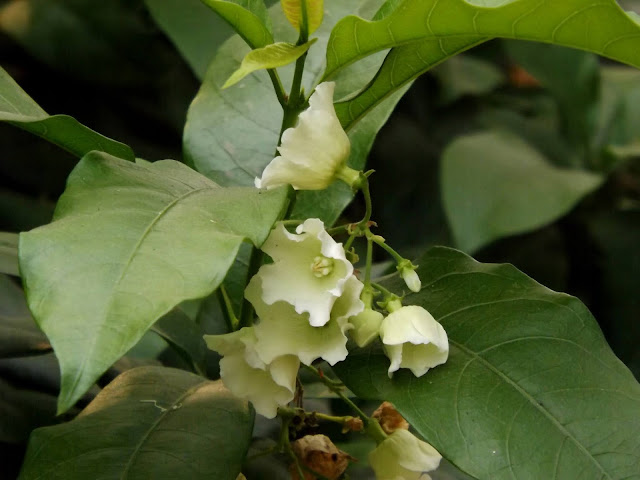
Hapormali or Bread Flower ( Vallaris solanacea , family: Apocynaceae) is a slightly woody and extensive creeper with pure white and highly scented flowers. The whole body of the plant is filled with milky latex. It is mainly found in the hilly forests of Bangladesh. In addition, it will be seen in some gardens and botanical gardens of the country. It is also found in South and Southeast Asia. Oher names: Mali, Ramsor, Hadpur. Leaves are big, 12-15 cm long and 4-6 cm wide, pale green, ovate-lanceolate with pointed apex, opposite, petioled. Fragrant flowers bloom in large clusters, usually 5-6 flowers. These are white, cup-shaped, abot 3 cm wide, peatals 5, sepals 5. The smell of the flower is so sweet that erasing it from our memory is a very difficult task. Flowers bloom in spring.  Milky latex is used in skin diseases somewhere. The plant is propagated by cuttings. It needs to be conserved in different parts of the country as it is limited to certai...

Roti, Kuch or Jequirity, Abrus precatorius

Image
Roti,  Kuch or Jequirity ( Abrus precatorius , family: Fabaceae) is a deciduous creeping woody herb. It grows naturally on fallow lands and beside canals and ponds. Nowadays it has been rare in Bangladesh.  In epic Mahabharata and Indian classical poetry it is known as Gunja.   Leaves are compound; leaflets 10-20 cm on a rachis, opposite, tastes sweet. Blades are oblong, midrib clearly visible. Flowers are small, pinkish white. Flowers bloom in summer. Fruits are bean-like. When the bean dried up, it burst. Seeds are round, brilliant red but have black mark at the top. All the seeds are almost of the same weight and shape. The extensive creeper is propagated by seeds. Other names: Rotti, Rottika, Lalkuch, Roktokuch, Rokta, Shonakuri, Churamoni, Tamrika, Shangushtha, Gunja. Fruit seeds are germicidal. These are used as anti-cancer medicines and laxatives. The seeds are also used in abortion. Roots and leaves are used in diarrhea, dys...