Posts

Showing posts with the label creeper

Dudhia or Shet kerui, Dentella repens
Image
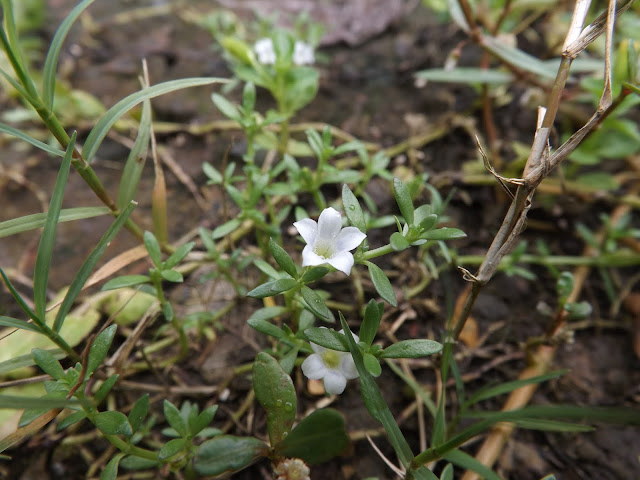
Dudhia or Shet kerui ( Dentella repens , family: Rubiaceae) is an annual herb with soft slender stem. It creeps along the ground and spreads around. Leaves are entire, thick and juicy, elliptic but pointed at both ends, 1 cm long.  Funnel-shaped flowers are solitary, small, nearly sessile, petals 5-lobed, 1 cm long, absolute white in color. Flowers bloom in the rainy season.  It is grown as weed on fallow land and at the edge of water bodies. The plant helps to prevent erosion of land. By the by, the plant's species name 'repens' means spreading or creeping.                                   Other Bangla names : Shadaphuli, Shada jabri, Bhuipat.

Ashari-lota or Asaria, Capparis zeylanica

Image
Ashari-lota or Asaria ( Capparis zeylanica , family : Capparaceae) is a thorny woody profusely branched creeper. The plant grows on fallow land, especially in damp jungle in Bangladesh. Other Bangla names : Kalokra, Kalkeya, Kelekra. Leaves are simple, green, petioled, alternate, ovate, 4.5-7.5 cm and 3-4 cm wide. Flowers are white to pink, borne on axillary lateral inflorescence. Sepals 8, arranged in two layers. Stamens numerous, look like a cat's mustache, gradually change color from white to pink to deep pink. Flower blooms in February-March. Fruit is a berry, smooth, 5-7 cm long. The seeds remain inside in circular form. It gives fruit in the rainy season. The propagation is caused by the seeds. The fruit is edible. Crow likes it. There are hard and curved spines on its body. Leaves are used in piles, blister and tumour. Roots are used in pain, jaundice, tuberculosis, bone fracture and liver diseases.  The plant has been mentioned in Charak-Sushru...

Modhu-monjori ori Rangoon creeper, Combretum indicum

Image
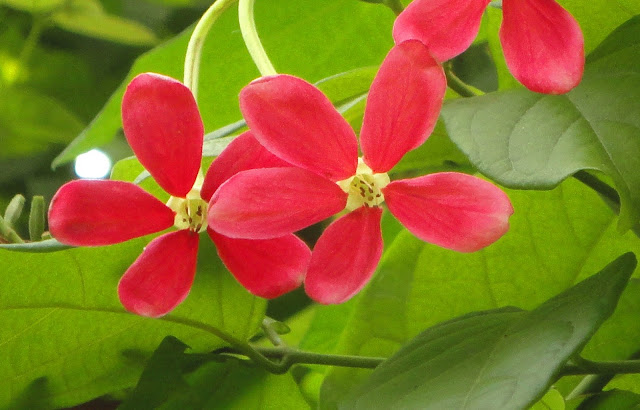
Modhu-monjori or Rangoon creeper (C ombretum indicum , family: Combretaceae) is a extensive woody perennial creeper with red flower clusters. The ornamental vine is native to South and Southeast Asia, specially to Indian subcontinent and Myanmar. The woody climber can reach a length up to 8 m. Common names: Modhu-monjori, Madhuri-lota, Rangoon creeper, Chinese honeysuckle. Flowers are originally red, slightly scented, corolla tubular, petals 5. Flowers bloom mainly in summer and rains.  Leaves are green, rough, opposite, ovate, apex acuminate, edge wavy, 6-14 cm long and 3-6 cm wide.  With the change of time the white flower becomes pink and then it turns red. Fruits are elliptical, 5-winged, dark brown in color.  The Bangla name of the flower (Modhu-monjori) is named by Rabindranath Tagore. It is grown in garden  as ornamental flower plant in Bangladesh. Leaves, roots and seeds are used in skin disease, worm, stomach disorder, ...

Lota futki or Balloon plant, Cardiospermum halicacabum

Image
Lota futki or Balloon plant ( Cardiospermum halicacabum , family: Sapindaceae) a large creeper with wiry stems, climbing other trees with tendrils, sometimes completely covering the host. The climber is native to tropical and subtropical Africa and Asia. The plant grows on fallow land as weed in Bangladesh.         Common names:  Kanfutki, kopalfutki, Noafutki, Futka (Bangla), Balloon vine, Love in a puff (English). Leaves are compound, ternate, lanceolate, lobed or serrated, 4-8 cm long. Flowering and budding occurs round the year. Flowers are very small, greenish white. Fruit is triangular, 1.5-4 cm wide, hairy and black when ripe. Calyx develop into the coat of fruit.   These are 3-seeded. Each seed have a heart-shaped mark at the top.                                                 ...

Bokkon or Frogfruit, phyla nodiflora

Image
Bokkon or   Frogfruit   ( phyla nodiflora , family: verbenaceae) is a creeper, 15-90 cm long. Stem is branched, nodes giving rise to aerial roots. The plant is is native to South America and the United States and has become naturalized in the warmer parts of the world. It grows on fallow land in Bangladesh.  Common names:  Bokkon, Frogfruit, Turkey tangle frogfruit, Capeweed Flowers are small, violet, whorled on the top of 2-7 cm long spike inflorescence. Leaves are small, sessile, obovate, front part serrate.  The plant bears flower in the nodule. For this reason, the species has been named nodiflora. In Sanskrit, it is called Vasir and Vasuka. A lar g e colony The plant is propagated by seeds, root division and cuttings.  Leaves are eaten as vegetables in rural areas to reduce pain and swelling of body. It is also used to destroy insects. Leaves are consumed as alternative to tea especially in the Philip...