Posts

Showing posts with the label capsule

Beguni hurhuri or Spider flower, Cleome houtteana

Image
Beguni hurhuri or Spider flower ( Cleome houtteana,  family: Capparaceae) is a perennial herb with glandular and sticky stem and few branches, attaining a height of 1.5 m. It is cultivated in gardens for decorative flowers. The erect plant is found abundantly in fallow lands of Sylhet. It is originated in tropical America. Other names:  Hurhuri, Swiss phul, Jhorna phul; Spider plant (Eng). Leaves are palmately compound; leaflets 5-7, lanceolate to elliptic-lanceolate, Middle one is about 5 cm long, long petioled, about 6 cm, having a pair of short spine-like stipules at base. Flowers are bright violet, racemes, terminal inflorescence, 30-40 cm long. Sepals 4, petals 4. Flowering occurs in winter.  Fruit is capsule, elongated-cyllindrical, 5-9 cm long, many seeded. The plant is propagated by seeds. Leaves are used in insect poisoning and seeds in stomach disorder and intestinal worm. Synonyms: Cleome spinosa, Cleome pungens, Cleome hasslerana  

Chinigura or Sweet broomweed, Scoparia dulcis

Image
Chinigura or Sweet broomweed ( Scoparia dulcis , family: Plantaginaceae) is an annual upright herb with sweet-tasted leaves and several branches. It does not reach a height of more than 1 m. It loves to grow in wet soil. The plant is usually found in fallow land and roadside area in Bangladesh. The herb is native to tropical America and it gradually spreads throughout the tropics. Other names:  Bon dhoney, Bon dhuni, Furfuri, Chinipata, Chiniguri, Michhridana, Bonduni. Sweet-tasted leaves are light green in color, obovoid-lanceolate with deeply serrated edge; 2-5 cm long, opposite. Flowers are small, white; bloom as pair or single, .3-.5 cm wide, pedicel quite long; sepals 4, petals 4. Flowering occurs in  May-July. The fruits look a lot like coriander. these are capsule, almost round, .5 cm in diametre. Dried fruits deep brown in color remain on the plant for several days. Seeds are round. It is propagated by seeds.  The leaves and ...

Chondona, Chandana, Macaranga peltata

Image
Chondona  or Chandana ( Macaranga peltata , family: Euphorbiaceae) is an evergreen tree with profuse branches and nice crown. The tree usually gets 12 m height. Young parts of the tree are hairy but smooth. Its leaves are very spectacular. In Bangladesh the plant is planted on the roadside areas and parks and gardens for this reason.  Leaves are big, dark green, broadly ovate to orbicular, apex pointed, extended slightly, 15-20 cm long and 12-18 cm wide, alternate, smooth upside, glandular beneath. Veins and midribs are palmately arranged on blade. Petiole is very long and it is strangely connected to the lower part of the blade. Flowers are small, creamy white on raceme inflorescence. Male flowers (in the pic) grow from the axil of large bracts.  Fruit is capsule, round, orange-red. Propagation of the plant is caused by seeds. Flowers appear in March-April and fruit in December-January.  By the by, the species name 'peltata' ...

Kew, Crepe ginger, Cheilocostus speciosus

Image
Kew or Crepe ginger ( Cheilocostus speciosus , family: Zingiberaceae) is a rhizomatous annual or perennial shrub, attaining a height of 2 to 4 m, with clump-forming stems. It is found almost everywhere in Bangladesh. It usually grows well in damp places. The plant itself a beautiful one. The gardeners of the country cultivate this plant for its clean white large flowers. Other names : Kustha, Kiumool, Bondugi, Kura, Kedogi (Chakma). Leaves are stalkless, downy, entire, big in size (18-24 cm), leathery, ovate-elliptical, about 10-20 cm long. Flowers are short-lived, very showy, trumpet-shaped, pure white in color, and have round yellow mark in the centre. Each flower is half-covered by brilliant red bract. The flowers begin to blossom at the end of the monsoon.  Fruit is a capsule. Mature or dry fruits are brown or reddish. Propagation of the good-looking plant is caused by seed or division of rhizomes.  Stem is used in heart disease, lep...

Shornolota or Dodder, Cuscuta reflexa

Image
Shornolota or Dodder ( Cuscuta reflexa , family: Cuscutaceae) is a golden-colored slender parasitic creeper grown on other trees. It clasps like cobweb, sometimes killing its shelter tree. It has branches. Many people think that it is a leafless plant. But it has leaves, those are scale-like, alternately grow from stem. The plant is well-mentioned in the Bengali literature, specially in medieval Baul poems.  Flowers are small, white and thickly clustered, petals 5. Corolla lobe is short and triangular. flowering period is April-December. Fruit is round capsule.   The juicy stem produces haustorium (a kind of tiny root) that help it to hold the host plant tightly. And with that kind of help sometimes the creeper covers its host plant completely.  Its seeds can be germinated almost throughout the year. The propagation of the perennial plant is caused by seeds and cuttings.  In Indian subcontinent, it has been used as a traditional ...

Boronukha or Leaf pondweed, monochoria hastata

Image
Boronukha or Leaf pondweed ( monochoria hastata , family: pontederiaceae) is a water herb attaining a height of 1.5 m. It is found in ponds, diches, canals and other water bodies of South and Southeast Asia and Australia. Common names: Boronukha, Leaf pondweed, Arrowleaf falsepickerelweed, Arrow leaf pondweed, arrow-leaf monochoria. Leaves of the aquatic plant come out from stem. They are cordate or triangular, green, glabrous, apex acute, petiole long and linear. Clusters of blue flowers (20- 55) grow from leaf axil. Petals 5. Flower blooms mainly in autumn. The fruit is a capsule, 5-7 mm long, and 4-7 mm wide. It can be planted as an ornamental water plant in garden or park. In  Bangladesh, t he plant is seen throughout the water bodies of rural areas along with Lotus and Water lilies .  Its root is used in tooth pain and bark in asthma. 

Choto hurhuri, Fringed spider flower, Cleome rutidosperma

Image
Choto hurhuri or   Fringed spider flower   ( Cleome rutidosperma , family: Cleomaceae) is a small-sized annual herb with branches up to 1 m height. The plant is native to tropical Africa and has become naturalized in the tropical and sub-tropical world. It grows on fallow land as weed in Bangladesh. Common names: Choto hurhuri, Fringed spider flower, Purple cleome. The plant flowers round the year.  Flowers are pink, white, lilac, violet or blue, single, on leaf axil. Sepals 4, petals 4, stamens 6. Leaves are trifoliate, middle one long, light green. Leaflets are glabrous, 4-7 cm long and 2-4 cm wide. Fruit is capsule, 4-7 cm long, tubular, narrow at both ends, with an array of seeds.  Cleome rutidosperma keeps fruiting throughout the year, although most abundantly in the rainy season in Bangladesh. The seed contains alkaloid.  The leaves are collected from the wild and eaten as a cooked vegetable or added to soup. Propaga...

Til or Sesame, Sesamum indicum

Image
Til or Sesame ( Sesamum indicum , family: Pedaliaceae) is an annual herb with hollow stem and branches attaining a height of 50 to 100 cm.  Sesame or Til seed is one of the oldest oil-seed  crops  o f t h e w o r l d.  The plant is originated in Africa. It is cultivated as crop throughout the tropical world.  Leaves are  opposite,  broad lanceolate,   dark green,  4- 14 cm long with an entire margin .  Flower is hairy, white or light pink, borne on leaf axil;  3-5 cm long with a four-lobed mouth. In Bangladesh, i t blooms generally in April-May.                Sesame fruit is a  rectangular capsule, 2-7 cm long, covered with tiny soft hair . Tiler khaja, a type of sweetened food made from sesame seed is very popular in Bangladesh.  Propagation of the plant is caused by seeds. Seeds are usually  off-white in c o l o r.  Sesame is ene...

Shimul or Red silk-cotton, Bombax ceiba

Image
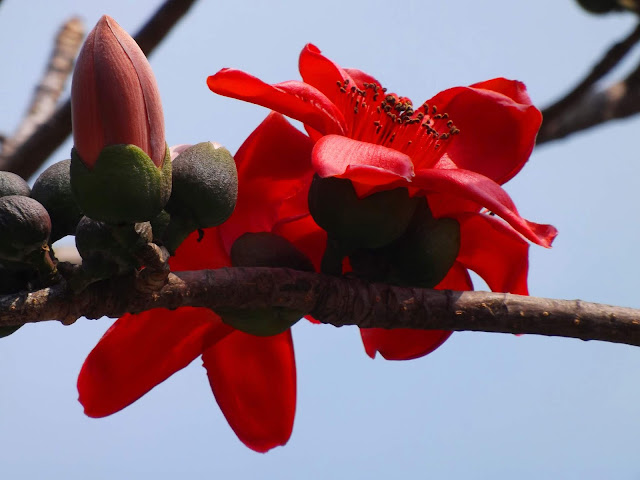
Shimul or  Red silk-cotton   ( Bombax ceiba , family: Malvaceae) is one of the most common trees that found in Bangladesh. This deciduous straight tall tree with thorny trunk and spreading crown is also found in tropical regions of Asia. In Bangladesh, the tree is planted in parks and on highways and beside national monuments for its gorgeous fire-red flowers. It can reach a height up to 60 m. Common names: Shimul, Red silk-cotton, Red cotton tree. Leaves are large, spreading, glabrous, digitate, leaflets lanceolate, entire, 10-15 cm long; petiole is up to 20 cm long.  It blooms in spring (March-April).  Flowers red, numerous, appearing when the tree is bare of leaves, stamens numerous arranged in five outer bundles and one middle bundle.  Fruit capsules, woody valves. 10-13 cm in length. Seeds smooth, black or grey embedded in long white wool. Oh! the flame of the forest! Young plant is used in dysentery, cough, plethor...