Posts

Showing posts with the label United_States

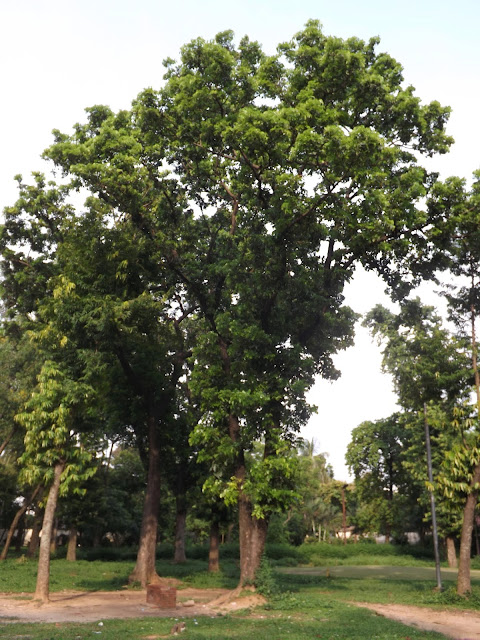
Mahogany, Swietenia mahagoni
Image
Mahogany  ( Swietenia mahagoni , family: Meliaceae)  is a medium-sized semi-deciduous tree   attaining a height of 30-35 m. It has  short but strong base, large canopy, many heavy branches and dense shade. It is native to United States and the Caribbean islands. It is grown as an ornamental tree in tropical regions of the world. Its wood is the first choice for making high-quality furniture throughout the world. The bark is  furrowed and dark  gray in color.  In Bangladesh, it is planted as ornamental tree beside roads, in parks and is planted by name of social forestry.   Common names: Mahagni, Mahogany, West Indian mahogany. The leaves  are compound, 60 cm long,   leaflets   4-10 pairs,  each lance-shaped leaflet 20 cm long and 5 cm wide; terminal leafletless. Young leaves are blood red, quickly becoming a bright, light green and darkening as they mature. The flowers are  very fragrant, g...

Bokkon or Frogfruit, phyla nodiflora

Image
Bokkon or   Frogfruit   ( phyla nodiflora , family: verbenaceae) is a creeper, 15-90 cm long. Stem is branched, nodes giving rise to aerial roots. The plant is is native to South America and the United States and has become naturalized in the warmer parts of the world. It grows on fallow land in Bangladesh.  Common names:  Bokkon, Frogfruit, Turkey tangle frogfruit, Capeweed Flowers are small, violet, whorled on the top of 2-7 cm long spike inflorescence. Leaves are small, sessile, obovate, front part serrate.  The plant bears flower in the nodule. For this reason, the species has been named nodiflora. In Sanskrit, it is called Vasir and Vasuka. A lar g e colony The plant is propagated by seeds, root division and cuttings.  Leaves are eaten as vegetables in rural areas to reduce pain and swelling of body. It is also used to destroy insects. Leaves are consumed as alternative to tea especially in the Philip...