Posts

Showing posts with the label Cucurbitaceae

Lau or Bottle gourd, Lagenaria siceraria

Image
Lau or Bottle gourd ( Lagenaria siceraria , family: Cucurbitaceae) is an annual vine with pubescent and angular stem and tendrils, attaining a length of 5 m. It is one of the most popular and widely cultivated vegetables in Bangladesh. It is grown as a homestead vegetable in almost every household in the village. Whole plant is consumed by the locals of the country except roots. The much-branched climber is probably originated in tropical Africa. Now it is found throughout the Asia and other tropics as well as some temperate areas of Asia, Africa and Americas.  Other names: Kodu, Pani lau (Bang); Calabash, Club gourd, White-flowered gourd (Eng). Leaves are thin, multilobed (5-9 usually), broadly ovate, 8-32 cm long and wide too, puberulous both sides, palmately veined, irregularly toothed, deeply cordate at base and tip acute, petiole 8-24 cm long, thick, hollow sometimes. The plant is monoeceous. Flowers are usually white, but can be yellow too. Male flowers' peduncle is as lon...

Dhundul or Smooth loofah, Luffa cylindrica

Image
Dhundul or Smooth loofah ( Luffa cylindrica , family: Cucurbitaceae) is an annual extensive climber with profuse branches and tendrils. Stem is stout, glabrous and angular. As vegetables, its fruit is one of the most popular one in Bangladesh. The plant is widely cultivated in the country as commercial crops. It is found in South and Southeast Asia and other tropical areas of the world. It is probably originated in South and Southeast Asia. Other names:  Purul, Tipola (Bang); Sponge gourd, Egyptian cucumber, Vietnamese luffa, Vegetable-sponge (Eng). Leaves are multilobed, usually 5-7, glabrous or slightly hairy, 14-26 cm long and wide too; base cordate, tip acute or acuminate. Petiole 10-12 cm long.  The plant is monoecious. Flowers are bright yellow, usually 15-20 male flowers in raceme inflorescence, 5-10 cm wide; female flowers solitary, both male and female are long-peduncled.  Fruits are cylindric, smooth and marked with 7-9 straight lines, straight or slightly curv...

Agmukhi or Madras pea pumpkin, Mukia maderaspatana

Image
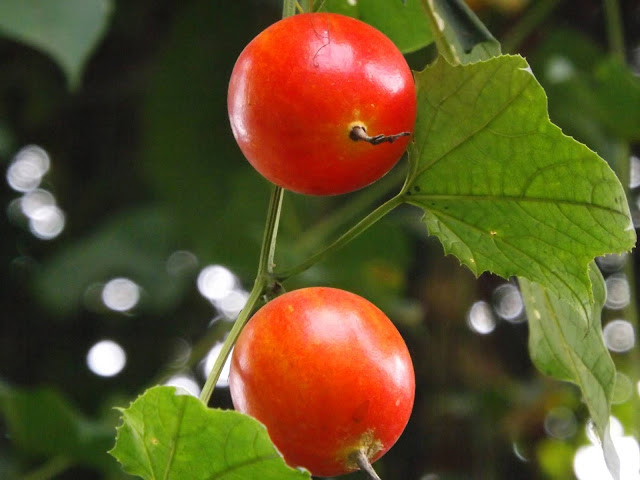
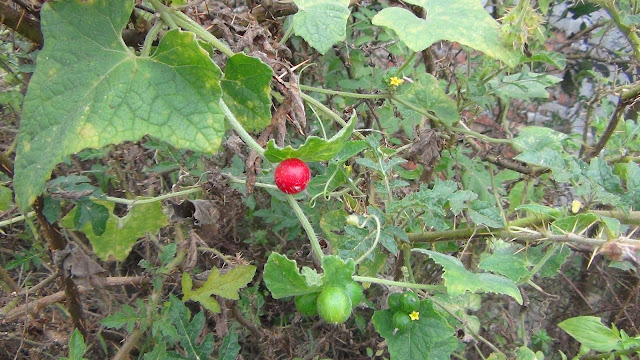
Agmukhi or Madras pea pumpkin ( Mukia maderaspatana , family: Cucurbitaceae) is an annual much-branched climber with angular shoots and tendrils, attaining a length of 3-4 m. There are spine-looking hairs all over its body. It is found in village thickets and fallow lands scatteredly all over Bangladesh. Sometimes it is found grabbing spiny herbs or shrubs to survive with hostile condition properly. It is also found in some countries of South and Southeast Asia also. Other names:   Bilari, Agamukhi (Bang); Rough bryoni (Eng).   Leaves are variable; mutilobed, usualy 3-5 lobed, can be found ovate and cordate at base, 5-9 cm long, both sides rough, dented irregularly, long-petioled, alternate. Flowers are tiny, 1 cm across, bright yellow, calyx tubular, petals 5, sepals 5, stamens 3. Flowering occurs in August-December. Fruits are hairy too. Green pea-sized fruits are stripped with two sahdes of green or green when raw and vivid red when mature. Flowers and fruits c...

Makal or Mahakal, Trichosanthes tricuspidata

Image
Makal or Mahakal ( Trichosanthes tricuspidata , family: Cucurbitaceae) is a woody climber with tendril and branches, attaining a height of 10-12 m. The multiangular-branched plant climbs up very far by holding any tree in the forest. It is found in the hilly areas as well as plain forests and village thickets in Bangladesh. It is also found in Indian subcontinent, Australia and some countries of South and Southeast Asia.  According to ancient Sanskrit scriptures the other names of the plant are Bishala, Mohendro-baruni.  In the Himalayas it has been seen at an altitude of 5000 feet. There are many refferences to the fruit in Bangla and Sanskrit literature. Someone is very nice to look at but he/she is useless--writers usually jokingly give examples of this fruit. Its roots and attractive fruits are packed with medicinal properties.  The size and shape of leaves may vary. These are multilobed or trilobed, alternate, rough in both sides, 5-12 cm long,...

Kakrol, Spiny gourd, Momordica dioica

Image
Kakrol or Spiny gourd ( Momordica dioica, family: Cucurbitaceae) is a perennial, dioecious, climbing creeper, originated from Indo-Malayan region and gradually found in East Asia, Polynesia, tropical Africa and South America. Common names: Kakrol, Spiny gourd, Teasel gourd, Bristly Balsam Pear, prickly carolaho. The yellowish and oval-shaped fruits have soft prickle. Seeds are egg-shaped, emarginate.    Leaves are petioled, 4-8 cm long and 3-6 cm wide, broadly ovate, base cordate, margin denticulate, apex acute. Flowers are single, axillary, whitish, yellow at the centre.  Momordica dioica is used as a vegetable in Bangladesh, India, as well as South Asian countries.  The climber has tuberous roots and simple tendrils. It is used in the treatment of  hypertension, diabetes and   to relieve pain.